
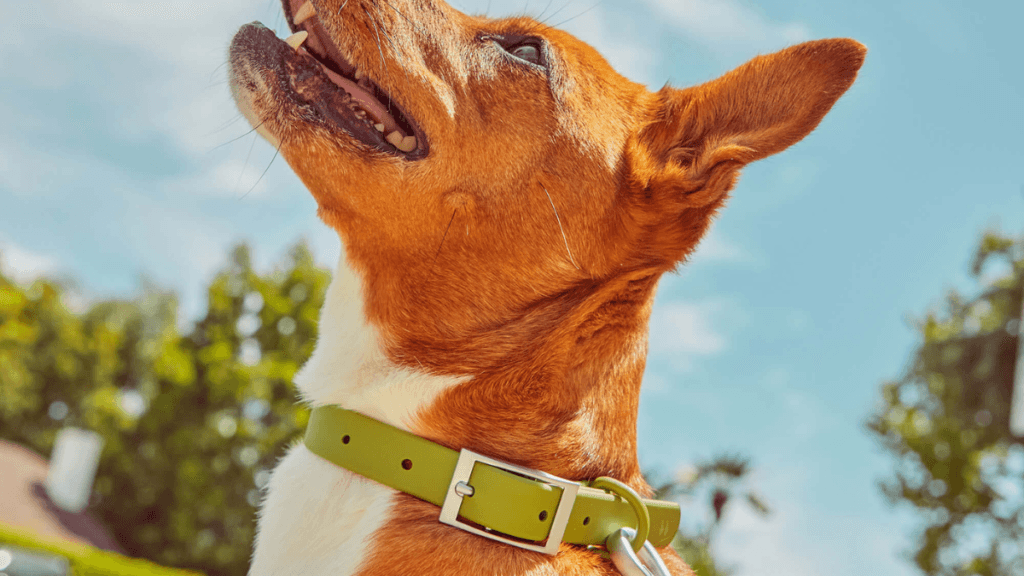
If you have ever watched your dog back out of their collar — that smooth, deliberate reverse-slide that leaves you holding an empty loop while they stand two feet away looking pleased with themselves — you have probably started asking questions about collar design.
The martingale collar exists specifically to solve this problem. But it is not the right choice for every dog, and understanding how it actually works helps you decide whether it is what your dog needs — or whether a well-fitted standard collar does the job just as well.
Here is a clear comparison of how each collar type works, which dogs each suits best, and what to look for when you are choosing between them.

How a Standard Collar Works
A standard flat collar — the type most people picture when they think of a dog collar — is a fixed loop of material with an adjustable buckle. You set the circumference once, buckle it on, and the collar stays at that fixed size throughout the walk. It does not tighten when the dog pulls and does not loosen when the dog relaxes.
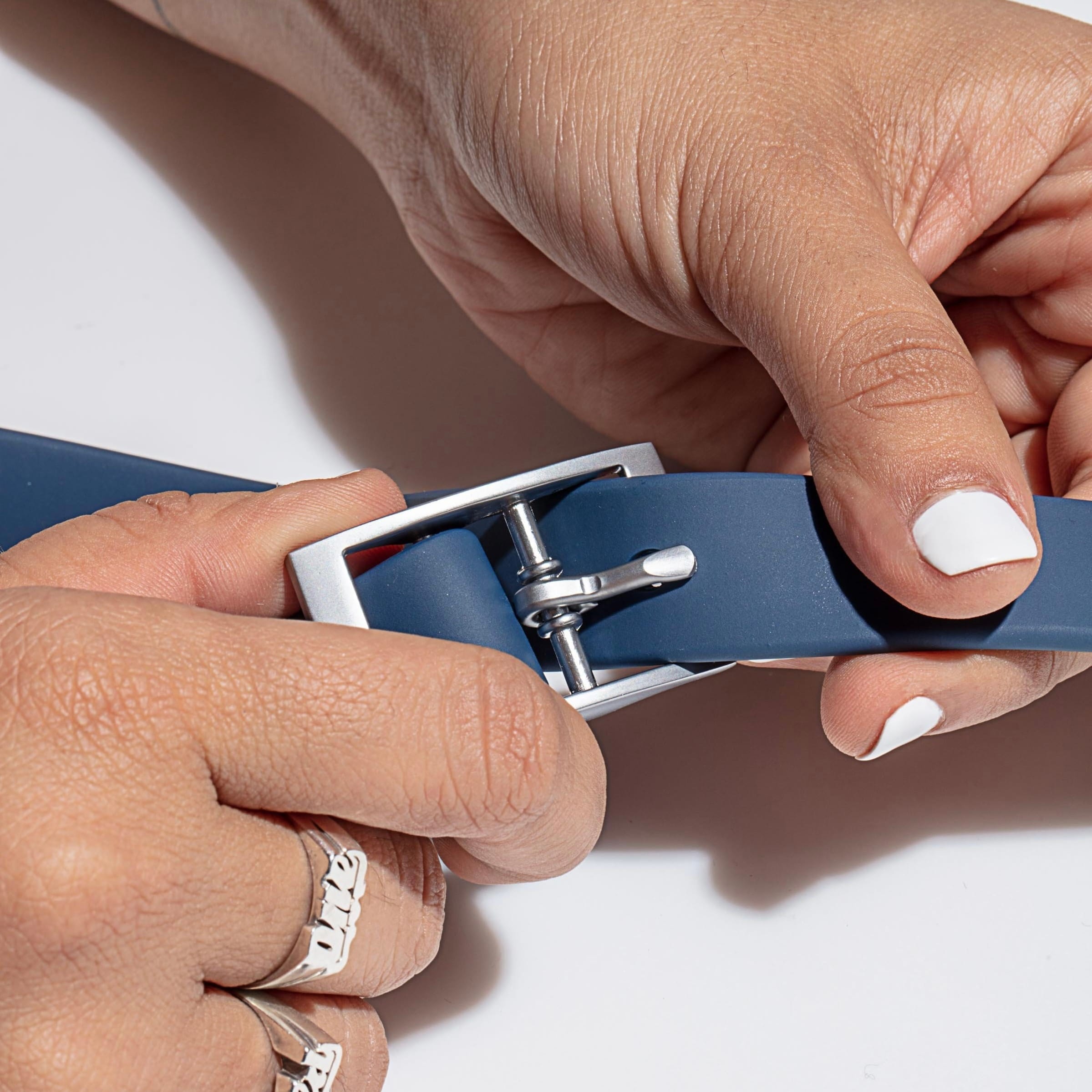
This fixed-size design works well for most dogs. The fit is consistent, the collar is comfortable to wear for extended periods, and the buckle keeps it securely in place as long as the size has been set correctly. The two-finger rule — you should be able to slide two fingers under the collar, but not your whole hand — is the standard fit check, and a collar passing that test on a dog with normal proportions will not slip off under ordinary conditions.
The limitation of a standard collar is that it can be defeated by a dog with particular neck proportions. Breeds whose heads are narrower than their necks — sighthounds like Greyhounds and Whippets, and some long-necked breeds — can slide a standard collar over their head when they pull backwards, even when the collar is fitted to the correct tightness for comfort. This is where the martingale collar addresses a genuine gap.
How a Martingale Collar Works
A martingale collar has two loops instead of one. The larger loop goes around the dog’s neck at a comfortable resting size — similar to where you would set a standard collar. The smaller loop, called the control loop, connects to the leash. When the dog pulls backwards or the leash tightens, the tension pulls the control loop outward, which draws the two sides of the larger loop together and tightens the collar around the neck. When the tension releases, the collar returns to its resting size.
The key design feature is that the martingale is limited in how much it can tighten. Unlike a choke chain or a slip lead, a properly sized martingale has a physical stop point — the two sides of the larger loop cannot come closer than the width of the control loop allows. This means the collar tightens enough to prevent slip-out under backward pressure, but cannot constrict beyond a safe maximum.
The result is a collar that is comfortable at rest — the dog is not wearing a tight collar — but escape-resistant under the specific conditions where a standard collar can fail. For sighthound breeds and similar neck shapes, this is a meaningful safety improvement over a standard flat collar.
Which Dogs Benefit Most from a Martingale?
The martingale collar was originally designed for sighthound breeds, and this is still where it makes the most practical difference. The relevant characteristic is a neck that is wider than the head — which describes Greyhounds, Whippets, Italian Greyhounds, Salukis, and similar breeds. A standard collar fitted to the neck of a Greyhound can be slipped over the head when the dog pulls backward because the head is narrower than the collar’s circumference.
Sighthound breeds
Greyhounds, Whippets, Italian Greyhounds, Salukis, Borzoi, Afghan Hounds. These breeds have the neck-wider-than-head proportions that make standard collars genuinely slip-prone. A martingale is often recommended as the default collar type for these breeds, not as a training aid but as a basic safety measure.
Dogs that have learned to back out of collars
Some dogs — regardless of breed — figure out that backing up while dropping their head gets them out of a standard collar. Once a dog has learned this trick, a standard collar is no longer reliable regardless of how well it is fitted. A martingale removes the option entirely by tightening under backward pressure rather than staying fixed.
Nervous or rescue dogs in unpredictable situations
A dog that is easily startled and prone to bolting may pull backwards suddenly in a way that a standard collar cannot reliably hold. For dogs in the early stages of walking in new environments — rescue dogs adjusting to life outside a shelter, for example — the additional security of a martingale can be a useful transitional measure even if the dog does not have narrow-head proportions.
When a Standard Collar Is the Better Choice
For the majority of dogs — those with standard head-to-neck proportions and no history of slipping their collar — a well-fitted standard collar is simpler, more comfortable for extended wear, and entirely sufficient for daily use.
All-day wear
A standard flat collar is designed to be worn comfortably throughout the day for ID tag purposes. A martingale is better suited to supervised walks with a leash attached — the tightening mechanism that makes it escape-resistant also makes it less suitable for unsupervised wear, since the collar can tighten if it catches on something.
Dogs that pull forward rather than backward
A martingale does not help with dogs that pull forward on the leash — it tightens under backward pressure, not forward. If pulling is the main issue, a no-pull harness is a more effective solution than either collar type. A collar — martingale or standard — is for attachment and identification; managing forward pulling requires a different approach entirely.
Active or water-involved dogs
For dogs that swim regularly or spend time in wet conditions, material choice matters more than collar type. A standard collar made from PVC-coated webbing holds up to water and drying cycles significantly better than most martingale collars, which are typically made from nylon or fabric. A PVC-coated standard collar in a correct size will outlast a fabric martingale collar by years in wet conditions.
Side-by-Side Comparison
| Martingale | Standard Flat | |
|---|---|---|
| Escape prevention | High — tightens under backward pressure | Moderate — depends on correct fit |
| All-day wear | Not recommended unsupervised | Suitable for all-day wear |
| Best for breed type | Sighthounds, narrow-headed breeds | Most breeds |
| Helps with pulling | No | No |
| Water resistance | Usually low (fabric/nylon) | High if PVC-coated |
| Simplicity of use | More complex sizing required | Simple buckle-and-go |
What About Using Both?
Many owners of sighthound breeds or escape-prone dogs use two collars with different purposes. A lightweight standard collar with ID tags stays on at all times — for identification purposes — while a martingale goes on for walks when a leash is attached. This approach separates the all-day identification function from the walk-time security function and uses each collar type for what it does best.
If this is the setup that makes sense for your dog, it is worth choosing a standard collar made from a material that holds up to daily wear without absorbing odour or deteriorating quickly. A PVC-coated collar worn 24 hours a day will outlast a nylon collar significantly and require less maintenance.
What to Look for in a Standard Collar for Most Dogs
If your dog does not have sighthound proportions and has not demonstrated a pattern of backing out of collars, a standard flat collar in the right size and material is the simpler, more versatile choice. The details that matter most are material, hardware quality, and accurate sizing.
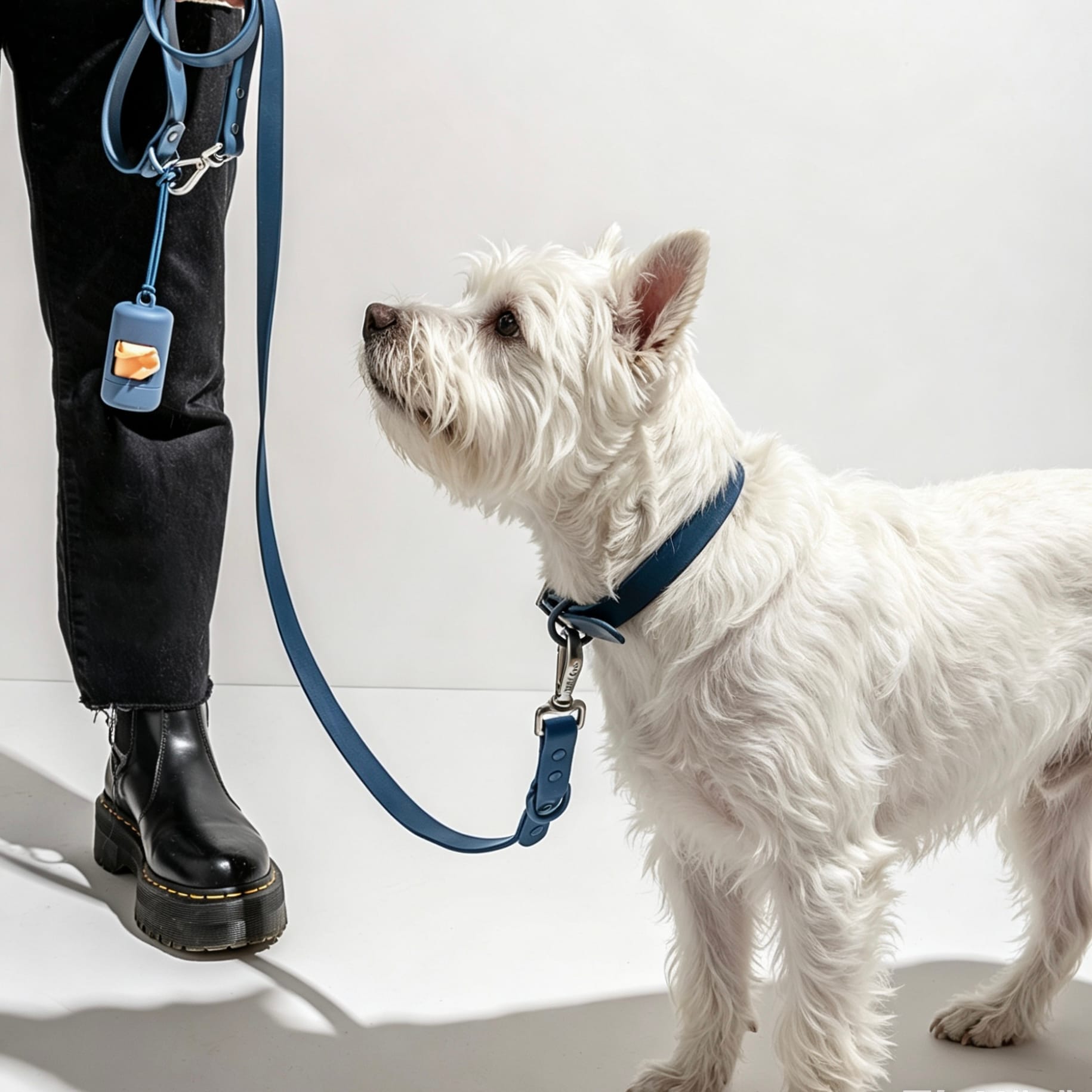
The MoonianPet Waterproof Dog Collar uses PVC-coated webbing — the same material used in BioThane collars — which gives it the look and durability of leather without the odour absorption of fabric. The zinc-alloy hardware resists the corrosion that causes cheap D-rings to rust within a year of regular wet use, and the adjustment slider holds its set position through daily walks rather than self-loosening over time. Available in 11 colors and five sizes, XS through XL.
For dogs on the boundary between two sizes, the dog collar size guide walks through how to measure correctly and which size to choose for each neck circumference.
Frequently Asked Questions
Is a martingale collar cruel?
No — a correctly sized martingale is not a punishment collar. It tightens to a fixed maximum that prevents escape without causing the sustained pressure of a choke chain. The key is correct sizing: the collar should reach a comfortably snug fit when the leash is taut, with the rings of the main loop meeting but not overlapping. A martingale that tightens beyond this point has been sized too large and needs adjustment. Used as intended with proper sizing, a martingale is safe and humane.
Can my dog wear a martingale collar all day?
Most trainers and veterinary behaviourists advise against leaving a martingale on unsupervised. Because the collar tightens under tension, there is a risk that it could tighten if caught on a fence, kennel bar, or another dog’s jaw during play — situations where no one is there to release the pressure. Many owners use a standard flat collar for all-day wear and identification, swapping to a martingale only during leashed walks.
Will a martingale stop my dog from pulling?
No. A martingale tightens when a dog pulls backward, not forward. It does not provide the front-clip redirection of a no-pull harness, and it does not apply any meaningful pressure on a dog pulling forward on a leash. If pulling is the primary problem, a no-pull harness is a more effective solution. The martingale solves a different problem: preventing backward escape, not managing forward pulling.
My dog is not a sighthound — do they still need a martingale?
Probably not, unless they have demonstrated a pattern of backing out of their collar. Most dogs with standard breed proportions — where the head is at least as wide as the neck — cannot slip a correctly fitted standard collar when it passes the two-finger rule. If your dog has never slipped their collar and does not have sighthound-type proportions, a standard flat collar in the correct size is sufficient and simpler to manage.
How do I know if my dog’s standard collar fits correctly?
The two-finger rule is the standard check: you should be able to slide two fingers under the collar comfortably, but not your whole hand. If two fingers slide in with room to spare, the collar is too loose and could potentially slip over the head. If two fingers fit but with resistance, the fit is correct. Check the fit every few weeks — collars can loosen with use, and a dog’s neck size can change with weight gain or loss. For full measurement guidance, see the dog collar size guide.
If pulling on the leash is the main issue you are trying to solve, see our guide to front clip vs back clip dog harness — a collar is not the right tool for that problem. For fit guidance on your current collar, the how tight should a dog collar be guide covers the two-finger rule in full.

Wenyue
Wenyue is the founder of MoonianPet and writes about dog collars, harnesses, waterproof pet gear, and everyday dog care. Growing up with dogs inspired her lifelong interest in pet care and practical dog gear. Through MoonianPet, she researches dog collars, harnesses, waterproof materials, and everyday solutions that help active dogs stay comfortable during daily adventures.