
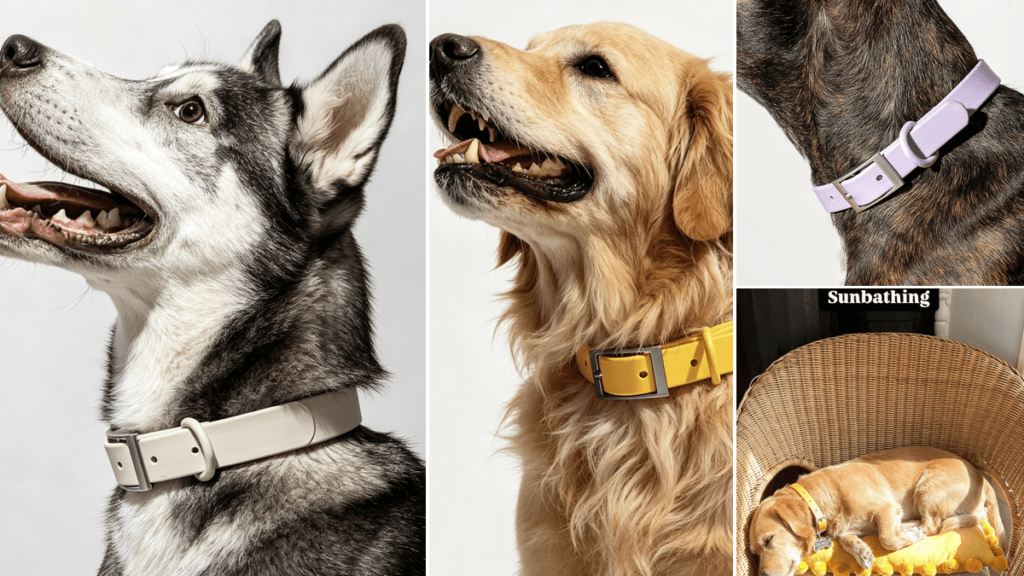
A collar that fits badly causes problems in opposite directions. Too tight and it creates pressure on the trachea, restricts breathing during exercise, and causes skin irritation at the contact points. Too loose and it becomes a slip hazard — a dog that backs up at the right moment or shakes their head with enough force can exit a loose collar entirely, leaving you holding an empty loop on a busy street.
The frustrating part is that both problems are easy to miss. A collar that is slightly too tight is often not obvious until you look carefully at the skin underneath. A collar that is slightly too loose passes a quick visual check but fails the moment it matters. Neither extreme announces itself clearly.
Here is how to identify both problems, fix them, and find the fit that sits correctly between the two extremes.

The Two-Finger Rule: The Starting Point for Every Fit Check
The two-finger rule is the standard fit check used by trainers and veterinarians: with the collar buckled at its current setting, slide two fingers — held flat, side by side — under the collar at the back of the neck. The fit is correct when two fingers slide in comfortably but the collar does not have room to move freely around them.
This is a useful starting point, but it has limitations. Finger width varies between people, and a dog’s neck is not uniform in circumference — it is narrower at the top and wider at the base. A collar that passes the two-finger check at the back of the neck may sit differently at the sides or the throat. The two-finger rule gives you a baseline; the signs of poor fit below tell you whether that baseline is actually working for your dog.
For a full measurement approach — using a tape measure rather than the finger check — see the dog collar size guide, which covers neck measurement and size selection in detail.
Signs Your Dog’s Collar Is Too Tight
A tight collar does not always look tight at a glance — particularly on dogs with thick coats where the collar is partially hidden in the fur. These are the signs to check for, rather than relying on visual inspection alone.
You cannot fit two fingers under the collar
This is the most direct test. If two fingers held flat cannot slide under the collar at all, or fit only with significant resistance that would not be comfortable against skin, the collar is too tight. Even if the dog does not appear distressed, a collar at this tightness creates sustained pressure that causes problems over time — particularly during exercise when the dog is breathing heavily and the neck muscles are more engaged.
Fur matting, thinning, or a visible line under the collar
Remove the collar and look at the skin and fur underneath. A collar at the correct tightness may leave a slight temporary impression in the fur — this is normal and clears within a few minutes. What is not normal is a persistent line in the fur that does not clear, visible fur thinning or loss in a band under the collar, or redness of the skin at the contact points. These are signs of sustained pressure that the collar has been sitting at a tightness that causes ongoing friction.
Coughing or gagging on walks
A dog that coughs or gags during walks — particularly when they reach the end of the leash and the collar pulls — may have a collar that is sitting too tight against the trachea. This is more common in small breeds and brachycephalic breeds (flat-faced dogs like Bulldogs and Pugs) where the trachea is more vulnerable to pressure. If coughing on the leash is a recurring issue, check the collar fit and also consider whether a harness might be a more appropriate choice for that dog.
The dog scratches at the collar frequently
Some collar scratching is normal, particularly with a new collar the dog is getting used to. Persistent scratching — several times per hour, or scratching that breaks the skin — suggests discomfort at the contact points. This can be caused by tightness, by a material that is irritating to that dog’s skin, or by the collar edge sitting at a pressure point. Check the fit first; if fit is correct, consider whether the material is the issue.
Signs Your Dog’s Collar Is Too Loose
A loose collar is less obviously a problem in daily life — the dog is comfortable, there is no pressure or friction, and nothing seems wrong. The issue is that a collar that is too loose can fail at the moment it matters most.
More than two fingers fit under the collar with room to move
If you can slide three fingers under the collar easily, or if two fingers fit and the collar moves loosely around them rather than sitting snugly, the collar is too loose. A collar at this looseness sits low on the neck and can rotate freely — which means it is not positioned to hold securely if the dog pulls backward. Tighten by one adjustment notch and recheck.
The collar rotates freely around the neck
A collar at the correct fit stays broadly in position. A collar that rotates completely around the neck — so that the D-ring swings freely from the back to the side to the front — is too loose. This rotation means the collar has more circumference than the neck it is sitting on, and there is enough slack for the dog to work their head through it under backward pressure.
The collar slides toward the head when the leash tightens
Watch what happens when the leash pulls taut — during a normal walk when the dog reaches the end of the leash, or when they turn to sniff something and the leash angle changes. A correctly fitted collar stays in position on the neck. A loose collar rides up toward the ears when the leash tightens, which means it is working its way into a position where it can slip over the head if the dog continues to pull backward.
The dog has slipped the collar before
If it has happened once, the collar was loose enough to allow it — and the dog now knows it is possible. Tighten the collar, recheck with the two-finger rule, and consider whether the collar has the right size range for that dog’s neck. Some dogs sit between standard size increments, and a collar adjusted to its tightest point in a size too large will still be looser than it should be. If this is the case, size down and adjust within the new collar’s range.
Getting the Fit Right: Step by Step
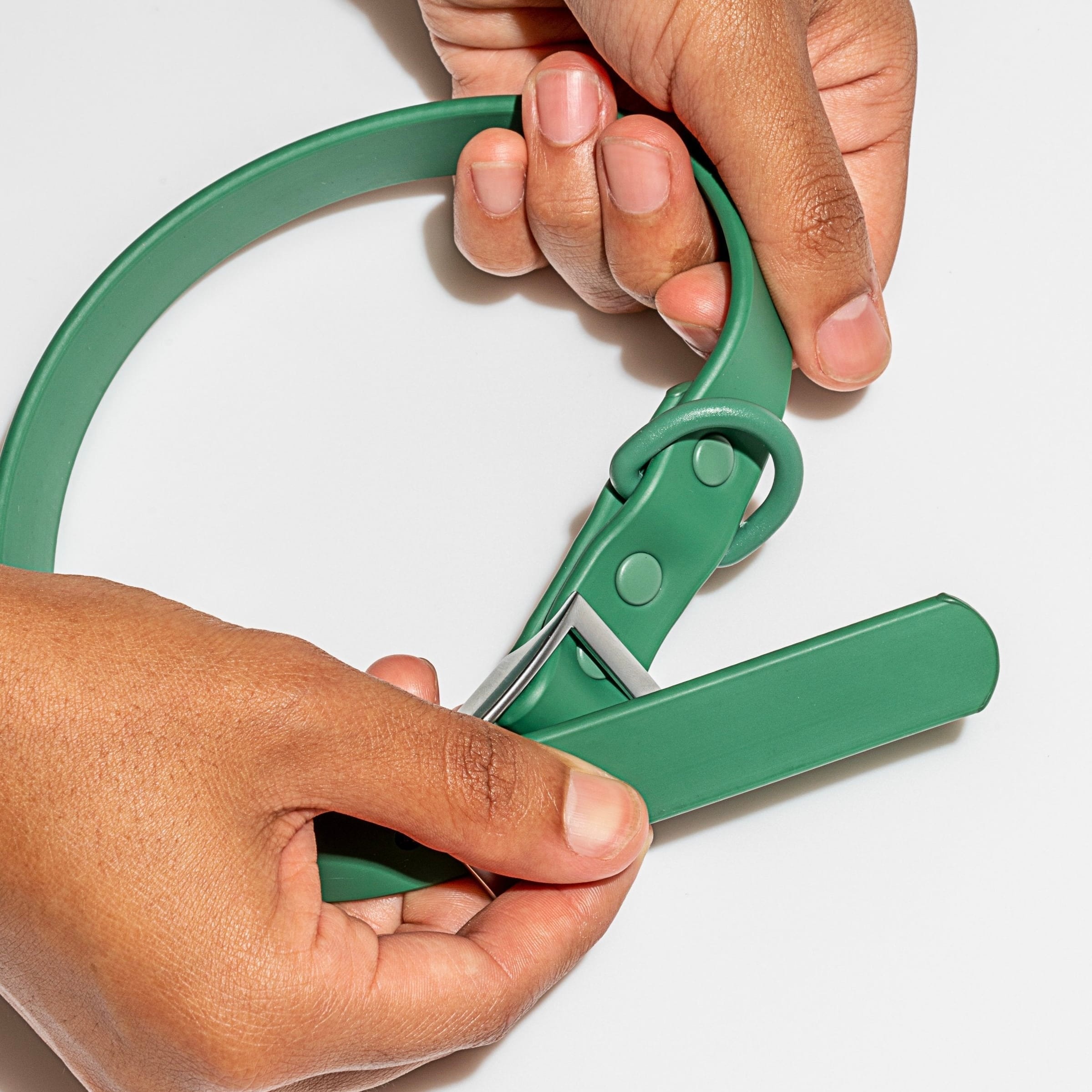
The most reliable approach is to start with a tape measure rather than guesswork. Measure your dog’s neck circumference at the point where the collar will sit — typically mid-neck, not at the base — with the tape snug but not tight. Add two centimetres to that measurement. This gives you the collar’s set circumference.
Once the collar is buckled at that circumference, do the two-finger check. Two fingers held flat should slide in comfortably at the back of the neck with the collar sitting snugly around them — not with room to move, but without the collar pressing tightly against the fingers. Adjust by one notch in either direction if the fit is not quite right, then recheck.
After the initial fit, check again after the first walk. A new collar may feel slightly different once the dog has moved in it and the buckle has settled. Recheck the two-finger test after twenty minutes of normal activity and adjust if needed.
After that, check the fit monthly as a matter of routine. A dog’s neck circumference can change gradually with weight gain or loss, and collars — particularly nylon ones — can stretch slightly with regular use, effectively loosening themselves over time without the fit being visibly changed.
When the Collar Material Affects the Fit Over Time
Fit is not just about the initial adjustment — it is about whether the collar holds that adjustment over weeks and months of daily use. Different materials behave differently in this respect.
Nylon stretches gradually with use, particularly if the collar gets wet regularly and dries under tension. A nylon collar that was fitted correctly in autumn may be noticeably looser by spring without any adjustment having been made. The material itself has changed. This is one of the reasons nylon collars need more frequent fit checks than collars made from more dimensionally stable materials.
PVC-coated webbing does not stretch in the same way. The coating stabilises the underlying fibres, which means the collar holds its set circumference reliably over time without the gradual loosening that happens with nylon in wet conditions. For active dogs that swim or walk in wet conditions regularly, this dimensional stability means the fit check every month is more likely to come back unchanged rather than requiring adjustment.

A Collar That Holds Its Fit
If you are replacing a collar that has stretched out of fit or whose adjustment slider no longer holds its position reliably, the MoonianPet Waterproof Dog Collar is built around dimensional stability. The PVC-coated webbing does not stretch with repeated wetting and drying, the adjustment slider holds its set position through daily walks, and the zinc-alloy hardware resists the corrosion that causes cheaper D-rings to weaken over time. Available in 11 colors and five sizes, XS through XL.
If you are unsure which size to order, the dog collar size guide has the full measurement chart and explains which size to choose for dogs that fall between size ranges.
Frequently Asked Questions
How do I know if my dog’s collar is too tight?
The clearest test is the two-finger check: if you cannot slide two fingers held flat under the collar at the back of the neck, it is too tight. Beyond the finger test, look for fur thinning or a persistent line in the fur under the collar, redness of the skin at the contact points, or frequent scratching at the collar. Any of these signs indicates the collar needs to be loosened by one or two adjustment notches.
Can a loose collar hurt my dog?
A loose collar is more of a safety risk than a comfort problem — the collar itself is not causing harm, but it may not hold if the dog slips backward out of it. A collar that is loose enough to rotate freely or to slide toward the head when the leash tightens can come off entirely under the right combination of backward pressure and head movement. Tighten to the two-finger standard and check that the collar stays in position during a normal walk.
My dog keeps slipping their collar. What should I do?
First check whether the collar is simply too loose — tighten it and recheck with the two-finger test. If the collar passes the fit test but the dog is still slipping it, the issue may be head-to-neck proportions: some breeds have necks that are wider than their heads, making standard collars inherently slip-prone regardless of how tightly they are adjusted. For these dogs — particularly sighthound breeds — a martingale collar is a better design choice. See our guide to martingale vs standard collar for more detail.
How often should I check my dog’s collar fit?
A quick two-finger check at buckle-on time costs nothing and catches sudden changes — weight gain or loss, a collar that has stretched after a wet walk. A more thorough check every month is good practice for adult dogs. For puppies, check every two weeks during the growth phase, as neck circumference can change faster than expected. Check more frequently after significant weight changes in either direction.
Should the collar sit high or low on the neck?
Mid-neck is the correct position for most dogs — not pulled up tight under the jaw, and not sitting down at the base of the neck where it can interfere with shoulder movement. The collar should sit comfortably in the middle section of the neck, where it can hold its position without being pushed up or down by normal movement. A collar adjusted to the correct circumference naturally settles in this position on most breeds.
For the full measurement approach to collar sizing, the dog collar size guide covers neck measurement and size selection in detail. If you are replacing a collar that has worn out of shape, see our guide on when to replace your dog’s collar for the signs to look for.
Wenyue
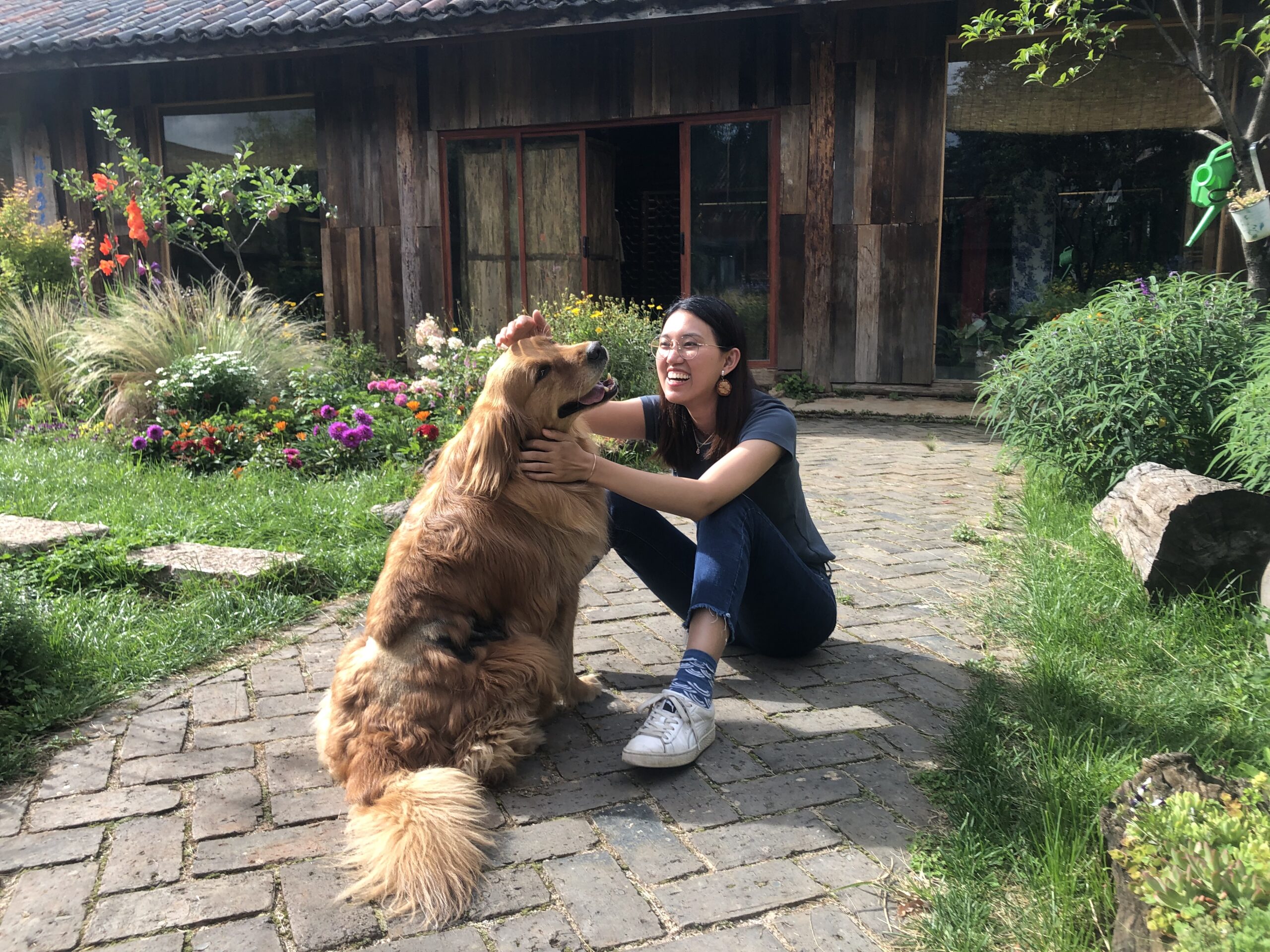
Wenyue is the founder of MoonianPet and writes about dog collars, harnesses, waterproof pet gear, and everyday dog care. Growing up with dogs inspired her lifelong interest in pet care and practical dog gear. Through MoonianPet, she researches dog collars, harnesses, waterproof materials, and everyday solutions that help active dogs stay comfortable during daily adventures.