
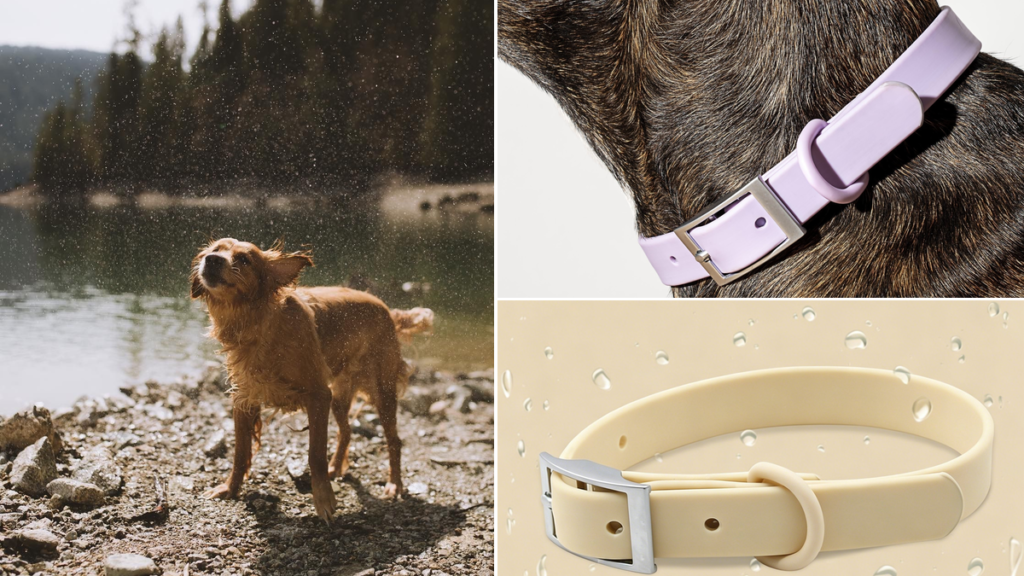
A standard nylon collar and a day at the beach are not a good combination. Salt water saturates the fibres and accelerates deterioration. Sand works its way into the weave and creates a surface that abrades the skin with every movement. The collar comes home wet, takes hours to dry, and smells distinctly of wet dog for days afterward — even after washing.
None of this is a problem that needs to be tolerated. The right collar material handles salt water, dries in minutes rather than hours, and does not absorb the smell that builds up in fabric over a summer of beach trips. But not every collar marketed as waterproof actually delivers on that in practice — and the details that distinguish genuinely waterproof collars from water-resistant ones are worth understanding before you buy.
Here is what to look for in a beach collar, and what to avoid.

Why Beach Conditions Are Hard on Collars
Beach use puts collars through conditions that everyday walking does not. The combination of factors is more demanding than any single element alone.
Salt water
Salt is corrosive to metal hardware and drying to many materials. A zinc-alloy or stainless steel D-ring survives salt water without rusting; a low-grade iron or steel fitting will show surface rust within a season of regular saltwater exposure. Salt also leaves a residue in fabric fibres as the water evaporates, which builds up over time and degrades the material from within.
Sand abrasion
Fine sand gets into everything — including the weave of a fabric collar. Once embedded, sand particles act as an abrasive against both the collar material and the dog’s skin with every movement of the collar. A collar whose surface cannot trap sand — smooth or coated rather than woven — avoids this problem entirely. A collar whose surface is textured fabric accumulates sand in a way that is difficult to fully rinse out.
Repeated wet-dry cycles
A beach day typically involves multiple cycles of the collar getting wet and drying — in the water, drying on the beach, back in the water, drying again. Each wet-dry cycle stresses the material. Nylon and fabric collars that absorb water take the full stress of this cycle repeatedly; collars that do not absorb water in the first place are not affected by it in the same way.
UV exposure
A full day on a bright beach involves sustained UV exposure that fades and degrades many materials over a season. This is more of a long-term factor than an immediate one, but it is worth noting for collar longevity — some materials hold their colour and structural integrity under sustained sun exposure better than others.
What to Look for in a Beach Collar
1. Non-absorbent material
The most important characteristic for beach use is whether the collar material absorbs water or repels it. Nylon absorbs water — it gets heavy when wet, takes hours to dry, and retains salt and odour in its fibres after saltwater exposure. Fabric and rope collars behave similarly. PVC-coated webbing does not absorb water at all — the surface is non-porous, so water sits on it rather than soaking in. The collar stays the same weight wet as dry, dries within minutes in open air, and does not retain salt or odour because there are no fibres for it to penetrate. For beach use specifically, this non-absorbent characteristic makes the largest practical difference.
2. Corrosion-resistant hardware
The D-ring and buckle are the most vulnerable components in saltwater conditions. Low-grade hardware — often identified by its light weight and bright chrome-like finish — rusts quickly when exposed to salt water regularly. Look for zinc alloy or stainless steel hardware, which resists corrosion significantly better. Zinc alloy is the standard for quality dog collars — it is heavier than low-grade hardware, has a slightly duller finish, and does not develop surface rust under normal saltwater exposure. Check the product description specifically for hardware material rather than assuming from the price point.
3. A smooth interior surface
The inside surface of the collar — the part that contacts the dog’s neck — matters more at the beach than in everyday use because of sand. A smooth inner surface does not trap sand particles; a textured or woven inner surface does. If the collar’s inner surface is the same woven fabric as the outside, sand will embed in it and create friction against the skin throughout the day. A collar with a smooth or lightly padded inner surface avoids this.
4. Easy to rinse clean
After a beach day, the collar should be rinsed in fresh water to remove salt residue — this applies even to fully waterproof collars, since salt left to dry on the hardware will eventually accelerate corrosion. A collar that can be rinsed under a tap and wiped dry in thirty seconds is significantly more convenient than one that needs to be soaked and worked through to clear the salt from its fibres. PVC-coated webbing wipes clean; fabric collars need to be washed through.

Water Resistant vs Waterproof: The Difference That Matters
Many collars are described as water resistant, which is not the same as waterproof. Water resistant means the material slows water absorption — a DWR-treated nylon collar, for example, will repel light rain but will soak through under sustained immersion. Waterproof means the material does not absorb water regardless of exposure duration.
For beach use — where the collar may be submerged repeatedly during swimming — water resistant is not sufficient. A collar that is water resistant in light rain will still absorb water, retain salt, and smell after a day of full immersion in the sea. Genuinely waterproof materials — PVC coating, certain rubbers, and some technical coatings — do not absorb water at any level of exposure.
The simplest test is the material description: if the collar is nylon with a water-resistant treatment, it will absorb water under sustained immersion. If the collar is PVC-coated webbing or solid PVC, it will not absorb water regardless of how long it is submerged.
Does Your Dog Need to Remove the Collar for Swimming?
With a fabric or nylon collar, many owners remove it before swimming because it becomes waterlogged and uncomfortable — and because the wet collar can cause chafing if worn for extended periods after swimming. A genuinely waterproof collar does not need to be removed for swimming. The material does not change when wet, the hardware is not damaged by submersion, and the collar can be worn throughout without the weight and odour issues that affect fabric collars.
The practical consideration is fit: check that the collar’s fit has not changed after swimming before reattaching the leash. A correctly fitted collar on dry land may sit slightly differently on a wet dog if the coat is plastered flat — run the two-finger check after swimming to confirm the fit is still correct before heading back on leash.

Built for Beach, Built for Every Day
The MoonianPet Waterproof Dog Collar is made from PVC-coated webbing — non-porous, non-absorbent, and genuinely waterproof rather than water resistant. It does not absorb salt water, sand does not embed in its surface, and it wipes clean with a damp cloth after a beach day. The zinc-alloy hardware resists corrosion in saltwater conditions, and the collar dries in minutes rather than hours after swimming.
Available in 11 colors and five sizes, XS through XL. Pair with the MoonianPet Waterproof Leash for a matching set that handles beach conditions as well as the collar does, or save with the Collar & Leash Set.
Frequently Asked Questions
Can my dog wear their collar while swimming?
With a genuinely waterproof collar, yes — there is no functional reason to remove it for swimming. The material does not become waterlogged, the hardware is not damaged by submersion, and the collar behaves the same wet as dry. With a fabric or nylon collar, many owners prefer to remove it before swimming because it becomes heavy and uncomfortable when saturated. After any swim, check the fit before reattaching the leash, as a wet coat can alter how the collar sits.
Does salt water damage dog collars?
It depends on the material and hardware. Salt water accelerates corrosion on low-grade metal hardware — a cheap D-ring that would last two years of freshwater use may rust within one summer of regular saltwater exposure. Salt also builds up in the fibres of fabric collars over time, degrading the material from within. Zinc-alloy hardware resists saltwater corrosion significantly better than low-grade hardware, and non-porous collar materials like PVC coating do not absorb salt in the first place. Rinse the collar in fresh water after every beach visit regardless of material.
How do I get sand out of my dog’s collar?
For fabric or nylon collars, rinse thoroughly under running water and work the material between your fingers to release embedded sand — this rarely gets all of it out, particularly from the weave around the hardware. For PVC-coated collars, sand sits on the surface rather than embedding in the material, so a rinse and wipe removes it entirely. If your dog regularly goes to the beach, a smooth-surface collar is considerably easier to keep clean than a woven one.
Is a waterproof collar safe for dogs with sensitive skin?
PVC-coated webbing is generally well-tolerated by dogs with sensitive skin — the smooth surface creates less friction than woven fabric, and the non-absorbent material does not hold moisture or bacteria against the skin the way a wet nylon collar does. If your dog has a known skin condition or allergy, check with your vet about specific materials, but in general a smooth, non-absorbent collar is a better choice for sensitive skin than a fabric collar that retains moisture.
Should I get a separate beach collar or use my dog’s everyday collar?
If your dog’s everyday collar is already genuinely waterproof — PVC-coated webbing or similar — there is no reason to have a separate beach collar. The same collar handles both daily walks and beach days without any change in care or performance. If your dog’s everyday collar is nylon or fabric, the practical choice is to replace it with a waterproof collar that works for both contexts, rather than managing two collars with different maintenance requirements.
For the full breakdown of what makes a collar genuinely waterproof vs water resistant, see our best waterproof dog collar guide. If you are unsure which size to order before summer, the dog collar size guide has the full measurement chart.

Wenyue
Wenyue is the founder of MoonianPet and writes about dog collars, harnesses, waterproof pet gear, and everyday dog care. Growing up with dogs inspired her lifelong interest in pet care and practical dog gear. Through MoonianPet, she researches dog collars, harnesses, waterproof materials, and everyday solutions that help active dogs stay comfortable during daily adventures.