
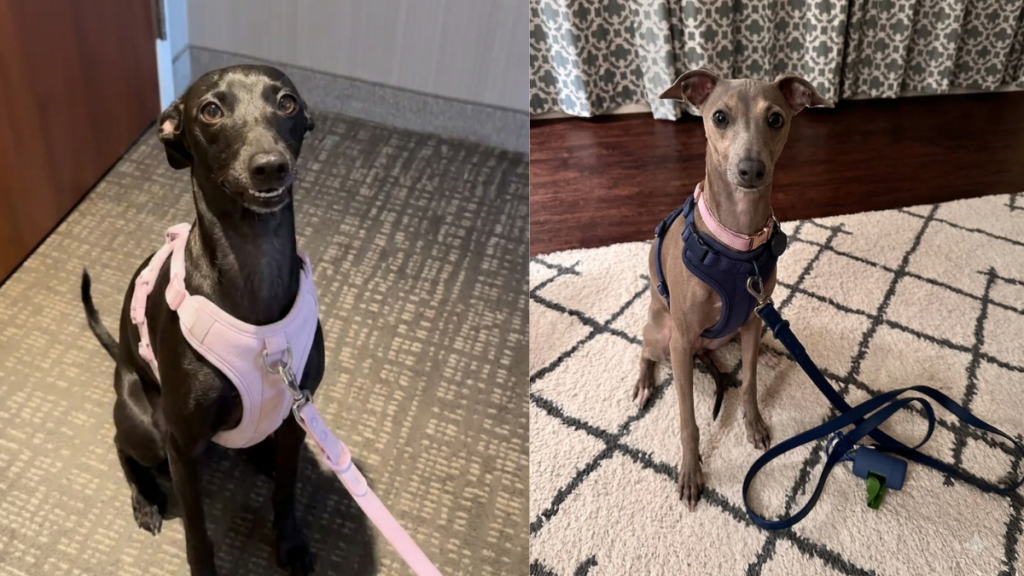
The Italian Greyhound presents one of the most challenging gear-fitting problems in the small breed world. It combines the neck-wider-than-head anatomy of its larger sighthound relatives with the delicate bone structure and thin skin of a toy breed — and adds a third complication: the sheer fragility of the dog’s legs and build means that any equipment that causes falls, entanglement, or sudden jerking forces carries real injury risk. At 3–5kg and with limbs as fine as pencils, an Italian Greyhound that trips over a poorly fitted harness chest strap can fracture a leg.
The Italian Greyhound — often called the IG or Iggy — is effectively a miniaturised sighthound. Like its larger relatives, it has a neck wider than its head, making standard flat collars unsuitable for leash attachment because the dog can back out of them. It also has the sighthound’s instinct to bolt after moving objects and accelerate to full speed almost instantly — so a collar that slips is not a minor inconvenience but a safety emergency.
This guide covers what actually works for Italian Greyhound collar and harness choices, how to measure the IG’s distinctive proportions, and the specific features that matter for this breed.
The Italian Greyhound’s Unique Gear Challenges
Neck wider than the head
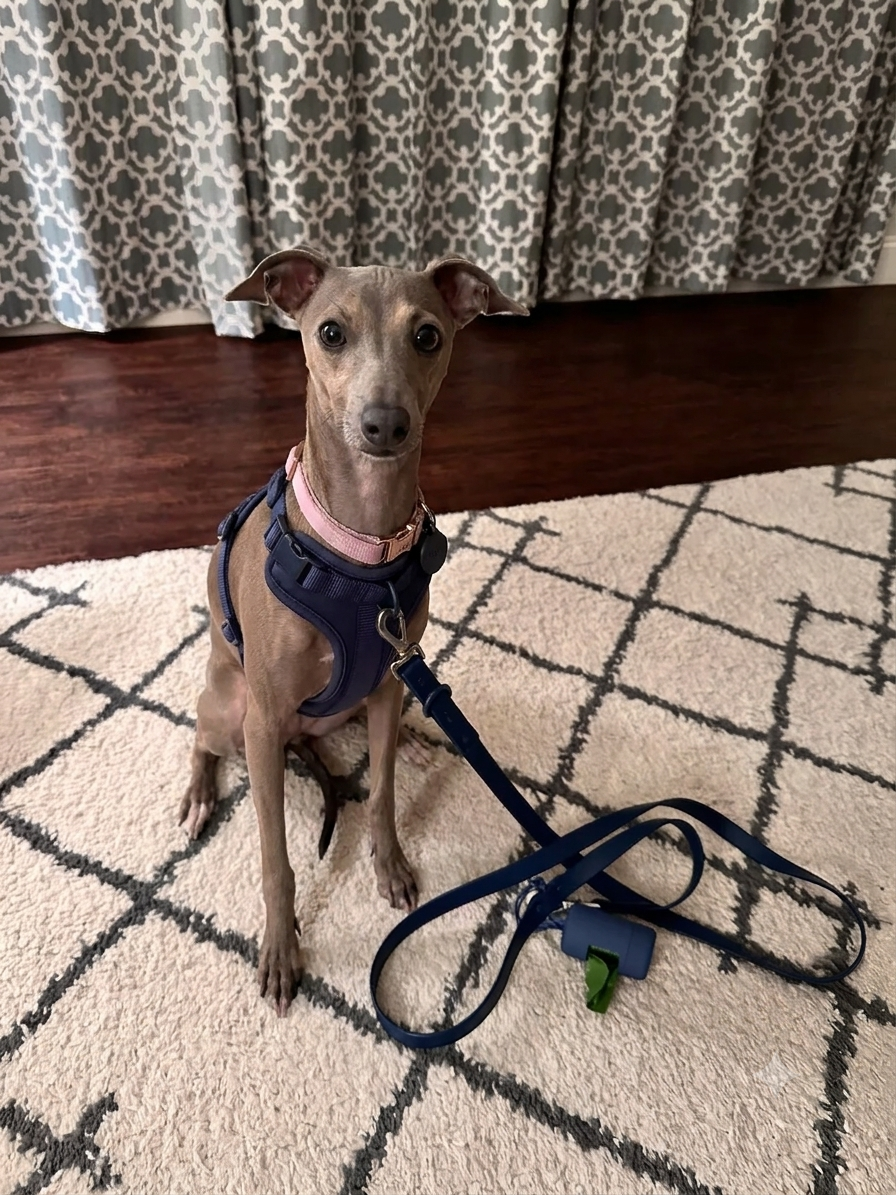
Like all sighthounds, the Italian Greyhound has a neck circumference that is typically equal to or wider than its skull circumference. A flat collar fitted comfortably on the neck will slip over the head with minimal resistance — which becomes a serious problem the moment the dog spooks, backs up, or the handler needs to restrain it. This is not a fitting mistake; it is the breed’s anatomy, and it means that standard flat collars are not appropriate as leash attachment points for Italian Greyhounds regardless of how they’re adjusted.
Extreme fragility
The Italian Greyhound’s leg bones are among the most fragile of any dog breed — hairline fractures from minor falls are a known occurrence in this breed, and leg fractures from more significant impacts are a serious welfare concern. Any equipment that causes stumbling, trips, or entanglement creates fracture risk. A harness chest strap that sits too high and catches the front legs, or one that the dog regularly steps through, is a potential injury cause on a breed where the stakes are higher than for a more robust dog.
Deeply tucked abdomen and narrow waist
Italian Greyhounds have a pronounced abdominal tuck — the waist is dramatically narrower than the chest. Many harness designs that fit the chest correctly gap open or hang awkwardly at the waist because they’re not designed for this extreme waist tuck. A harness that gaps and shifts constantly on an Italian Greyhound creates entanglement risk for the hind legs and is uncomfortable enough that many IGs resist wearing it. Finding a harness that accommodates the narrow waist alongside the proportionally wider chest is the central fitting challenge.
Thin skin and temperature sensitivity
Italian Greyhounds have almost no body fat and a single, very short coat that provides essentially no insulation. They feel cold more quickly than any other small breed and are prone to shivering and discomfort in cool weather. A harness that fits well and stays in position provides some protection against wind on the chest — a relevant consideration in cooler climates. They also have very thin skin that bruises and abrades easily; harness contact surfaces need to be smooth and non-abrasive.
Collar Options for Italian Greyhounds
Martingale collar — the safest collar option for leash attachment
A martingale collar solves the neck-wider-than-head problem by tightening to skull circumference when the leash is taut. For an Italian Greyhound, this means the collar cannot slip over the head even if the dog backs up or spooks — the tightening action prevents escape before the collar reaches the skull’s widest point. The collar relaxes to a comfortable loose fit when the leash is slack. An IG martingale needs to be scaled for a small dog — appropriately narrow webbing, small hardware — and fitted with the tightened circumference matching the skull measurement. See our martingale collar guide for full fitting instructions.
Wide flat collar — for ID wear only, not leash attachment
A wide flat collar (25–35mm wide) sized to the skull circumference can be used for carrying ID tags without leash attachment. The width prevents the collar from collapsing enough to slip over the skull under the dog’s own movement. However, at Italian Greyhound sizes, this approach is less reliable than on larger sighthounds — the skull circumference and neck circumference are closer together in small IGs, making the sizing margin tighter. Most IG owners prefer a martingale for any collar use where escape resistance matters, reserving a flat collar purely for indoor ID tag wearing when the dog is safely enclosed.
Never use a slip collar or slip lead on an Italian Greyhound
Slip collars and slip leads tighten without a stop — they can close completely if the dog pulls hard or panics. On a sighthound with thin skin and a delicate trachea, this creates genuine injury risk to the neck. On an IG specifically, the combination of sighthound neck anatomy and toy breed fragility makes slip collars actively dangerous. They should never be used on this breed.
How to Measure an Italian Greyhound for a Harness
Chest girth
Measure the widest point of the chest directly behind the front legs. For most adult Italian Greyhounds, chest girth falls between 30 and 42cm — putting them solidly in the XS to small range of most harness brands. The IG chest is deeper than a Chihuahua’s but narrower in width — it’s a different shape from other small breeds, which is why harnesses designed around an average small breed body shape often don’t fit well on an IG.
Neck girth and skull circumference
For harness sizing, measure neck girth at the base of the neck — for most adult IGs this is between 22 and 30cm. For collar sizing, also measure skull circumference at the widest point (just behind the brow ridges) — typically 24 to 30cm. The relationship between these two measurements determines what collar design will work: if skull circumference is close to neck circumference (less than 2cm difference), a standard flat collar will slip easily and a martingale is essential.
Checking harness fit on an IG
Two fingers should slide under the chest strap. The chest panel should sit below the shoulder blades with clear space above the front legs — it should not restrict leg movement in any direction. Walk the dog a short distance and watch specifically for the chest strap snagging on the front legs during the stride. If the strap catches a front leg during the walking stride at any point, the harness needs to be repositioned or is the wrong design for the IG’s proportions. This is the most important fit check for a breed where any tripping risk is a fracture risk.
What to Look for in an Italian Greyhound Harness
Chest strap positioned well clear of the front legs
This is the most critical safety feature for an Italian Greyhound harness. The chest strap — the horizontal section that connects the two sides of the harness across the front of the chest — must sit high enough on the chest that it cannot contact the front legs during normal walking. On a standard dog this is a comfort issue; on an IG with fragile legs it is a safety issue. Check this specifically during a short walk before committing to a harness for regular use.
Lightweight and minimal bulk
An Italian Greyhound at 4kg carries any harness weight proportionally more than a 30kg Labrador. A heavy harness shifts during walking — and a shifting harness on an IG creates the entanglement risk that the breed’s fragility makes so consequential. The harness should feel almost weightless in the hand. Narrow webbing (10–15mm), small hardware, and a lightweight body material are essential at this size.
Smooth, non-abrasive contact surfaces
The IG’s thin skin and minimal coat provide almost no protection against friction from rough harness edges. A harness with textured webbing or rough padding edges will cause skin irritation and, over time, hair loss at the contact points. Smooth neoprene or a smooth-finished webbing slides against the bare skin without friction damage. Inspect the inner edges of any harness you consider — they should feel smooth against your skin, not scratchy.
Secure, stable fit that doesn’t shift
A harness that shifts position on a walking IG is a harness that creates leg entanglement risk. Independent three-point adjustment allows the harness to be fitted precisely to the IG’s unusual proportions — wide relative chest depth, narrow waist, thin neck. A harness adjusted to sit stable and centred on the IG’s back throughout a walk is safer than one that rotates or slides during movement.
The MoonianPet No-Pull Harness for Italian Greyhounds
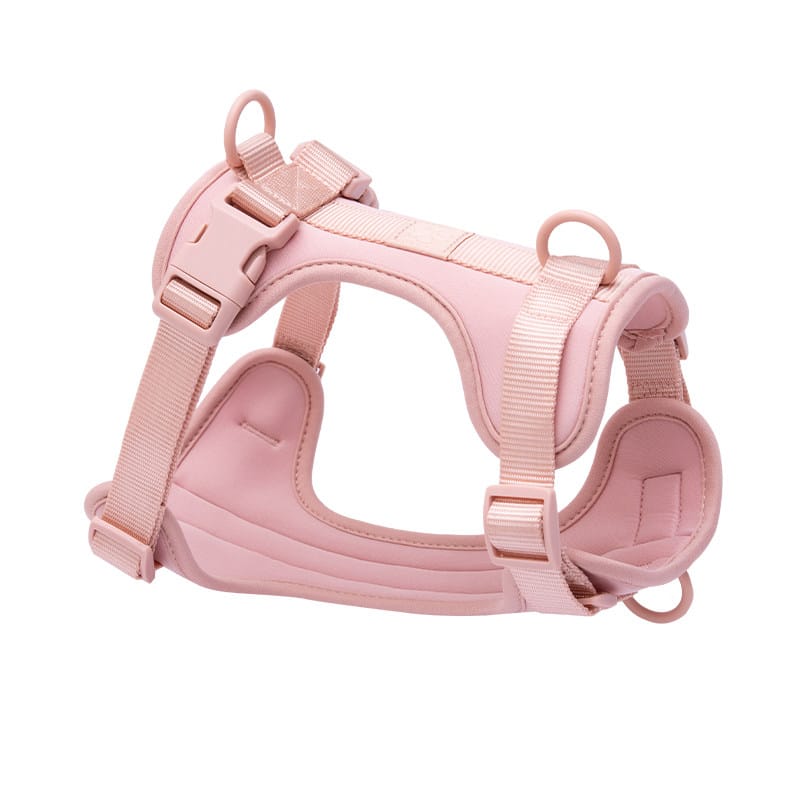
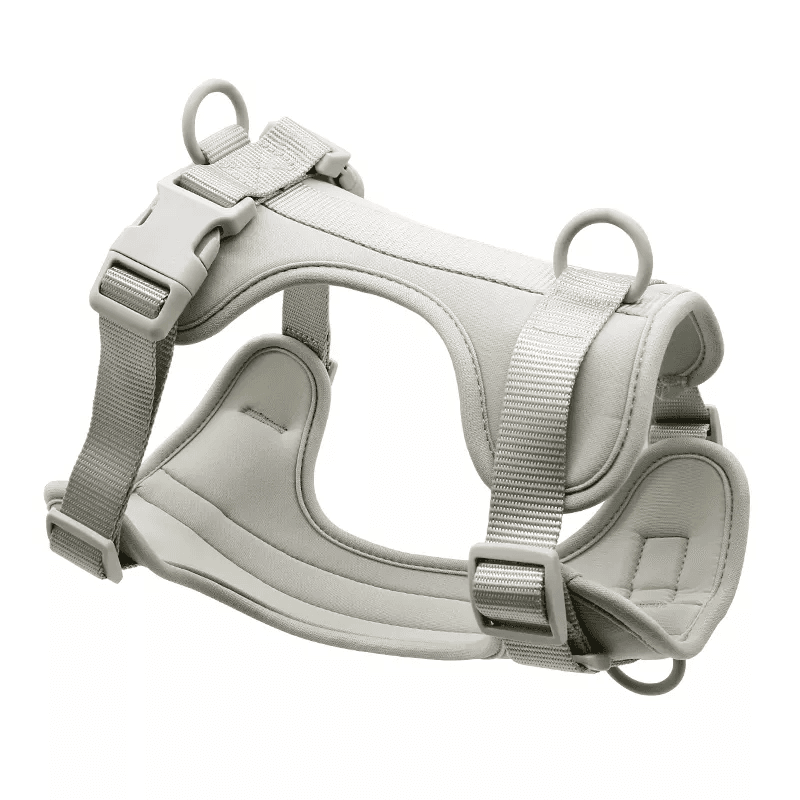
The MoonianPet No-Pull Dog Harness in XS fits a chest girth of 30–40cm — covering most adult Italian Greyhounds. The neoprene body is smooth against the IG’s thin, bare skin, lightweight enough to stay proportional, and the three-point adjustment system allows the neck and chest to be set independently to the IG’s particular proportions.
Both front and back D-rings are available. For an Italian Greyhound, the back D-ring is typically the preferred leash attachment — it keeps the leash behind the dog where it won’t cross the front legs, and the IG’s pace is generally not pulling-intensive enough to require the front clip’s redirection effect. The front clip is available if needed for dogs that do pull, but confirm that the chest strap clears the front legs in your dog’s specific movement before using the front clip regularly.
For the collar, a lightweight flat collar worn for ID — not leash attachment — alongside the harness is the standard Italian Greyhound setup. See our sighthound collar guide for more detail on martingale fitting for the walking collar. Use our dog harness size guide to confirm sizing before ordering.
Frequently Asked Questions
Why does my Italian Greyhound slip its collar?
Italian Greyhounds share the sighthound anatomy of a neck circumference equal to or wider than the skull — a flat collar that fits comfortably on the neck will slip over the head under backward pressure. This is not a fitting error; it is the breed’s body shape. The solution is a martingale collar for any situation where the collar is the leash attachment point, or using a harness as the leash attachment and a flat collar purely for ID. See our sighthound collar guide for full detail on this problem and its solutions.
What size harness does an Italian Greyhound need?
Most adult Italian Greyhounds fit an XS harness with a chest girth range of 30–42cm. Measure chest girth at the widest point behind the front legs and match to the brand’s specific size chart. IGs vary in size — some are very fine at 3kg, others are sturdier at 5kg — and individual chest girths vary accordingly. Our dog harness size guide has the full chart. If between sizes, size down for a more stable fit.
Do Italian Greyhounds need both a collar and a harness?
Most IG owners use both. A flat collar or martingale worn at all times carries ID tags — essential for any dog in case of separation. A harness is used as the leash attachment point for walks, removing the escape risk that a collar presents for this breed. The collar and harness serve different purposes and wearing both simultaneously is the standard IG setup. The harness is not in constant use — it goes on for walks and comes off at home, while the collar remains on for ID.
My Italian Greyhound’s harness keeps tripping them — what should I do?
A harness that contacts the front legs during walking is incorrectly fitted or the wrong design for an IG. Check the position of the chest strap — it should sit across the sternum, high enough above the armpit that it cannot contact the front legs during the normal walking stride. If the chest strap can’t be positioned this way through adjustment alone, try a different harness design. Given the IG’s leg fragility, a harness that trips the dog should be replaced immediately rather than adjusted and retried.
Are Italian Greyhounds related to Greyhounds?
Yes — the Italian Greyhound is a true miniaturised sighthound, bred down from larger sighthound stock over centuries. It is not simply a small dog with sighthound appearance; it has the full sighthound anatomy including the neck-wider-than-head proportion and the strong chase-and-sprint instinct. This ancestry is why Italian Greyhound owners face the same collar escape challenges as Greyhound and Whippet owners, and why the same solutions — martingale collars, wide collars, or harness-as-leash-attachment — apply despite the much smaller size.
For full detail on sighthound collar design and why standard collars don’t work for this breed group, see our sighthound collar guide. For martingale collar fitting and how the tightening mechanism works, see our martingale collar guide.
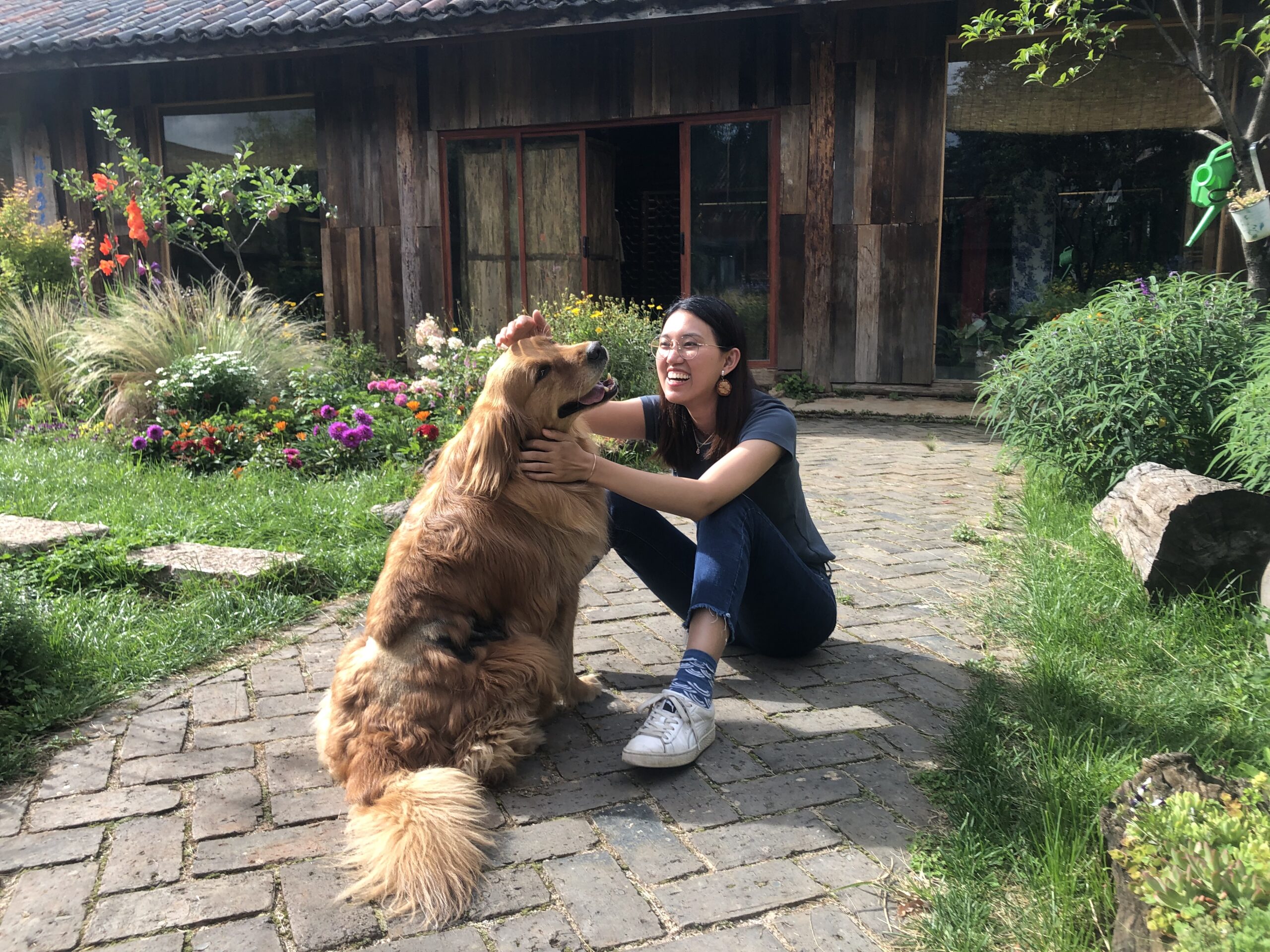
Wenyue
Wenyue is the founder of MoonianPet and writes about dog collars, harnesses, waterproof pet gear, and everyday dog care. Growing up with dogs inspired her lifelong interest in pet care and practical dog gear. Through MoonianPet, she researches dog collars, harnesses, waterproof materials, and everyday solutions that help active dogs stay comfortable during daily adventures.