
Sighthounds — Greyhounds, Whippets, Italian Greyhounds, Salukis, Lurchers, and similar breeds — have a body shape that creates a collar problem no other dog group faces with the same consistency. Their necks are wide relative to their heads: a Greyhound’s neck circumference is typically larger than its skull circumference, which means a collar fitted to sit securely on the neck can be pulled straight over the head by the dog backing up or shaking its head. A standard flat collar that passes the two-finger test for fit will, on many sighthounds, pull free under minimal backward pressure.
This isn’t a minor inconvenience — a sighthound loose from its collar in a public space is a serious safety concern. Sighthounds can reach speeds of 60–70km/h and have a strong chase instinct triggered by moving objects. Once a sighthound locks onto something moving and accelerates, the ability to recall it is limited. The collar staying on the dog is not optional for this breed group.
The solution — used by sighthound owners for centuries — is a collar designed specifically for this neck-to-head ratio. This guide explains the collar designs that work for sighthounds, how to measure correctly, and what to look for in a collar for a Greyhound, Whippet, Lurcher, or similar breed.
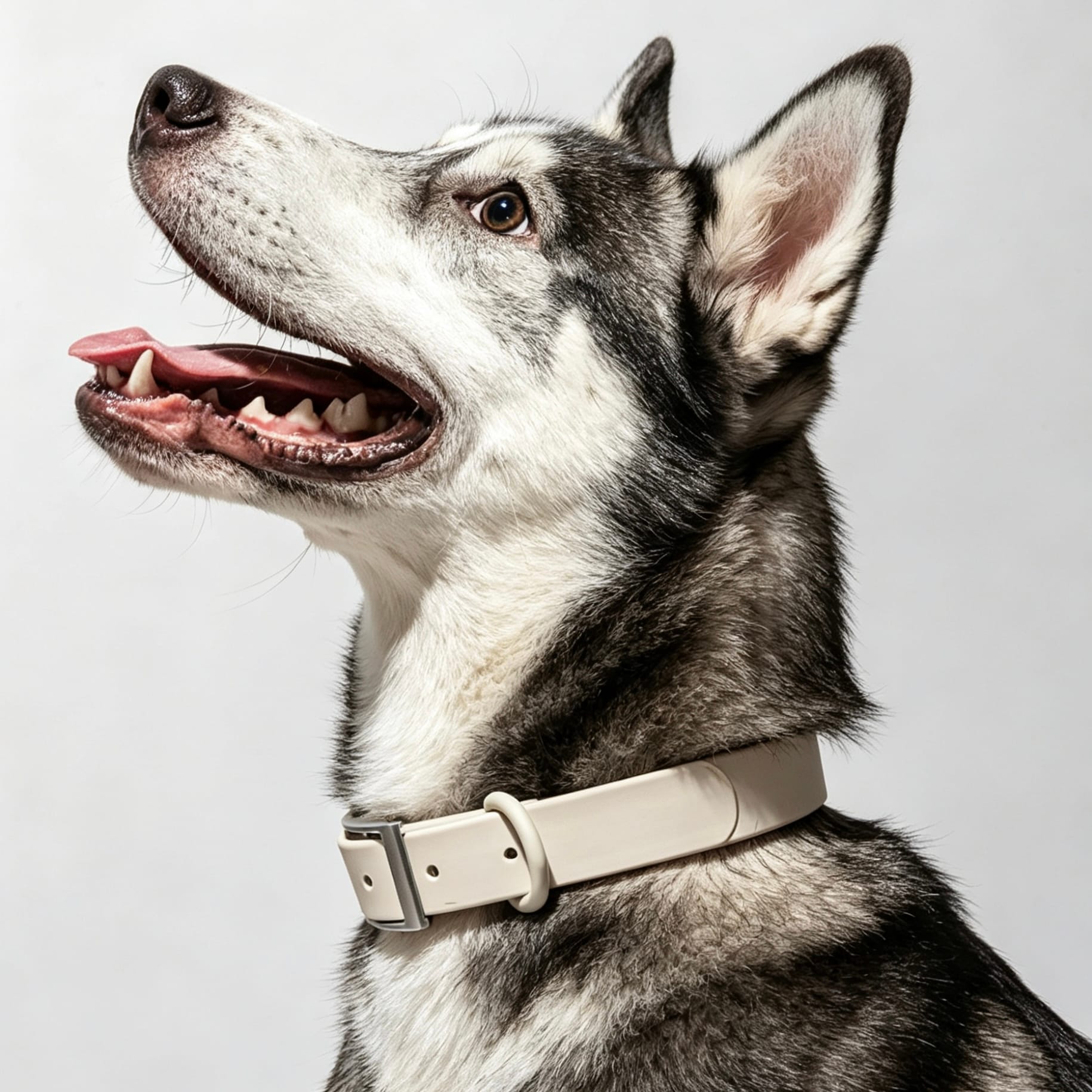
Why Standard Collars Don’t Work for Sighthounds
The neck-wider-than-head problem
In most dog breeds, the head is wider than the neck — a collar sized to fit securely on the neck cannot be pulled over the head. In sighthounds, this relationship is reversed. A Greyhound’s neck can measure 40–45cm in circumference, while its skull circumference — the widest point of the head — may measure only 38–42cm. A collar fitted snugly on the neck at 42cm will pass over a 40cm skull with very little resistance. The only way a standard flat collar stays on a sighthound is if it’s tight enough to cause discomfort and restriction — which is not a solution.
The backing-up slip
Sighthounds being spooked by sudden noise or movement — a common occurrence in urban environments — frequently back up rapidly. This backing motion compresses the neck while the head moves backward, and a standard collar provides almost no resistance to the collar slipping over the skull during this movement. Many sighthound owners experience this the first time they use a standard collar on a rescue Greyhound — the dog spooks, backs up once, and is suddenly loose. It’s not a training issue or a fitting mistake; it’s the breed’s anatomy.
Thin skin and sensitive necks
Beyond the escape risk, sighthounds have thinner skin and less subcutaneous fat than most other breeds. A standard collar on a sighthound’s neck creates pressure on a more sensitive neck structure than the same collar would on a Labrador or a Border Collie. Wide collars — the traditional sighthound collar is typically 4–6cm wide — distribute any leash pressure across a broader area, reducing the per-unit-area pressure on the thin skin of the neck significantly.
Collar Designs That Work for Sighthounds
Martingale collar — the most widely used sighthound collar
A martingale collar has two loops: a large main loop that sits around the neck, and a smaller control loop that the leash attaches to. When the leash is taut, the control loop tightens the main loop — the collar cinches slightly, preventing it from slipping over the head. When the leash is slack, the main loop sits comfortably loose. The key design requirement is that the control loop is limited in how far it can tighten — a correctly configured martingale stops tightening before it becomes uncomfortable, unlike a slip collar which can close completely. For most sighthound owners, the martingale is the default collar choice because it solves the escape problem without creating sustained pressure on the neck. See our martingale collar vs standard collar guide for a full explanation of how martingales work.
Wide flat collar sized to the skull
The traditional sighthound collar — used historically for Greyhounds and Whippets — is a wide, padded flat collar fitted to the skull circumference rather than the neck. The collar is wide enough (typically 4–6cm) that it cannot collapse and slip over the skull even when loose on the neck, because the width prevents it from folding sufficiently to pass over the skull’s widest point. This works only with genuinely wide collars — a standard 25mm flat collar cannot achieve the same effect regardless of how it’s fitted.
Combination of harness and collar
Many sighthound owners use a harness as the leash attachment point — which removes the escape risk entirely since a correctly fitted harness cannot be backed out of in the same way — and a wide flat collar or martingale for ID tag wearing when not on leash. This is particularly common for Greyhounds, where the harness also protects the dog’s deep chest and long legs during the walk. A harness suited to a sighthound’s deep chest and narrow waist needs to accommodate those proportions — see our dog collar vs harness guide for more on when each is the better choice.

How to Measure a Sighthound for a Collar
For a martingale collar — measure both neck and skull
A martingale is sized so that the main loop, when fully tightened via the control loop, matches the skull circumference — it can tighten to prevent slipping over the skull but no further. Measure neck circumference at the base of the neck (where the collar sits) and skull circumference at the widest point (just behind the brow ridges). The martingale’s tightened circumference should equal or be very slightly smaller than the skull circumference. When you have both measurements, look for a martingale whose stated tightened circumference matches your skull measurement and whose relaxed circumference is comfortable at the neck.
For a wide flat collar — measure skull circumference
A wide flat sighthound collar is sized to the skull circumference — it fits over the skull and sits on the neck below. Measure the skull at its widest point and add 2–3cm for the collar to slip on and off without forcing. A wide collar sized correctly to the skull will sit loosely on the neck but cannot be pulled over the skull because its width prevents it from folding enough to pass over the widest point of the head.
The MoonianPet Waterproof Collar for Sighthounds
The MoonianPet Waterproof Dog Collar is a 25mm flat collar available in five sizes with a wide adjustment range. It is not a martingale collar — it is a standard flat collar suited to sighthounds as a home-wear ID collar or as part of a collar-plus-harness walking setup where the harness handles the leash attachment. For sighthound owners who use the collar purely for ID tags with the harness as the walking attachment, the waterproof PVC-coated webbing is practical for the same reasons as for any active dog: it wipes clean, doesn’t hold odour, and maintains its condition through water exposure.
For sighthound owners who need a walking collar with anti-slip security, a dedicated martingale collar is the appropriate choice for leash attachment — the MoonianPet flat collar works as the ID-tag collar worn alongside it. Measure skull circumference and neck circumference before ordering any collar for a sighthound. Our dog collar size guide has the full measurement chart for standard flat collar sizing.

Frequently Asked Questions
Why does my Greyhound keep slipping its collar?
This is the defining characteristic of sighthound neck anatomy — the neck is wider than the head in most Greyhounds, Whippets, and Lurchers. A flat collar that fits comfortably on the neck can be slipped over the skull by the dog backing up, shaking its head, or spooking. The solution is a martingale collar (which tightens to skull circumference when the leash is taut) or a wide flat collar sized to the skull rather than the neck. A standard flat collar, however well fitted, will not stay on most sighthounds under any real pressure.
What is the best collar for a Greyhound?
The martingale collar is the most widely recommended collar for Greyhounds used as a leash attachment. It tightens to skull circumference when the leash is taut — preventing escape — and relaxes to a comfortable fit when the leash is slack. A wide flat collar (4–6cm wide) sized to the skull circumference is the alternative for owners who prefer not to use a martingale. Many Greyhound owners use both: a martingale for walks and a wide flat collar for home wear and ID. See our martingale collar guide for a full comparison.
Should a Whippet wear a collar or a harness?
Many Whippet owners use both. A martingale or wide flat collar for ID and home wear, and a well-fitted harness as the leash attachment point for walks. The harness removes the escape risk entirely — a correctly fitted harness cannot be slipped in the same way a collar can. Whippets are also prone to the sighthound cold sensitivity that makes a harness more comfortable in cooler weather (some Whippet harnesses are padded or lined). The collar serves the ID function; the harness handles walking. See our dog collar vs harness guide for more on when each is the better choice.
How wide should a sighthound collar be?
Traditional sighthound collars are typically 4–6cm (40–60mm) wide. This width serves two purposes: it distributes leash pressure across a wider area of the sighthound’s thin, sensitive skin, and — in the case of wide flat collars sized to the skull — it prevents the collar from folding sufficiently to slip over the skull. Standard collars at 15–25mm width are too narrow for either purpose. For martingale collars, widths of 25–38mm are more common, with the anti-escape function provided by the tightening mechanism rather than the collar width alone.
Can a sighthound wear a standard flat collar at home?
Yes — a flat collar worn at home for ID purposes without a leash attached poses no escape risk, because the dog isn’t being controlled through the collar. The risk of slipping arises specifically when the collar is used as a leash attachment point with backward or lateral force on the collar. A flat collar worn loosely around the house for tag-carrying purposes is fine; the same collar used as a leash attachment on a walk is the problem. Many sighthound owners use a wide flat collar or martingale for home wear (for security if the dog somehow gets outside) and a harness or martingale for walks.
For more on martingale collar design and when to use one, see our martingale collar vs standard collar guide. For Italian Greyhound-specific collar and harness guidance, see our Italian Greyhound collar and harness guide.
Wenyue
Wenyue is the founder of MoonianPet and writes about dog collars, harnesses, waterproof pet gear, and everyday dog care. Growing up with dogs inspired her lifelong interest in pet care and practical dog gear. Through MoonianPet, she researches dog collars, harnesses, waterproof materials, and everyday solutions that help active dogs stay comfortable during daily adventures.