
A limited slip collar is one of the more misunderstood collar types — often confused with a full slip lead, often overlooked in favour of a standard flat collar, and frequently underused by the owners who would benefit from it most.
The principle is simple: a limited slip collar has a tightening loop — like a slip collar — but that loop can only close to a fixed maximum diameter. It cannot choke. It cannot close beyond the point you set it. The tightening action is there to prevent the collar from sliding over the dog’s head in the moment they back up or pull suddenly; once that moment passes, the collar returns to its resting diameter.
This guide covers how a limited slip collar differs from both a flat collar and a full slip lead, which dogs are genuinely suited to one, what to look for when choosing, and when a standard collar is the better option.
How a Limited Slip Collar Works
Most limited slip collars are built from a single length of webbing or cord, looped through two rings. One ring is fixed — this is where the leash attaches. The other ring slides along the webbing, forming the tightening loop. When the dog pulls against the leash or backs away from you, tension on the leash pulls the fixed ring away from the sliding ring, which draws the loop tighter around the neck. When the tension releases, the loop opens again.
The critical difference from a full slip lead or chain collar is the stop point. On a limited slip collar, the tightening loop is sized so that it cannot close beyond a safe diameter — typically set about two fingers’ width larger than the dog’s neck. The collar snugs up; it does not choke.
This makes it mechanically distinct from a martingale collar, which has a separate control loop attached to the main collar band. A limited slip collar is a single-piece construction. Martingales are often categorised together with limited slip collars because the function is similar — tighten under tension, stop before choking — but the construction differs.
Limited Slip vs Flat Collar vs Full Slip Lead
Flat collar
Fixed diameter, adjustable via a buckle. Comfortable for everyday wear, secure for most dogs. The weakness is that a dog with a neck wider than their skull — greyhounds, whippets, some terriers — can back out of it if they pull away suddenly. For these dogs, a correctly fitted flat collar does not have enough mechanical advantage to stay on the neck under backward pressure. A limited slip collar fills this gap.
Full slip lead or chain slip collar
No stop point — the loop closes to whatever diameter the leash tension creates. Used in some training contexts because the pressure self-releases when the dog stops pulling. The risk is that sustained tension — from a dog that pulls consistently rather than in bursts — keeps the collar closed tight around the neck for extended periods. Full slip collars are not recommended for unsupervised wear or for dogs that pull continuously. A limited slip collar removes this risk while preserving the tightening function.
Limited slip collar
The middle option. It tightens under tension — preventing escape — but stops at a set maximum. No sustained pressure, no choking, no risk of the collar closing beyond safe parameters. It sits closest in everyday use to a flat collar, with the added mechanical security of the tightening action in the moments it matters.
Which Dogs Benefit Most from a Limited Slip Collar
Sighthounds and breeds with narrow skulls
Greyhounds, whippets, Italian Greyhounds, Salukis, and similar breeds have a neck diameter that can exceed their skull circumference. This means a flat collar sized for their neck can, under sufficient backward force, slide straight over their head. A limited slip collar closes down on the neck before reaching the skull diameter, making escape impossible regardless of the pulling direction. This is the primary use case the collar was designed for.
Dogs that back away from triggers
Some dogs — particularly anxious dogs, dogs that have been startled, or dogs in unfamiliar environments — react by pulling directly away from the handler rather than forward. The backward pull is the motion most likely to work a flat collar over the head, because it reverses the usual direction of tension. A limited slip collar closes regardless of which direction the dog is pulling, which makes it more secure for dogs with this habit.
Dogs being groomed or examined
At the vet, the groomer, or during nail trims at home, dogs often back away from what is being done to them. A limited slip collar prevents this motion from becoming an escape in a controlled setting where a harness may be impractical or where the dog is transitioning between the waiting area and the treatment area. Many professional groomers and vet nurses keep limited slip collars specifically for this use.
Dogs new to walking on a lead
Puppies and dogs being introduced to a lead for the first time often resist initially by backing up, sitting down suddenly, or throwing their head backward. A limited slip collar prevents an accidental slip-out during the first few weeks of lead training, when the dog’s understanding of collar pressure is still developing and their movements are unpredictable.

What to Look for When Choosing One
A clearly defined stop point
The most important feature. The stop should be a physical limit built into the collar — a fixed ring position or a stop bead — that prevents the loop from closing beyond a set diameter. If the stop can be adjusted or is poorly constructed, the collar loses its primary advantage over a full slip lead. Check that the stop is solid, not just a knot in the webbing that could slip under load.
Correct sizing of the stop
The stop should be set so the fully closed loop leaves two fingers of space between the collar and the dog’s neck. Tighter than this puts sustained pressure on the throat when the collar tightens; looser than this reduces the anti-escape function because the collar can move too far before the stop engages. For sighthounds specifically, measure the neck and set the stop so the closed loop sits visibly smaller than the widest point of the skull — this is what prevents the collar from passing over the head.
Material on the tightening loop
The loop itself — the part that closes around the neck — should be made from a smooth, soft material that does not abrade the neck when the collar tightens. Cord, thin webbing, or chain all work functionally, but smooth nylon or a padded fabric loop is kinder to the neck fur and skin, particularly on dogs with fine or long coats where friction from repeated tightening causes coat damage over time.
Ring quality at the leash attachment point
The fixed ring where the leash clips should be welded, not bent into shape. A D-ring that is bent closed — as opposed to fully welded around its circumference — can open under sustained lateral load, particularly on a heavy dog. For a collar being used precisely because the dog is likely to put force on the attachment point, this is worth checking.
Whether it is suitable for all-day wear
Most limited slip collars are not designed for unsupervised or overnight wear, because the sliding loop can catch on objects — furniture, crate bars, another dog’s collar — and create a hazard. For all-day wear at home or in a crate, a standard flat collar with a safety buckle is the better choice. The limited slip collar is a supervised walking collar for most dogs.
When a Standard Flat Collar Is the Better Choice
For the majority of dogs — those with a skull wider than their neck, those that do not back away from the handler, those that are confident on the lead — a correctly fitted flat collar does everything a limited slip collar does, with simpler construction and more predictable behaviour in all situations.
A limited slip collar is a solution to a specific problem: the combination of a dog that can physically back out of a flat collar plus a situation where the consequences of escape are serious. If neither of those conditions applies, the added mechanical complexity of the tightening loop does not improve on a well-fitted flat collar.
For dogs that pull forward consistently rather than backing away, a no-pull harness is typically the more useful piece of gear — the collar type does not affect forward pulling behaviour. For more on matching collar type to the dog’s specific walking habits, our guide on how to size a dog collar correctly covers fit for flat collars in detail.

The MoonianPet Waterproof Dog Collar
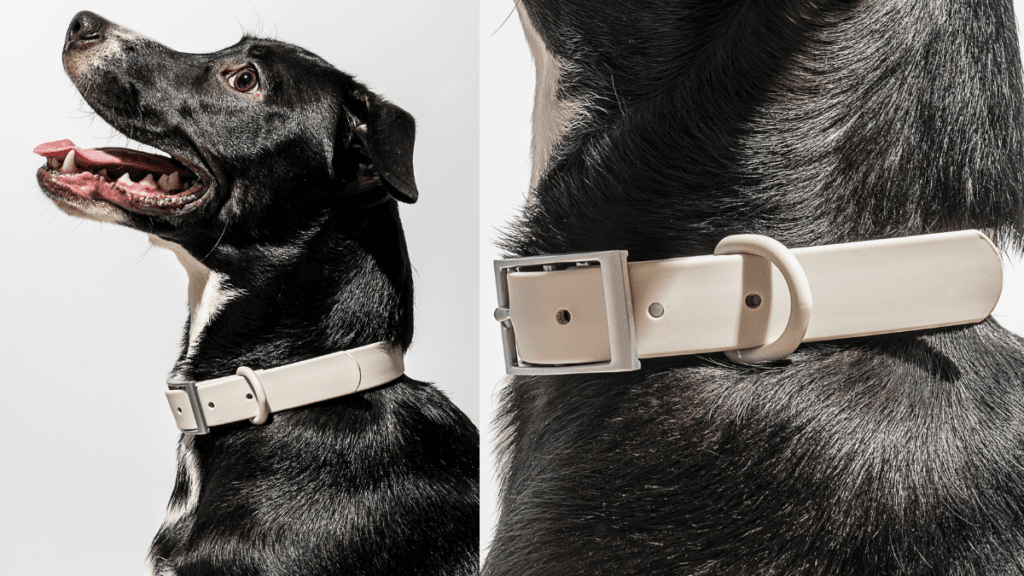
The MoonianPet Waterproof Dog Collar is a flat collar — adjustable, PVC-coated webbing, with a secure safety buckle and a welded D-ring for the leash. It is not a limited slip collar, and if your primary need is a limited slip design for a sighthound or escape-prone dog, a purpose-built limited slip collar is the correct choice.
For dogs where a flat collar is appropriate — the majority of dogs in most walking situations — the MoonianPet collar offers a practical combination of features: fully waterproof, odour-resistant, easy to wipe clean, and available in 11 colours and five sizes. It is suited to dogs that swim, walk in wet conditions, or simply need a collar that can be cleaned without losing shape.
Use the dog collar size guide to measure before ordering. For an ID tag and leash in matching colours, the Waterproof Collar & Leash Set is available in all 11 colours.
Frequently Asked Questions
Is a limited slip collar the same as a martingale collar?
They share the same principle — tighten under tension, stop before choking — but the construction differs. A martingale has a separate control loop attached to a flat collar band, so it has two distinct sections. A limited slip collar is built from a single piece of material looped through two rings, with no separate collar band. Both are suitable for the same types of dogs, and the terms are sometimes used interchangeably. If you see a collar sold as a martingale, check whether it has a separate loop or is a single-piece construction — the function should be similar either way if the stop point is properly set.
Can a limited slip collar choke a dog?
Not if the stop is correctly set and functioning. The stop prevents the loop from closing beyond a fixed point, so sustained pressure on the throat is not possible. The collar tightens momentarily under tension and releases when the tension goes. The risk of choking arises only if the stop fails or was never correctly sized — which is why checking the stop point before use and after any significant pulling incident is important. A correctly functioning limited slip collar is safer in this respect than a full slip lead or chain collar.
Can I leave a limited slip collar on my dog all day?
Most limited slip collars are not recommended for unsupervised wear. The sliding loop can catch on crate bars, furniture legs, or another dog’s collar and create a hazard. For a collar that can be worn at home without supervision, a flat collar with a standard buckle is the safer option. Use the limited slip collar for walks and other supervised situations, and switch to a flat collar for home wear if your dog needs identification tags on them at all times.
Does a limited slip collar help with pulling?
Not directly. The limited slip collar prevents escape — it does not discourage forward pulling. A dog that pulls forward will still pull forward in a limited slip collar; the collar will simply stay on rather than sliding off. If pulling is the primary concern, a no-pull harness with a front D-ring clip is a more effective tool. The limited slip collar addresses the escape risk; the harness addresses the pulling behaviour.
My dog is a greyhound — should I always use a limited slip collar?
A limited slip or martingale collar is the standard recommendation for greyhounds and similar sighthound breeds precisely because their neck-to-skull proportions make flat collar escape a genuine risk. Many greyhound adoption organisations include a martingale collar as standard equipment with every adoption. It does not need to be the only collar your dog owns — a flat collar for home identification tags is fine — but for any walk where the dog will be on a lead and could be startled, the limited slip design provides a meaningful safety advantage over a standard flat collar.
For a full breakdown of collar types and how they differ, see our guide on types of dog collars explained. For sizing any collar correctly, the dog collar size guide covers measurement and fit in detail.
Wenyue
Wenyue is the founder of MoonianPet and writes about dog collars, harnesses, waterproof pet gear, and everyday dog care. Growing up with dogs inspired her lifelong interest in pet care and practical dog gear. Through MoonianPet, she researches dog collars, harnesses, waterproof materials, and everyday solutions that help active dogs stay comfortable during daily adventures.