
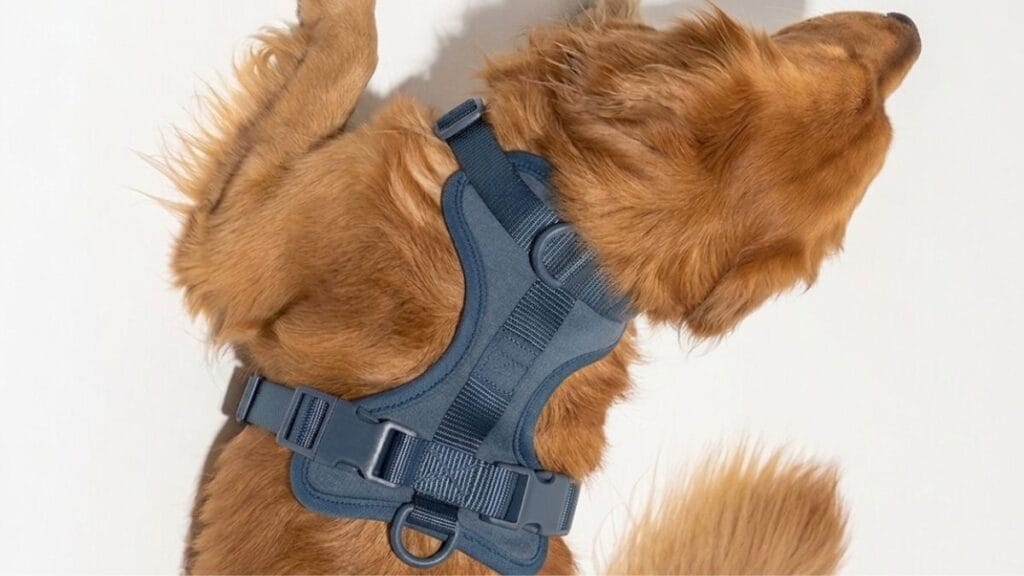
Golden Retrievers have a way of making everything look effortless — except, often, the walk. That same enthusiasm that makes them such warm, people-focused dogs also means a lot of forward momentum on the leash, especially in the first few years. A Golden that spots another dog, a jogger, or anything remotely interesting tends to go toward it with their whole body, and a harness that isn’t built for that energy ends up sliding, twisting, or simply not helping much.
Golden Retrievers also have a specific build to fit around — a deep, broad chest, a thick neck under a heavy coat, and a size range that varies more than people expect between a smaller female and a large American male. A harness sized by weight alone often misses the mark on a breed where chest girth and coat thickness vary so much.
This guide covers what actually matters when choosing a harness for a Golden — fit through their coat and chest shape, pulling control for an enthusiastic breed, and how to handle sizing as a puppy grows into an adult.
The Golden Retriever Build: What a Harness Needs to Fit Around
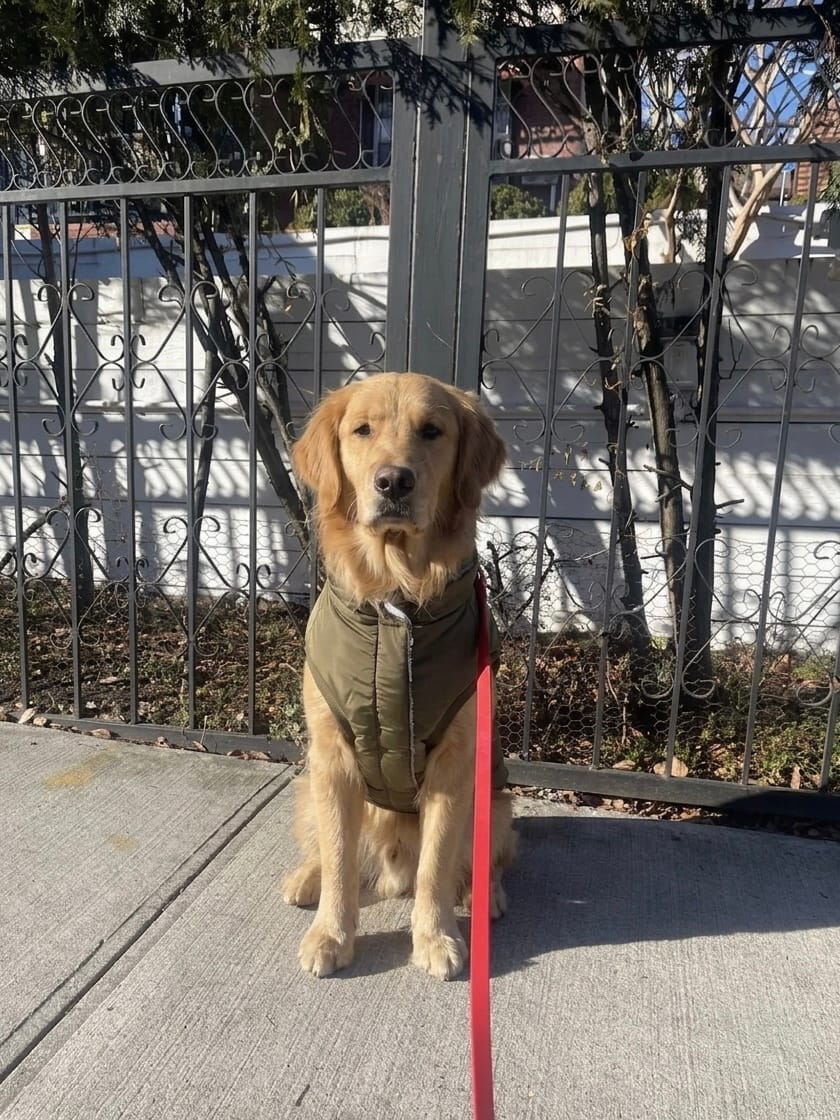
Golden Retrievers carry a deep chest and broad ribcage relative to their height — a shape built for swimming and retrieving, not for a narrow, racing-dog silhouette. A harness that fits a leaner, longer-legged breed of similar weight often sits too low or too tight across a Golden’s chest, because the chest girth measurement on a Golden is proportionally larger than on many other breeds at the same weight.
The double coat adds another layer of complexity. A Golden’s coat is thick, especially around the neck and shoulders, and it compresses under a snug harness strap during wear. A harness fitted to the surface of the coat rather than to the body underneath it will end up loose once the fur settles — which is part of why the two-finger rule should always be checked at skin level, pressing gently through the coat, not at the fur surface.
Size variation within the breed is also significant. Adult male Goldens commonly range from 65 to 75 lb with a chest girth that can reach the high 30s in inches, while smaller females can sit comfortably in a size down from that. Measuring rather than guessing by “Golden Retriever = Large” avoids the most common sizing mistake.
Why Pulling Control Matters More Than People Expect
Golden Retrievers aren’t typically described as “difficult” dogs, but their friendliness is exactly what creates pulling habits — they want to greet every dog, every person, every interesting smell, and they’re strong enough from a young age to make that want felt through the leash. Adolescent Goldens in particular, between around six months and two years old, often pull hardest precisely because their curiosity outpaces their training.
A front-clip harness gives you a mechanical advantage here that a back-clip harness or collar doesn’t. When a Golden pulls toward something, the front D-ring redirects their chest sideways rather than letting them power straight ahead — it doesn’t stop the enthusiasm, but it makes it much easier to manage without a tug-of-war on every walk.
A dual-clip design — front clip for walks, back clip for swimming and free play — covers both sides of a Golden’s life well. Many Goldens are also enthusiastic swimmers, and a back-clip attachment doesn’t interfere with the dog’s natural swimming motion the way a front clip can. For the full breakdown of when to use each, see our front clip vs back clip guide.

Hardware That Holds Up to a Golden’s Activity Level
Golden Retrievers are an active breed by design — bred for long days of retrieving work, they tend to want regular exercise well into adulthood. That activity level means harness hardware sees real, sustained use: daily walks, fetch sessions, swimming, hiking. Hardware that’s adequate for an occasional-use harness can start to show wear faster on a dog that’s in their harness every day for an hour or more.
Metal D-rings at the front clip
The front D-ring is under regular tension on a Golden that pulls toward things. Plastic D-rings can gradually deform under this repeated load, shifting out of their centred position and reducing how well the no-pull redirection works. Zinc alloy D-rings hold their shape through years of daily use.
Quick-drying material for a swimming breed
If your Golden swims — and most do, given any opportunity — a harness that absorbs water and stays damp against the skin for hours afterward isn’t ideal. Lightweight neoprene doesn’t hold moisture the way nylon webbing does, dries quickly, and doesn’t develop the lingering “wet dog” smell that a soaked nylon harness can hold onto.
Padded chest panel for long walks
A Golden that’s out for an hour or more needs a harness that doesn’t create pressure points over that duration. A padded chest panel distributes the harness’s contact area more evenly than a thin strap, which matters most on the longer end of a Golden’s typical exercise needs.
Sizing for a Golden Retriever Puppy
Golden Retriever puppies grow quickly and substantially — a Golden can go from around 10kg at four months to 25-30kg as an adult, often within the first year. This makes harness sizing a moving target, and a harness bought for a small puppy will likely need replacing at least once before the dog reaches full size.
A harness with generous adjustment range on all three straps — neck, chest, and belly — buys you more time before a size change is needed, since you can tighten from a looser starting point as the puppy grows into the harness. Re-check the two-finger fit every couple of weeks during the fastest growth period (typically four to nine months), and don’t assume a harness that fit at the last check still fits now. Full sizing details in our dog harness size guide.
Common Fit Mistakes Specific to Goldens
Chest strap sitting too low
On a Golden’s deep chest, a chest strap that’s adjusted too loosely can drift down toward the belly rather than sitting across the widest point of the chest just behind the front legs. This shifts the front D-ring’s position and reduces the effectiveness of front-clip redirection. Check that the chest strap sits high and snug — at the widest point — rather than sagging lower.
Fitting over the coat instead of through it
A Golden’s neck and shoulder coat is thick enough that a strap which feels snug against the fur surface can be genuinely loose at skin level. Press the tape measure — and the harness straps — gently through the coat to the body underneath when checking fit, especially after grooming or seasonal coat changes when coat volume shifts.
Assuming one size fits the whole breed
The difference between a smaller female Golden and a large American-type male can be the difference between a size L and a size XL on most harness ranges. Always measure your individual dog’s chest and neck girth rather than ordering based on what “Golden Retriever size” generally means — the range within the breed is wider than the name suggests.

A Harness Built for Goldens at Every Life Stage
The MoonianPet No-Pull Dog Harness uses three-point independent adjustment for neck, chest, and belly — giving you the range to fit a Golden’s deep chest correctly and the room to grow with a puppy. Zinc alloy hardware throughout holds up to daily walks, fetch, and swimming, and the lightweight neoprene construction dries quickly after a swim instead of holding water and odour. Front and back clips cover both pulling management and free play. Available in five sizes from XS to XL and 11 colours.
For a matched walking setup, the Harness & Leash Set pairs the harness with a PVC-coated waterproof leash — odour-proof and easy to wipe down after a muddy retrieve.
Frequently Asked Questions
What size harness does a Golden Retriever need?
Most adult Golden Retrievers fall into a size L or XL depending on whether they’re a smaller female or a larger American-type male — chest girth often ranges from around 28 to 38 inches across the breed. Always measure your individual dog’s chest girth at the widest point and neck girth at the base of the neck rather than sizing by weight or breed name alone. Full chart in our dog harness size guide.
Do Golden Retrievers need a no-pull harness?
Most benefit from one, especially during adolescence (roughly six months to two years) when curiosity and strength often outpace training. A front-clip harness redirects pulling momentum and makes walks more manageable without putting pressure on the neck. Even calmer adult Goldens benefit from the option, since most dogs pull occasionally toward something exciting.
My Golden’s harness keeps sliding to one side — why?
This usually means the chest strap is too loose, allowing the whole harness to rotate as the dog moves. Tighten the chest strap so it sits snugly at the widest point of the chest, just behind the front legs, using the two-finger rule at skin level through the coat. A belly strap that’s too loose can also contribute, since it gives the harness more room to shift.
How often will I need to resize my Golden’s harness as a puppy?
Expect to check fit every couple of weeks between roughly four and nine months old, when growth is fastest. A harness with generous adjustment range on all three straps may see you through one full size before a replacement is needed, but most Golden puppies will need at least one harness upgrade between puppyhood and adult size.
Is neoprene or nylon better for a Golden Retriever that swims?
Neoprene is generally better for a swimming Golden — it doesn’t absorb water the way nylon webbing does, so it dries faster and doesn’t hold onto the “wet dog” smell after repeated swims. Nylon harnesses that get wet regularly can develop lingering odour over time and take longer to fully dry between outings.
Getting the fit right matters more than the harness itself — our step-by-step fitting guide covers every strap adjustment. For more on choosing between front and back clip for different activities, see our front clip vs back clip guide.
Wenyue
Wenyue is the founder of MoonianPet and writes about dog collars, harnesses, waterproof pet gear, and everyday dog care. Growing up with dogs inspired her lifelong interest in pet care and practical dog gear. Through MoonianPet, she researches dog collars, harnesses, waterproof materials, and everyday solutions that help active dogs stay comfortable during daily adventures.