
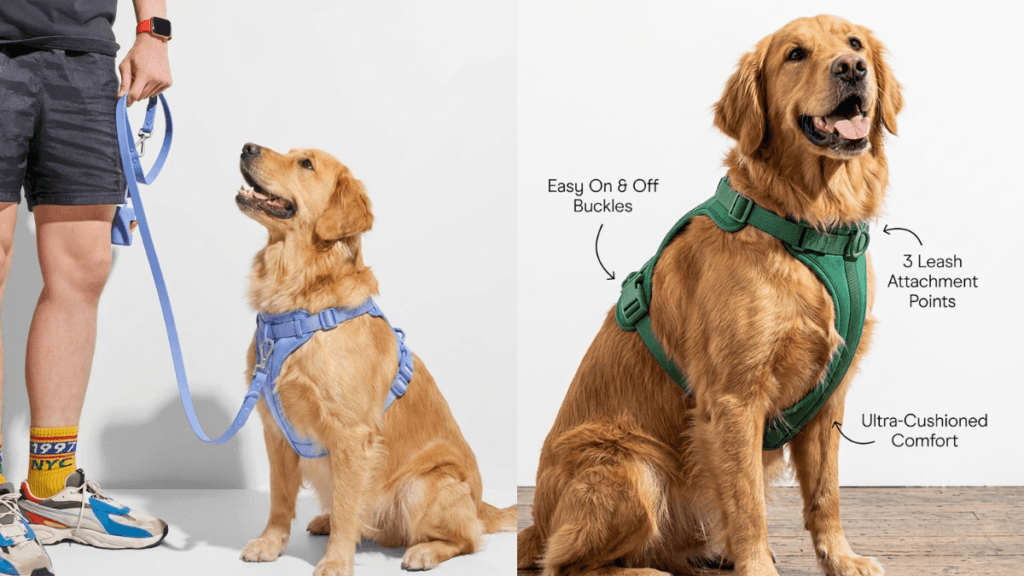
A friend who does canicross with her Whippet once told me she’d never go back to a standard harness — she swore the Y-shaped straps gave her dog a completely different stride. I was sceptical. A harness is a harness, surely? But the more I looked into it, the more I understood why the shape of the straps across a dog’s chest is something worth paying attention to, even if you’re not running ultramarathons with your dog.
The Y-harness and the standard chest harness look similar from a distance — both sit across the front of the dog’s body, both have a leash attachment point. The difference is in exactly where the straps cross the chest and shoulders, and that small difference in geometry changes how freely the dog’s front legs can move.
This guide breaks down what a Y-harness actually is, how it compares to a standard chest harness, which dogs benefit most from each, and what matters more for most everyday walks than the shape of the straps.
What Is a Y-Harness?
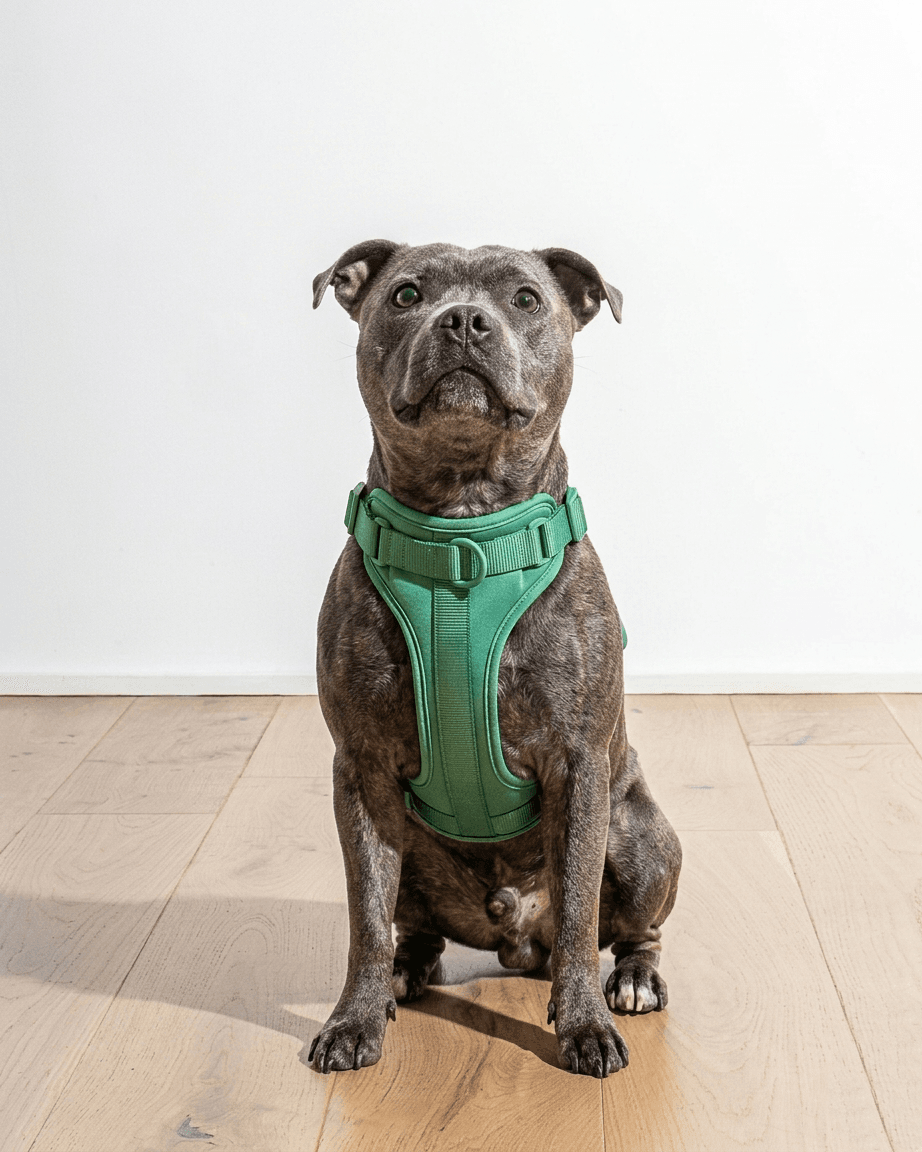
A Y-harness gets its name from the shape formed by the straps when laid flat — a single strap runs down the centre of the chest from a point at the base of the throat, then splits into two straps that angle outward and up toward the shoulders, forming a Y. The leash attachment sits at the point where the straps meet, low on the chest.
The design intention is straightforward: by routing the straps around the shoulder blades rather than across them, the Y-harness aims to leave the shoulder joint completely free to move through its natural range — which matters most when a dog is moving at speed and reaching forward with each stride.
What Is a Standard Chest Harness?
A standard chest harness — the kind most no-pull harnesses are built on — uses a horizontal strap that sits across the front of the chest, roughly at the point where the front legs meet the body, connected to a neck loop and a body strap that wraps around behind the front legs. The front D-ring sits centred on this horizontal chest strap.
This is the most common harness configuration because it’s straightforward to fit, provides a stable and central front-clip attachment point for no-pull redirection, and works well across a huge range of body shapes. The tradeoff some people point to is that the horizontal chest strap sits closer to the shoulder joint than the Y-harness’s angled straps.

Does the Difference Actually Matter for Most Dogs?
This is the question that’s harder to answer than the marketing around both designs suggests. The theory behind the Y-harness — that any strap crossing the front of the shoulder restricts the joint’s range of motion — is mechanically sound. Whether that restriction has a meaningful real-world effect depends heavily on the dog’s activity level and the harness fit.
For a dog on a 30–45 minute daily walk at a normal pace, the shoulder isn’t reaching anywhere close to its full range of motion on most strides. A well-fitted standard chest harness that doesn’t sit too high or too tight is unlikely to produce a noticeable difference in gait for this kind of activity. The two-finger rule — correct fit at the neck, chest, and belly — matters far more for everyday comfort than the strap geometry.
Where the difference becomes more relevant is at higher speeds and longer distances — running, hiking at pace, canicross, agility, or any activity where the dog’s front legs are reaching forward through a much larger range with every stride. At these speeds, a chest strap sitting across the point of the shoulder can interrupt that reach more noticeably, which is why Y-harnesses are popular in dog sport communities.
Which Dogs Suit Each Design
Y-harness tends to suit
Dogs doing canicross, bikejoring, or running sports where sustained forward reach at speed is the dominant movement. Sighthounds and other breeds with a naturally long, reaching stride — Greyhounds, Whippets, Salukis — where shoulder freedom is particularly relevant to their gait. Dogs recovering from shoulder injuries, often on the recommendation of a canine physiotherapist, where minimising any restriction during the recovery period is the priority.
Standard chest harness tends to suit
Everyday walking at normal pace — the majority of dogs and the majority of walks. Dogs that pull, where a centred front D-ring on a stable chest strap gives the most reliable no-pull redirection. Dogs with broad, muscular chests — Pitbulls, Staffies, Bulldogs — where the wider horizontal strap distributes pressure more evenly across a broad chest than angled straps might. Anyone who wants one harness that covers walking, light exercise, and general daily use without needing to think about strap geometry.

What Matters More If Your Dog Pulls
If pulling is the main thing you’re trying to solve, the strap geometry question becomes secondary to a more important one: where is the front clip, and does it stay centred under load?
Most Y-harnesses are designed around freedom of movement first, and many don’t include a front-clip no-pull mechanism at all — they’re built for activities where the dog is expected to pull forward (canicross, sledding) rather than activities where you’re trying to discourage it. If you need both shoulder freedom and pulling control, look specifically for a Y-harness with a front D-ring — they exist, but they’re less common than standard front-clip designs.
A standard chest harness with a centred front D-ring, metal hardware that doesn’t deform under sustained tension, and three-point independent adjustment is the more reliable choice for everyday pulling management. The redirecting mechanism depends on the D-ring staying centred and the harness staying snug — both of which are more straightforward to achieve with the standard chest configuration. For the full breakdown of what to look for, see our best no-pull dog harness guide.
Fit Matters More Than Shape
Whichever design you choose, a poorly fitted harness causes more discomfort and movement restriction than the difference between Y-shaped and horizontal straps ever will. A chest strap that sits too high — up near the throat — restricts the neck and can affect breathing regardless of whether it’s part of a Y or a straight strap. A strap that’s too loose shifts and rubs with every stride, on any design.
The two-finger rule applies regardless of harness shape: two fingers should slide under every strap with light resistance, not freely and not with difficulty. Three-point independent adjustment — neck, chest, and belly adjusted separately — gives you the ability to fine-tune fit on whichever design you choose, which has a bigger impact on comfort and gait than the strap geometry itself. For a full fitting walkthrough, see our no-pull harness fitting guide.

A Chest Harness Built for Everyday Walking and Pulling Control
The MoonianPet No-Pull Dog Harness uses a standard chest configuration with a centred front D-ring — zinc alloy hardware, metal tri-glide sliders, and three-point independent adjustment across neck, chest, and belly for a precise fit on any body shape. The lightweight neoprene construction is breathable and comfortable for everyday walks of any length, available in five sizes and 11 colours.
For a matched walking setup, the Harness & Leash Set pairs the harness with a PVC-coated waterproof leash — odour-proof and easy to wipe clean after muddy walks.
Frequently Asked Questions
Is a Y-harness better for dogs?
Not universally — it depends on the dog’s activity. A Y-harness allows more shoulder freedom at speed, which matters for running sports, sighthounds, and dogs recovering from shoulder injuries. For everyday walking at normal pace, a well-fitted standard chest harness performs comparably for most dogs, and often provides more reliable front-clip pulling control.
Do chest harnesses restrict shoulder movement?
A correctly fitted chest harness does not noticeably restrict movement during normal walking pace. At running speed, where the shoulder reaches a much greater range of motion, a horizontal chest strap can interrupt that reach more than a Y-shaped design. The effect is most relevant for dogs doing sustained running activities rather than everyday walks.
Can a Y-harness stop my dog from pulling?
It depends on the specific harness. Many Y-harnesses are designed for activities where pulling forward is the goal (canicross, sledding) and don’t include a front-clip no-pull mechanism. If you need both shoulder freedom and pulling control, look for a Y-harness specifically designed with a front D-ring — otherwise a standard front-clip chest harness is the more reliable choice for reducing pulling.
Which is better for a sighthound — Y-harness or chest harness?
Sighthounds have a naturally long, reaching stride, and a Y-harness’s design avoids placing a strap across the point of the shoulder during that reach. For active sighthounds doing regular running or zoomies in open spaces, a Y-harness is often preferred. For calmer everyday walking, a well-fitted standard chest harness — sized correctly for a sighthound’s narrow, deep-chested build — works comfortably too.
What matters more — harness shape or fit?
Fit matters more for the vast majority of dogs and activities. A poorly fitted harness of either shape causes rubbing, restricts movement more than the strap geometry would, and can affect the effectiveness of any no-pull mechanism. Get the fit right first — using the two-finger rule on every strap — and then consider strap shape based on your dog’s specific activity level.
For a full overview of every harness style and which suits which dog, see our types of dog harnesses guide. To get the fit right on your current harness, our fitting guide covers every strap adjustment step by step.
Wenyue
Wenyue is the founder of MoonianPet and writes about dog collars, harnesses, waterproof pet gear, and everyday dog care. Growing up with dogs inspired her lifelong interest in pet care and practical dog gear. Through MoonianPet, she researches dog collars, harnesses, waterproof materials, and everyday solutions that help active dogs stay comfortable during daily adventures.