
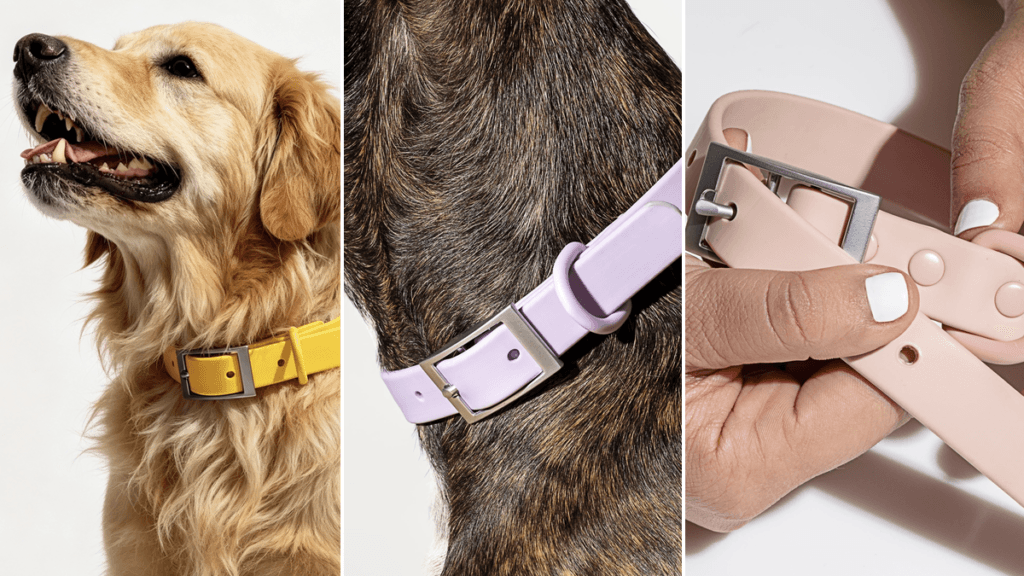
Most dog owners replace their dog’s collar reactively — when it finally breaks, when the buckle stops working, or when they notice the collar has turned a worrying shade of grey despite being bought in red. By that point, the collar has usually been past its useful life for months.
A collar in poor condition is not just an aesthetic problem. A frayed strap can snap unexpectedly on a walk. A weakened buckle can fail at the worst possible moment. A collar that has lost its shape may fit differently than it did when new — sometimes looser, sometimes tighter — without the owner noticing the change.
Here are the five signs that tell you it is time to replace your dog’s collar, and what to look for in a replacement that holds up longer.
Sign 1: The Webbing Is Fraying or Visibly Worn
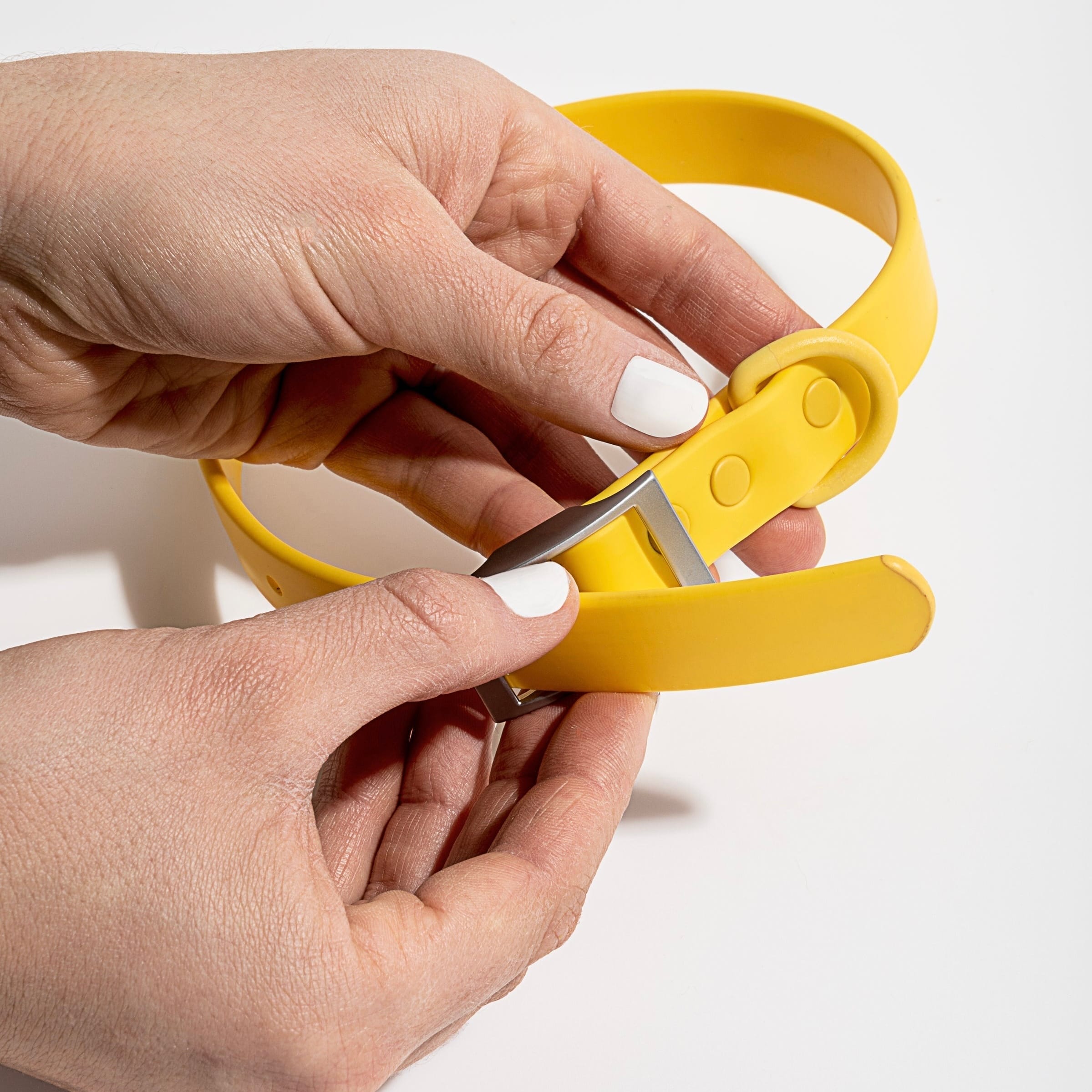
Fraying almost always starts at the stress points — the edges of the buckle, where the D-ring sits, and along the fold where the strap doubles back on itself at the adjustment slider. These are the points where the material is under repeated strain every time the collar moves, and they are the first places to check during any inspection.
Early fraying — a few loose fibres at an edge — is a warning sign, not an emergency. But fraying that has progressed to visible thinning of the webbing, or where individual strands are breaking rather than just loosening, means the structural integrity of the collar is compromised. A strap that is fraying significantly can snap under the sudden load of a dog lunging at another animal or bolting from a startled reaction.
Nylon collars fray faster than most other materials because the fibres are exposed along the cut edges and the weave loosens with repeated wetting and drying. PVC-coated webbing — the material used in the MoonianPet collar — does not fray in the same way because the coating encapsulates the fibres, but it can crack at stress points after years of use, which is the equivalent signal to watch for.
Sign 2: The Buckle or Hardware Is Failing
Buckles fail gradually before they fail completely, and the warning signs are there if you know what to feel for.
The click feels different
A side-release buckle in good condition clicks firmly and positively. When the spring inside the buckle begins to weaken, the click becomes softer, less definite, or requires more pressure to engage. If you notice the buckle clicking less confidently than it used to, the spring is likely weakening. A buckle with a compromised spring can release under less force than it should — which is exactly what you do not want on a walk.
Visible rust or corrosion on the D-ring or buckle
Low-grade hardware rusts quickly, particularly if the collar gets wet regularly. Surface rust on the D-ring is cosmetic; rust that has penetrated into the metal or appears as flaking is structural. Corroded metal is weaker than sound metal, and a corroded D-ring can deform or snap under the sudden load of a strong dog. If you see rust that goes beyond surface discolouration, replace the collar.
The adjustment slider no longer holds its position
If you adjust the collar to the correct fit and find it has loosened itself by the end of a walk — without any obvious reason — the adjustment slider has worn to the point where it no longer grips the webbing securely. A collar that self-loosens during a walk is a safety risk. This is more common on nylon collars where the webbing surface wears smooth over time, reducing friction in the slider.
Sign 3: The Collar Has Developed a Permanent Smell
A collar that smells after a walk is normal. A collar that smells even immediately after washing — or that returns to smelling within hours of being cleaned — has reached the end of its useful life.
Nylon and fabric collars absorb odour into the fibres over months of regular use. Sweat, saliva, wet dog, mud, and any water your dog swims in all contribute. Once the fibres are saturated at a deep level, surface washing does not reach the source of the smell. The collar is not dirty in a way you can clean — the odour is embedded in the material itself.
This is one of the practical advantages of PVC-coated webbing: because the coating is non-porous, odour cannot penetrate the material the way it does with fabric. The collar wipes clean rather than needing to be washed through, and it does not develop embedded smell over time. If your current collar has reached the permanent-smell stage, it is worth considering this when choosing the replacement.

Sign 4: The Collar No Longer Fits Correctly
Collars change shape with use. Nylon stretches slightly over time, which means a collar that fitted snugly when new may have loosened half a size after a year of daily use. Leather can stiffen or soften depending on moisture exposure. Even PVC-coated webbing can lose some of its structure at stress points after extended heavy use.
If you have adjusted a collar to its tightest setting and it still passes the two-finger rule with room to spare, the collar has stretched beyond its intended range. The same applies in reverse — a collar adjusted to its loosest setting that is still uncomfortably tight has likely shrunk (more common with nylon after repeated washing in warm water) and needs replacing.
A collar that no longer has room to adjust within its intended range cannot be relied upon to hold the fit that was measured and set when it was new. Replace it and measure fresh rather than compensating with workarounds. Our dog collar size guide has a full measurement chart if you need to re-measure before ordering.
Sign 5: The Collar Has Skin or Coat Contact Issues
Over time, a collar that has been acceptable can start causing problems at the contact points — particularly under the D-ring, where the metal sits against the skin, and along the inside edges of the strap where the material meets the neck.
Fur matting or thinning under the collar
Check the fur and skin under the collar monthly. A small amount of fur compression is normal where any collar sits, but visible thinning — patches where the fur is noticeably shorter or absent — indicates that the collar is causing repeated friction or pressure in that spot. This can happen when a collar stretches and starts moving more than it should, when the inside surface of the strap has roughened with age, or when the fit has changed and the collar is now sitting in a slightly different position than intended.
Skin redness or irritation that does not resolve
Occasional mild redness after an active day is not necessarily cause for alarm, but redness that is present most days or that does not clear up when the collar is removed for a day suggests the collar material has degraded in a way that is causing sustained irritation. Some collars develop rough edges or surface degradation after extended use that are not visible to the eye but are perceptible to skin. If the skin condition improves when the collar comes off and returns when it goes back on, the collar is the problem.
How Long Should a Dog Collar Last?
It depends almost entirely on the material. Nylon collars, realistically, last one to two years for a dog walked daily in mixed conditions — wet grass, occasional swimming, regular washing. The fibres fray, the buckle spring weakens, and the odour builds up over that period.
Leather collars can last three to five years with proper conditioning and care, but that maintenance requirement is genuine — a leather collar that gets repeatedly wet and is not conditioned will crack and stiffen within a year or two.
PVC-coated webbing collars last three to five years under normal daily use without the maintenance requirements of leather — the coating prevents the fraying, odour absorption, and shrinkage that limits nylon, and it does not need conditioning. The hardware is still worth checking annually, but the strap itself holds up significantly longer than nylon for active dogs in wet conditions.
A Replacement Built to Last Longer
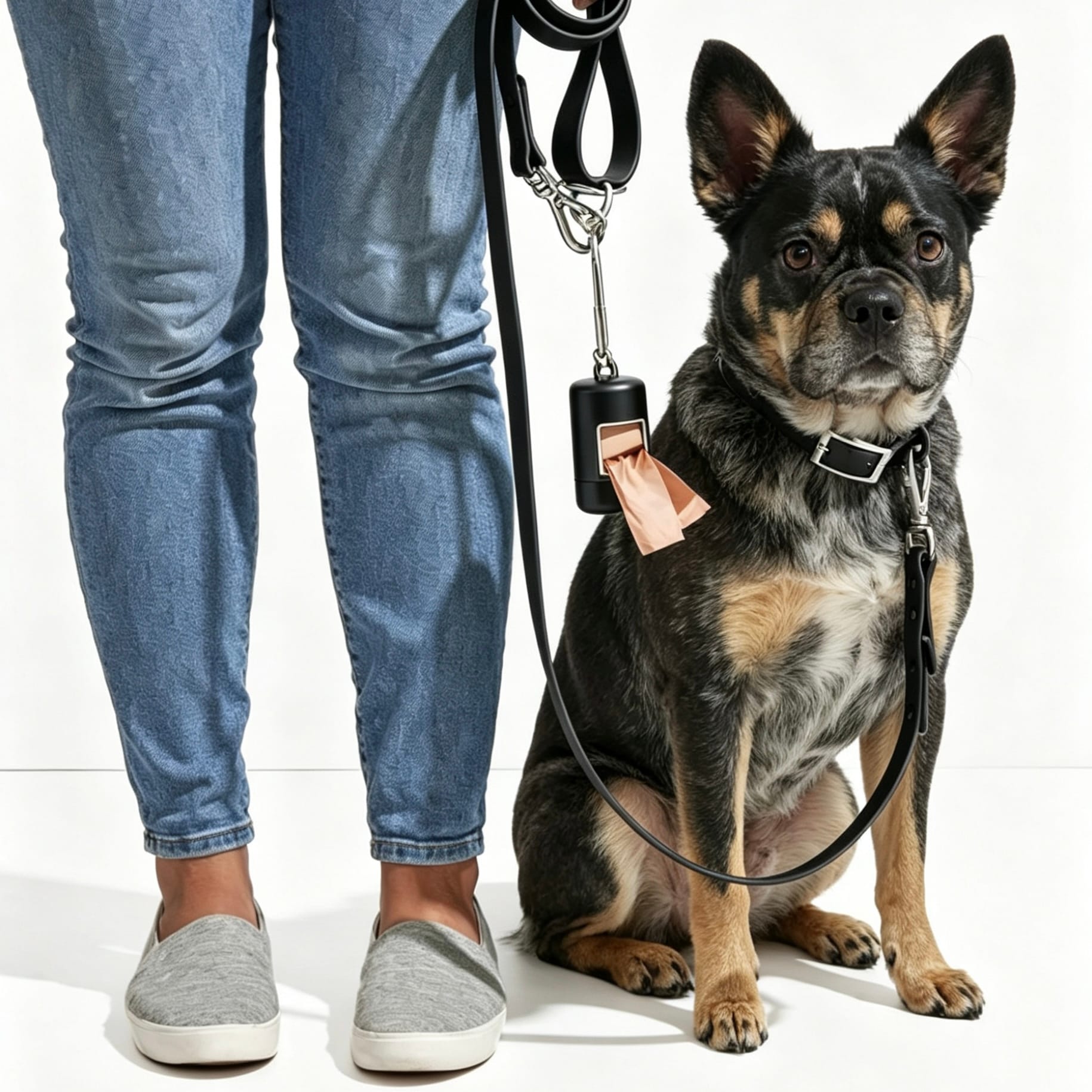
If you are replacing a nylon collar that has reached the end of its life, the MoonianPet Waterproof Dog Collar addresses the three most common failure modes directly — PVC coating eliminates fraying and odour absorption, zinc-alloy hardware resists corrosion, and the adjustment slider holds its position through daily use. Available in 11 colors and 5 sizes, XS through XL.
Pair with the MoonianPet Waterproof Leash for a matching set, or save with the Collar & Leash Set. Not sure which size to order? The dog collar size guide walks you through measuring in under two minutes.
Frequently Asked Questions
How often should I replace my dog’s collar?
There is no fixed schedule — it depends on material, how active your dog is, and how often the collar gets wet. A practical approach is to inspect the collar thoroughly every three months: check the strap for fraying or cracking, test the buckle click, check the D-ring for corrosion, and confirm the adjustment slider still holds position. Replace when you find any of the five signs above, rather than waiting for a specific time period. Nylon collars typically need replacing every one to two years; PVC-coated collars typically last three to five years under similar conditions.
Can I repair a fraying collar instead of replacing it?
Very minor fraying at an edge — a few loose fibres — can sometimes be managed by carefully trimming the loose fibres and applying a small amount of fray-check sealant to the edge. But fraying that has progressed to thinning of the webbing or broken strands is a structural issue that cannot be reliably repaired. At that point, the collar’s load-bearing capacity is compromised, and a repair that holds in normal use may still fail under the sudden load of a dog lunging. Replace rather than repair once fraying has reached the webbing itself.
My dog’s collar still looks fine but smells terrible. Should I replace it?
If the collar smells persistently after washing — or returns to smelling within a day or two of being cleaned — the odour is embedded in the material rather than on the surface. At that stage, further washing will not resolve it and the collar is at the end of its useful life from a hygiene standpoint, even if it looks structurally sound. Replace it, and consider a PVC-coated replacement if odour has been a recurring issue — the coating prevents the deep odour absorption that causes this problem.
Do I need to replace the collar when my puppy grows up?
Almost certainly yes — most puppies will go through two or three collar sizes between eight weeks and adult size, depending on breed. A puppy collar that fit at twelve weeks is unlikely to fit at six months, let alone at adult size. Track the fit every two weeks during the growth phase and size up when you reach the upper limit of the current collar’s adjustment range. Adult size varies enormously by breed — a Chihuahua’s adult collar is not much bigger than their puppy collar, while a Great Dane’s adult collar may be two or three sizes up.
Is it worth spending more on a collar that lasts longer?
Over a two to three year period, yes — a collar that costs twice as much but lasts three times as long costs less overall and involves less hassle. The more useful calculation is cost per year of use: a $10 nylon collar replaced every 18 months costs about $7 per year; a $35 PVC-coated collar replaced every four years costs about $9 per year, with the practical advantages of no odour absorption and no fraying built in. The gap is smaller than the sticker price suggests, and the daily experience of a collar that wipes clean and stays odour-free is meaningfully better.
Once you have replaced the collar, see our guide on how to put on a dog collar correctly to make sure the new one fits right from the start. For the full size chart, the dog collar size guide covers measurement in detail.
Wenyue
Wenyue is the founder of MoonianPet and writes about dog collars, harnesses, waterproof pet gear, and everyday dog care. Growing up with dogs inspired her lifelong interest in pet care and practical dog gear. Through MoonianPet, she researches dog collars, harnesses, waterproof materials, and everyday solutions that help active dogs stay comfortable during daily adventures.