
A slip collar is one of the oldest and most widely recognised pieces of dog equipment — and also one of the most frequently misused. The design is almost brutally simple: a loop of rope, cord, or chain that tightens when the leash is pulled and loosens when pressure releases. No buckle, no fixed diameter, no adjustment mechanism. Just a loop that responds directly to tension.
In the right hands and the right context, a slip collar is a precise communication tool. In the wrong context — on a dog that pulls consistently, worn by an owner unfamiliar with the mechanics, or left on a dog unsupervised — it is a genuine hazard. Understanding which situation you are in is the starting point for deciding whether a slip collar belongs in your kit.
This guide covers how a slip collar works mechanically, the training context it was designed for, the risks that come with misuse, which dogs it suits and which it does not, and what to use instead for everyday walking.

How a Slip Collar Works
A slip collar — sometimes called a slip lead when the leash and collar are combined into a single piece — works through a simple loop mechanism. The collar is a continuous loop of material with a ring at each end. One ring is threaded through the other, creating the loop that goes around the dog’s neck. The leash clips to, or is part of, the outer ring.
When leash tension increases — the handler pulls, or the dog pulls against the handler — the loop tightens. When tension releases, the loop loosens. There is no stop point: the collar can, in theory, close to any diameter, including one that restricts breathing. This is the mechanical fact that defines both the legitimate use of a slip collar and the risks of misuse.
The intended use in traditional training is a brief, sharp tug followed by an immediate release. The tightening acts as a signal — a moment of pressure — and the release is the reward. The dog learns to associate slack in the lead with correct behaviour. This requires the handler to release immediately and consistently, so the collar is never under sustained tension.
The problem arises when the collar is used on a dog that pulls continuously rather than in bursts. A consistent puller keeps sustained tension on the collar — which means the collar stays partially or fully closed for the duration of the walk. This is not the intended use, and it is where the risk of tracheal pressure and physical discomfort becomes real.
The Training Context It Was Designed For
Slip collars became standard equipment in obedience training in the mid-twentieth century, before the dominance of reward-based training methods. The technique — a sharp check on the lead followed by immediate release — was used to correct position, attention, and heel work. In that context, a skilled handler with a responsive dog used the slip collar as a communication tool with very brief pressure windows.
What the collar requires from the handler
Timing is everything. The check-and-release must happen in under a second — pressure applied, pressure released, slack restored. A handler who holds tension after the check, or who applies multiple slow checks instead of one quick one, defeats the mechanism and creates sustained pressure on the dog’s neck. This is a skill that requires practice and instruction; it is not self-evident from the equipment itself.
What the collar requires from the dog
The slip collar works best on dogs that respond quickly to pressure signals and that pull intermittently rather than continuously. A dog that is already attentive to the handler and needs occasional position correction is a different candidate from a dog that pulls hard and consistently from the moment the lead goes on. The slip collar was not designed for the latter.
Modern training context
Most professional trainers working in reward-based frameworks have moved away from slip collars as primary training tools. The check-and-release method requires precise timing that is difficult for most pet owners to replicate consistently, and the consequences of inconsistent technique fall on the dog. Slip collars remain in use in some competition obedience, Schutzhund, and working dog contexts — where handlers are specifically trained in their correct use.
Risks of Misuse
Sustained tracheal pressure
A dog that pulls consistently keeps the slip collar closed around their throat for extended periods. This puts pressure directly on the trachea and the structures of the neck. In brachycephalic breeds — pugs, bulldogs, French bulldogs — which already have compromised airways, even brief sustained pressure is a serious concern. In any breed, extended tracheal pressure is associated with coughing, gagging, and in severe cases long-term tracheal damage.
Injury risk during reactive incidents
When a reactive dog lunges suddenly at full force, the slip collar closes rapidly and at high tension. The force concentrated on the neck in this moment — all of the dog’s forward momentum stopped by a tightening loop — is significantly greater than what the collar experiences during a steady walk. Neck injury from a hard reactive lunge in a slip collar is a documented risk, particularly in larger, heavier dogs.
Escape if worn incorrectly
A slip collar worn with the ring on the wrong side — so the loop does not self-release — stays tight regardless of what the dog does, creating constant pressure. Additionally, if the collar is worn too loosely, a dog backing away from the handler can slip out of it entirely, because there is no stop point to prevent the loop from expanding over the widest part of the skull. A slip collar provides either too much closing force or too little security, depending on which mistake is made.
Unsupervised wear
A slip collar should never be left on a dog unsupervised. The loop can catch on crate bars, furniture, or another dog and pull tight, with no mechanism to release. This is a strangulation risk. Slip collars and slip leads are strictly for supervised use — on during the walk, off when the dog is home.

Which Dogs a Slip Collar Suits — and Which It Does Not
Better suited to
Dogs already trained to walk on a loose lead, where the slip collar serves as a lightweight, buckle-free option for dogs that reliably maintain lead position. Dogs in specific working or competition contexts where the handler has been trained in correct check-and-release technique. Temporary use at the vet or groomer for a dog that needs a quick, adjustable collar fit without fuss.
Not suited to
Dogs that pull consistently on the lead. Brachycephalic breeds with compromised airways — pugs, bulldogs, French bulldogs, Shih Tzus, Boxers. Dogs with existing neck or tracheal issues. Reactive dogs that lunge suddenly and at force. Puppies, whose tracheas are still developing. Dogs that will be left unsupervised in the collar. Any situation where the handler is unfamiliar with slip collar mechanics and release timing.
What to Use Instead for Everyday Walking
For the vast majority of dog owners — those with dogs that pull on the lead, dogs with any neck or airway sensitivity, or owners who simply want a reliable everyday setup — there are better options than a slip collar.
Flat collar with a safety buckle
The standard option for most dogs. Fixed diameter, adjustable fit, no pressure mechanics. For a dog that does not have a neck narrower than their skull — which is most dogs outside of sighthound breeds — a correctly fitted flat collar stays on reliably and puts no sustained pressure on the neck during normal walking. For everyday use, this is the baseline.
Limited slip or martingale collar
For dogs that can back out of a flat collar — particularly sighthounds — a limited slip or martingale collar adds tightening action under tension but stops at a fixed maximum diameter. It provides the escape-prevention benefit of the slip collar without the risk of sustained closure. This is the recommended alternative for breeds with narrow skulls. For a full breakdown of how these work, see our guide on limited slip dog collars.
No-pull harness
For dogs that pull, a no-pull harness with a front D-ring clip addresses the pulling behaviour directly by redirecting the dog’s momentum inward when they lunge forward. It distributes force across the chest and shoulders rather than concentrating it on the neck. For any dog with a history of pulling, neck sensitivity, or airway concerns, a harness is the more appropriate equipment choice than any collar-based solution. The collar stays on for ID tags; the harness takes the leash for the walk.
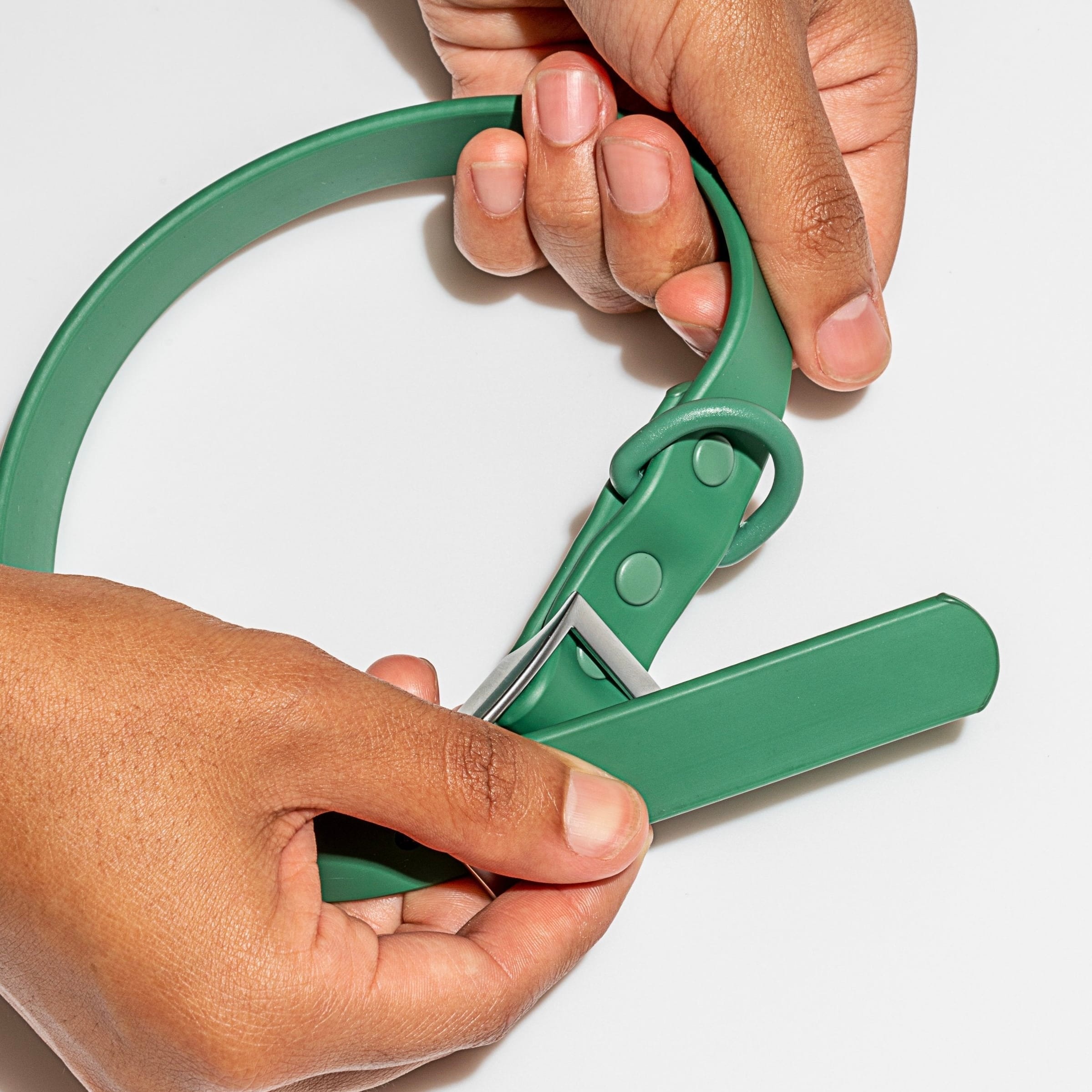
The MoonianPet Waterproof Dog Collar
The MoonianPet Waterproof Dog Collar is a flat collar — adjustable buckle, fixed diameter, PVC-coated webbing that is fully waterproof and odour-resistant. It does not have slip mechanics of any kind, which makes it a straightforward, reliable everyday collar for dogs that walk well on a lead or that use a harness for leash attachment.
For dogs that pull and need a no-pull solution, the MoonianPet No-Pull Dog Harness with a front D-ring clip is the more appropriate pairing. Wear the flat collar for ID tags; clip the leash to the harness. Both are available in 11 matching colours if a coordinated set matters.
Use the dog collar size guide to measure before ordering. For a matched collar and leash without the need for a separate harness, the Waterproof Collar & Leash Set is available in all 11 colours.
Frequently Asked Questions
Are slip collars cruel?
This depends entirely on how they are used. In the hands of a trained handler with a responsive dog, a brief check-and-release causes momentary pressure and no injury. On a consistent puller worn by an owner unfamiliar with release timing, the same collar can cause sustained tracheal pressure and physical discomfort over the course of a walk. The collar is not inherently cruel; the risk lies in misapplication. For most pet owners without specific slip collar training, a flat collar or no-pull harness is a safer and more effective everyday choice.
What is the difference between a slip collar and a slip lead?
A slip collar is just the collar — a loop of material that goes around the neck, with a ring for the leash to clip to. A slip lead combines the collar and leash into a single piece: the loop at one end goes around the neck, and the lead runs directly from it without a separate clip. The mechanics are identical; the slip lead is simply a more minimal, one-piece version that is popular in vet practices and kennels for quick, temporary use. Both have the same limitations and the same risks.
Where should a slip collar sit on the neck?
High on the neck, just behind the ears and jaw — not low on the throat. The closer to the base of the skull the collar sits, the more mechanical advantage the handler has with a lighter check, and the further from the trachea the pressure point is. A slip collar worn low on the throat puts pressure directly on the tracheal cartilage even with light leash tension. High placement does not eliminate the risks of misuse, but it does reduce the anatomical impact of any given pressure.
Can I use a slip collar on a puppy?
Not recommended. A puppy’s trachea is still developing and is more vulnerable to pressure damage than an adult dog’s. Puppies are also unpredictable in their movement — they lunge, back up, and throw their body weight in ways that create sudden high-force tightening in a slip collar. A well-fitted flat collar or a lightweight puppy harness is the appropriate starting point. Lead training from the beginning with reward-based methods removes the need for any pressure-based collar tool in the first place.
Will a slip collar stop my dog from pulling?
Unlikely, without specific training. A dog that pulls consistently will simply pull against the slip collar the way it pulls against any other collar — the tightening sensation does not automatically produce lead manners. What changes pulling behaviour is training: teaching the dog that a loose lead is rewarding and that tension on the lead causes the walk to stop. A no-pull harness with a front clip can assist by redirecting forward momentum, but it also works best as part of a training approach rather than as a substitute for one.
For dogs that need escape-proof security without slip collar risks, see our guide on limited slip dog collars. For the full range of collar types and how to choose between them, see types of dog collars explained.
Wenyue
Wenyue is the founder of MoonianPet and writes about dog collars, harnesses, waterproof pet gear, and everyday dog care. Growing up with dogs inspired her lifelong interest in pet care and practical dog gear. Through MoonianPet, she researches dog collars, harnesses, waterproof materials, and everyday solutions that help active dogs stay comfortable during daily adventures.