
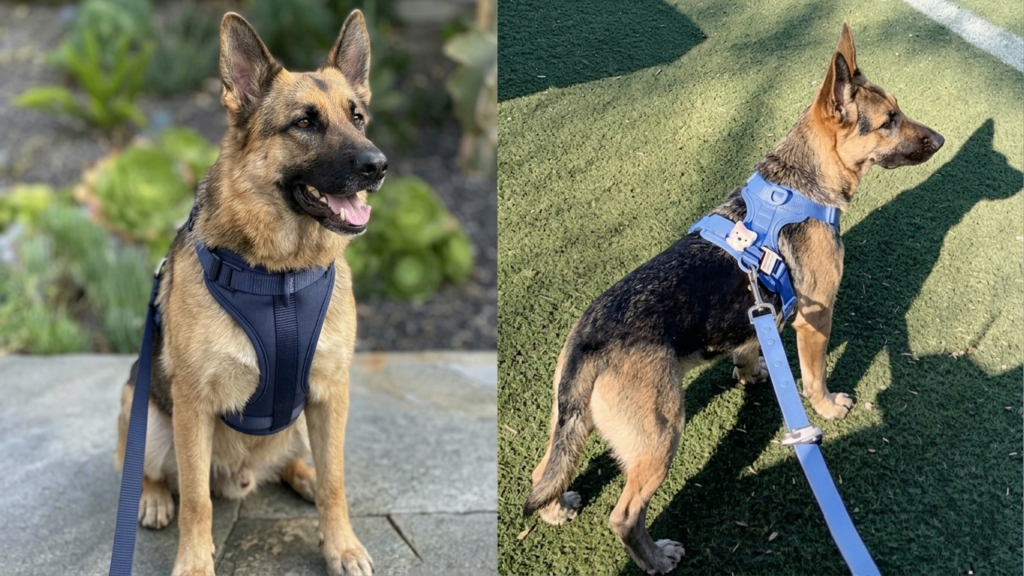
German Shepherds are working dogs at heart, and they walk like it. They’re alert, strong, and built for sustained effort — which on a daily walk means a dog that’s constantly assessing its environment and occasionally deciding something requires urgent investigation at full speed. A harness that can’t handle that combination of intelligence and physical capability doesn’t last long in the role.
The German Shepherd also has a specific body shape that doesn’t always fit harness sizing charts designed for more generic large-dog proportions. Their distinctive sloped back, deep chest, and often narrower waist relative to chest depth creates fit challenges that can leave a harness sitting unevenly or shifting during movement — which matters both for comfort and for the reliability of any no-pull mechanism.
This guide covers what to look for when choosing a harness for a German Shepherd — fitting their unique proportions, managing pulling and reactivity in an alert breed, escape prevention for a dog that’s smart enough to figure out poorly fitted equipment, and hardware that matches the breed’s strength and daily activity level.
The German Shepherd Build: What Makes Fitting Tricky
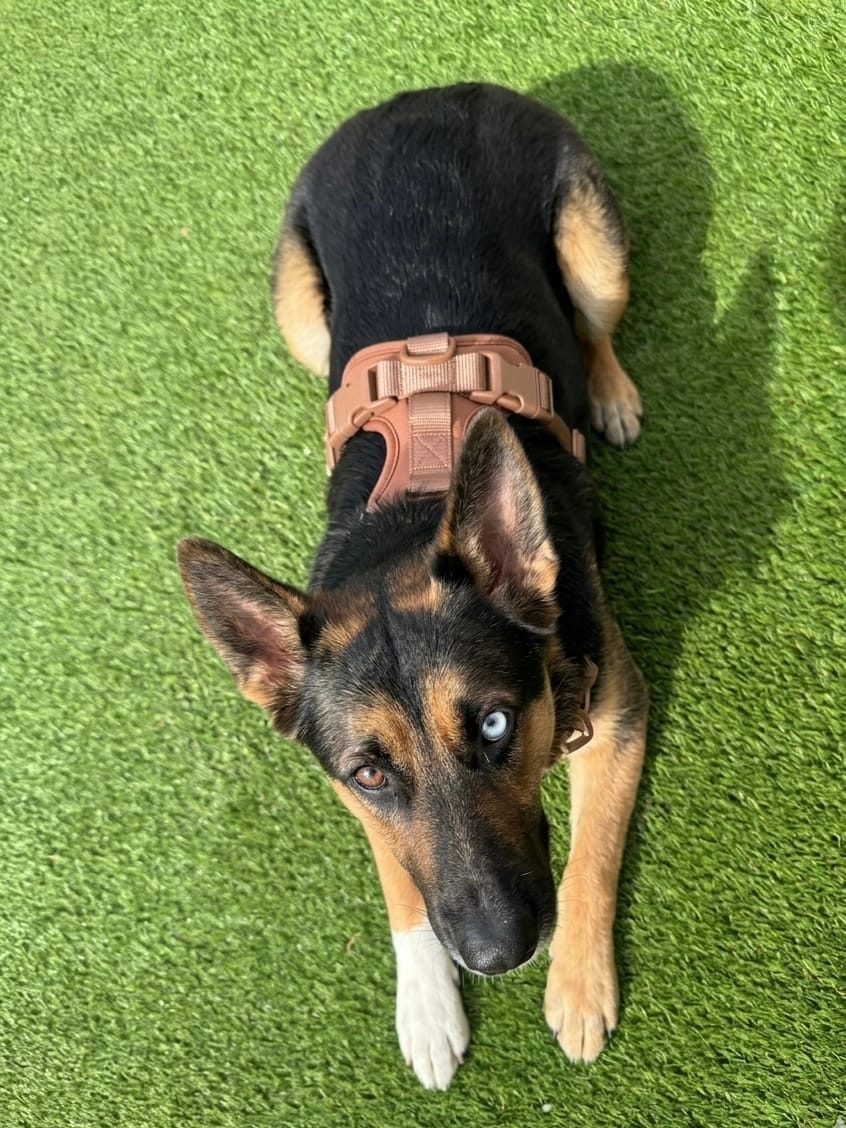
A German Shepherd’s body proportions are distinctive enough that a harness fitting a Labrador of similar weight often sits wrong on a GSD. The deep chest combined with a noticeably narrower waist means a belly strap that fits the chest measurement tends to be too loose around the midsection — which allows the whole harness to shift and rotate during movement.
The sloped topline — a characteristic of many GSD lines — means the back of the harness also sits at an angle rather than horizontally, which can cause some harness designs to slide forward toward the neck during walks. A back strap that wraps behind the front legs and cinches snugly is what keeps the harness stable on a GSD’s body rather than drifting forward with every stride.
The double coat adds measurement complexity similar to other double-coated breeds — a measurement taken at the fur surface will produce a harness that’s too large once the coat compresses during wear. Measure to skin contact by pressing the tape gently through the coat, and apply the two-finger fit check at the same level. For the full measurement process, see our dog harness measurement guide.
Pulling, Reactivity, and Why a Front Clip Matters
German Shepherds don’t usually pull in the same mindless, enthusiastic way a Labrador does. Their pulling tends to be more purposeful — they’re alert to something, they’ve decided it needs attention, and they’re going toward it with intent. This alert, reactive style of pulling is actually harder to manage than simple enthusiasm, because the dog is in a heightened state and more committed to the direction they’ve chosen.
A front-clip harness is particularly effective for this pattern because the sideways redirect it creates interrupts the dog’s line of sight toward whatever triggered the reaction — turning the head slightly sideways breaks the visual fixation that’s driving the pull. The mechanism works because it’s not just physically redirecting the body; it’s disrupting the behaviour before it builds into a full lunge.
Keeping the leash short enough that the front clip engages early matters more for a reactive GSD than for a casual puller — the interruption needs to happen before the dog reaches full commitment, not after. For a full comparison of how front and back clips handle different pulling patterns, see our front clip vs back clip guide.

Escape Prevention: Intelligence Makes This More Important
German Shepherds are intelligent enough to figure out poorly fitted equipment faster than most breeds. A neck loop that’s slightly too loose on a GSD doesn’t stay slightly too loose for long — they’ll find it within the first few walks and learn that backing up while lowering the head is the exit. Once a GSD has learned that behaviour, it becomes a reliable strategy they’ll keep trying.
The neck loop must pass the escape test before every walk
With the harness on, gently try to slide the neck loop forward over the skull. It should not be able to pass the widest point of the head. If it can, tighten the neck strap one notch and retest. Two fingers should fit under the neck loop with light resistance — not three, not freely. Do this test before every walk until you’ve confirmed the fit is consistently correct, then re-check weekly. For detailed escape-proofing steps, see our escape-proof harness guide.
Tighten all three straps, not just the neck
A loose belly strap gives the dog more room to manoeuvre during a backward escape attempt — the harness can rotate and shift, making it easier to work the neck loop forward. All three straps — neck, chest, and belly — should be at the two-finger rule, not just the neck. On a GSD’s narrower waist, the belly strap often needs to be tighter than you’d expect relative to the chest strap.
Re-check fit after seasonal coat changes
German Shepherds shed heavily twice a year. After a significant coat shed, the harness will be measurably looser at skin level — the reduced coat volume means what felt snug now has extra room. Re-check and readjust all three straps at each seasonal coat change.
Hardware Requirements for a Working-Breed Build
German Shepherds are large, strong dogs used to sustained activity — hardware that’s fine for a smaller or calmer breed can show wear faster on a GSD that’s in their harness daily.
Zinc alloy D-rings throughout
Both the front and back D-rings see real load on a GSD — the front during reactive lunges, the back during hiking or active exercise. Zinc alloy holds its shape under both sudden and sustained loads; plastic deforms over time under the force a German Shepherd generates.
Metal tri-glide sliders
On a GSD that pulls reactively, sudden sharp loads test the sliders as much as the D-rings. Plastic sliders can slip under a sudden jolt, gradually loosening the harness during a walk. Metal sliders hold the set adjustment under sudden loads as well as steady tension.
Reinforced quick-release buckle
A buckle that pops open easily for daily use but resists lateral stress during twisting and lunging — a GSD throwing their weight sideways during a reactive moment puts significant lateral force on the buckle. An ABS-reinforced buckle that clicks firmly locked is what handles that without issue.

Built for Intelligence, Strength, and Daily Active Use
The MoonianPet No-Pull Dog Harness gives you the three-point independent adjustment a GSD’s proportions need — neck, chest, and belly adjusted separately, so you can tighten the belly strap independently of the chest to account for the narrower waist. Zinc alloy D-rings and metal tri-glide sliders throughout hold up to reactive lunges and sustained daily use, and the reinforced ABS quick-release buckle locks firmly without popping under lateral stress. Available in five sizes from XS to XL and 11 colours.
For a matched walking setup, the Harness & Leash Set pairs the harness with a heavy-duty PVC-coated leash — odour-proof and built to handle the sharp tension a reactive GSD generates.
Frequently Asked Questions
What size harness does a German Shepherd need?
Most adult German Shepherds fit a size L or XL, though the GSD’s narrower waist relative to chest depth means measuring both chest girth and neck girth is especially important — sizing by weight alone often misses the proportional differences between a GSD and a more uniformly built breed at similar weight. Full size chart in our dog harness size guide.
My German Shepherd escapes from every harness — what am I doing wrong?
Almost always a neck loop that’s too loose. With the harness on, test whether the neck loop can be slid forward over the widest point of the skull — if it can, it’s too loose regardless of how it feels on the neck. Tighten the neck strap until it genuinely cannot pass the skull, apply the two-finger check, and retest. A GSD that has learned to escape will test the harness actively, so the fit needs to be correct, not approximately correct.
Why does my GSD’s harness keep twisting to one side?
Usually a loose belly strap. On a GSD’s narrow waist, the belly strap needs to be snugger than the chest strap to keep the harness centred — it’s the strap that stops the whole harness rotating. Tighten the belly strap to the two-finger rule independently of the chest strap and recheck after a walk.
Is a front-clip or back-clip harness better for a reactive German Shepherd?
Front clip for reactive walks — the sideways redirect interrupts the dog’s visual fixation on the trigger before the lunge builds, which is particularly useful for alert reactive breeds. Back clip for exercise, hiking, or calm walks where natural movement is the priority. A dual-clip harness covers both without needing separate equipment.
Do German Shepherds need a harness or is a collar enough?
For a GSD that pulls or reacts on the leash, a harness distributes leash force across the chest and shoulders rather than concentrating it on the trachea and neck — which is safer for a dog that generates the level of force a GSD can. A collar remains useful for ID tags. Most GSD owners use a harness as the primary walking tool and keep a collar for identification only.
For step-by-step harness fitting covering every strap adjustment, see our no-pull harness fitting guide. For more on escape-proofing a harness on a determined dog, our Husky escape-proof guide covers the same principles in detail.
Wenyue
Wenyue is the founder of MoonianPet and writes about dog collars, harnesses, waterproof pet gear, and everyday dog care. Growing up with dogs inspired her lifelong interest in pet care and practical dog gear. Through MoonianPet, she researches dog collars, harnesses, waterproof materials, and everyday solutions that help active dogs stay comfortable during daily adventures.