
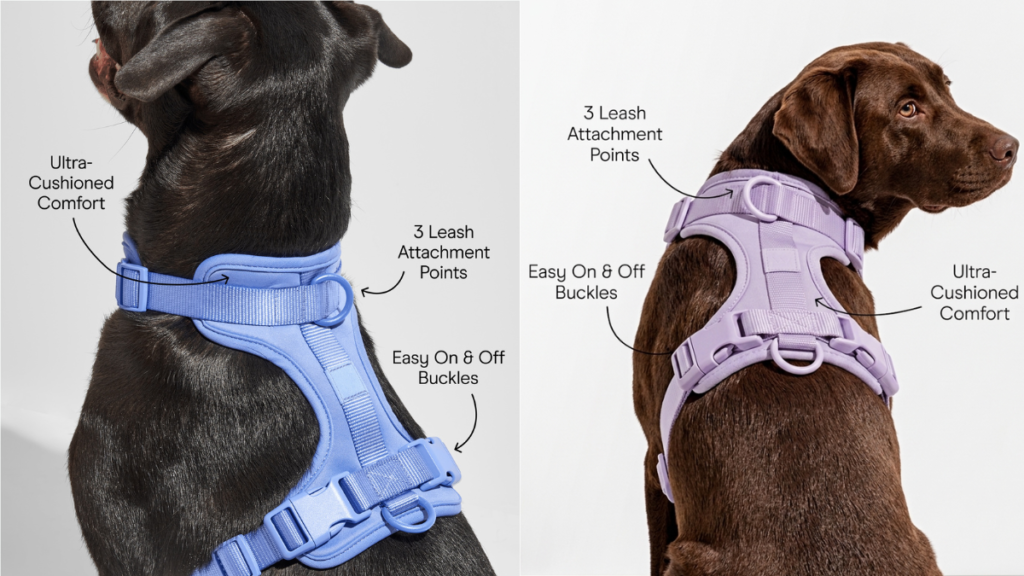
Labradors are deceptively strong. They’re friendly, food-motivated, and generally easygoing — which makes it easy to underestimate just how much force a 30kg Lab can put through a leash when something interesting shows up. A harness that’s slightly underbuilt doesn’t usually fail dramatically; it just slowly stops doing its job, sliding around, loosening over a walk, or letting the front D-ring drift off to one side until the no-pull effect quietly disappears.
Labradors also have a build that’s worth understanding before you size a harness — a broad, barrel-shaped ribcage, a short dense coat, and a weight range that varies enormously between a lean working-line Lab and a heavier-set show-line Lab of the same height. Two Labradors that look similar standing side by side can need genuinely different harness sizes.
This guide covers what to look for in a harness for a Labrador — fitting their build correctly, managing pulling in a strong and enthusiastic breed, hardware that holds up to daily use, and sizing through the puppy growth period.
The Labrador Build: Barrel Chest, Big Range
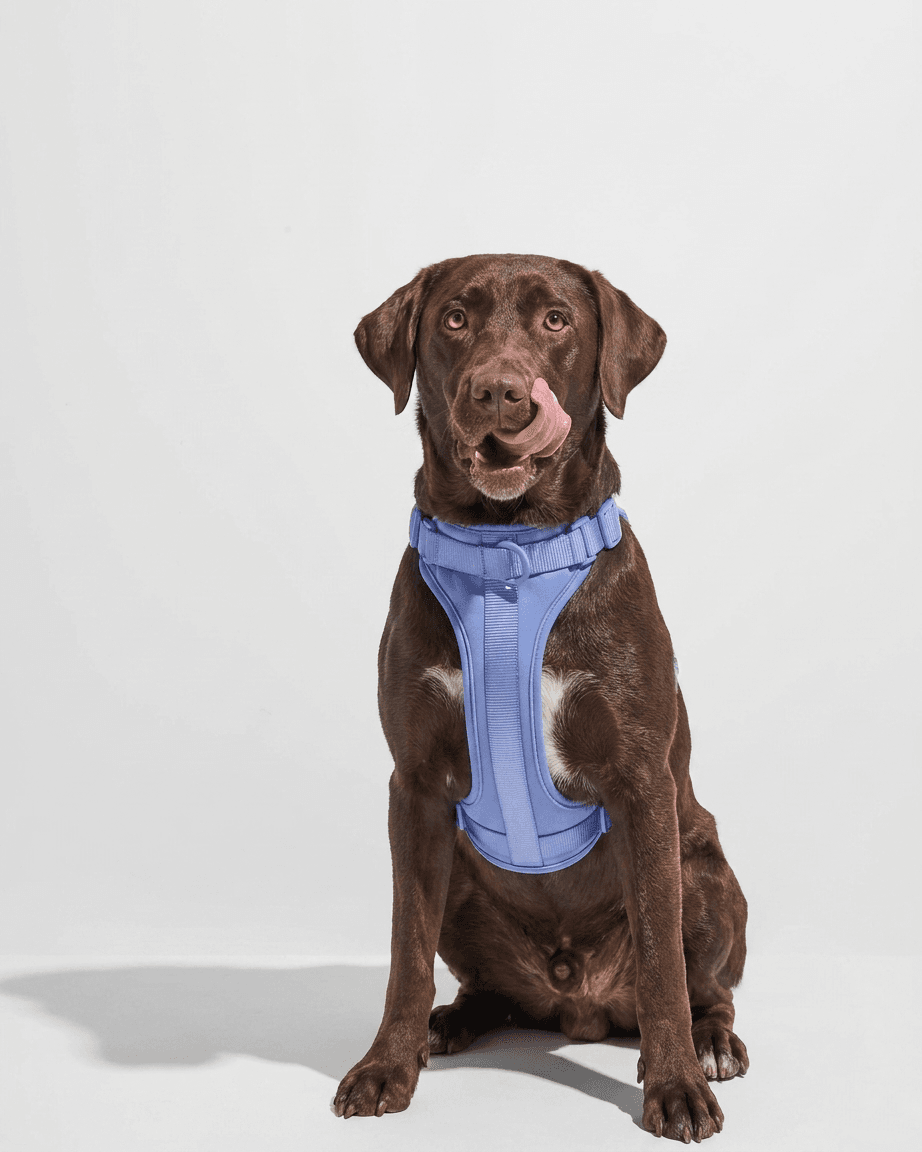
A Labrador’s ribcage is rounded and deep — often described as “barrel-chested” — which means the chest strap on a harness needs real circumference to wrap comfortably without digging in. A harness designed around a narrower, more tubular body shape can sit awkwardly on a Lab, with the chest strap riding up toward the armpits rather than sitting flat across the widest point.
The weight range within the breed is wider than most people expect. A lean field-line Labrador might sit around 25kg, while a heavier-set show-line Lab of the same height can comfortably be 35kg or more. Both are “normal” Labradors, but they can need different harness sizes — which is exactly why measuring your individual dog’s chest girth matters more than going by what size other Labrador owners say they bought.
The short coat is one thing working in your favour — there’s no thick fur to compress or fit through, so a measurement taken at skin level is straightforward and accurate. The two-finger rule applies cleanly on a Lab’s coat without the extra step of pressing through fur that double-coated breeds require.
Pulling Control for a Strong, Food-Driven Breed
Labradors are famously motivated by food, smell, and general enthusiasm for the world — which on a walk translates into a dog that commits fully toward anything that catches their interest. Unlike breeds that pull as a sustained default, a Lab’s pulling often comes in bursts: calm one moment, suddenly leaning hard toward a dropped chip or another dog’s dinner the next. That burst-style pulling puts a sudden load on the harness rather than constant tension.
A front-clip harness handles this well — when the sudden lunge happens, the front D-ring redirects the chest sideways, turning the dog rather than letting them power straight ahead toward the dropped chip. The redirect is most effective when the leash is kept reasonably short, so the mechanism engages early in the lunge rather than after the dog has already built up speed.
Because the load on the harness during these bursts can be significant — a 30kg dog committing suddenly generates real force — hardware quality matters more for Labs than it might for a smaller or calmer breed. For the full breakdown of front vs back clip use, see our front clip vs back clip guide.

Hardware That Survives Sudden Loads
The burst-pulling pattern common in Labradors is a different kind of stress than the sustained pulling of a Husky or a working breed, but it’s no less demanding on hardware — a sudden jolt can put as much instantaneous load on a D-ring or buckle as steady tension does over time.
Zinc alloy D-rings that don’t bend under sudden force
A plastic D-ring can crack or deform under a sharp, sudden lunge in a way it might tolerate fine under gradual sustained pulling. Zinc alloy holds its shape under sudden loads as well as sustained ones — important for a breed whose pulling pattern is unpredictable bursts rather than steady pressure.
A buckle that locks securely under impact
A sudden lunge tests the buckle’s lock just as much as the D-ring. A reinforced ABS quick-release buckle that clicks firmly into place and resists popping open under a sharp jolt matters for a breed that goes from calm to fully committed in a fraction of a second.
Metal sliders that hold the set fit
A sudden lunge can also test the adjustment sliders — a plastic slider under a sharp jolt can slip slightly, loosening the harness bit by bit over a walk full of small lunges. Metal tri-glide sliders grip the strap under sudden load and hold the set adjustment through a full walk of starts and stops.
Fit Issues Specific to Labradors
Chest strap riding into the armpits
On a barrel-chested Lab, a chest strap that’s slightly too high or too tight can ride up into the armpit area, causing chafing on longer walks. The chest strap should sit across the broadest part of the ribcage, just behind the front legs, with enough length to wrap that circumference without pulling up. If you notice rubbing in the armpit area after walks, the strap is likely sitting too high.
Sizing by weight alone
Given how much weight varies within the breed at the same height, a size chart based on weight ranges can put two genuinely different-shaped Labradors in the wrong size. Measure chest girth at the widest point and neck girth at the base of the neck, and use those two numbers against the size chart rather than weight alone.
Not re-checking fit as weight changes
Labradors are prone to weight fluctuation — both gain (a breed well known for never refusing food) and loss (during increased exercise periods, illness, or age-related muscle loss in seniors). A harness that fit well six months ago may need adjustment if your Lab’s weight has shifted. The two-finger rule is a quick monthly check that catches this before it becomes a fit problem.
Sizing for a Labrador Puppy
Labrador puppies go through one of the more dramatic growth curves of any breed — often tripling or more in weight between three and six months old, and continuing to fill out in chest depth and overall mass well into their second year. A harness bought for an 8-week-old Lab puppy will be comically small by the time they’re six months, and likely needs at least one size change before they reach adult size.
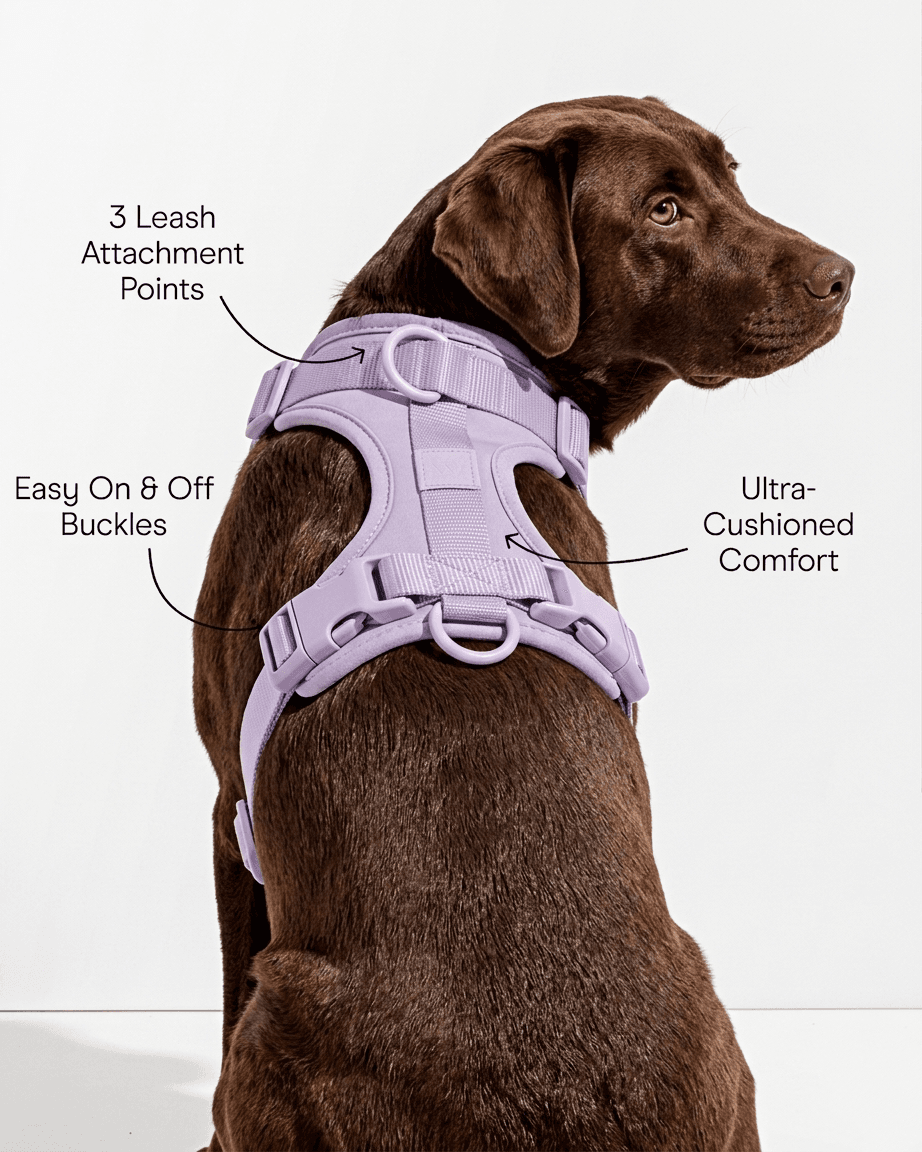
During the fastest growth period — roughly three to seven months — check the two-finger fit weekly rather than monthly. A harness with generous adjustment range on all three straps gives you more runway before a size change is needed, since you can start with the straps tightened to their smallest setting and loosen progressively as the puppy grows. Full details in our dog harness size guide.
A Harness Built for Sudden Strength and Daily Use
The MoonianPet No-Pull Dog Harness uses zinc alloy D-rings, metal tri-glide sliders, and a reinforced ABS quick-release buckle — hardware that holds up to a Labrador’s sudden bursts of pulling as well as steady daily wear. Three-point independent adjustment lets you fit a barrel-shaped chest correctly without the strap riding into the armpits, and the range covers everything from a lean field-line Lab to a heavier show-line build. Available in five sizes from XS to XL and 11 colours.
For a matched everyday setup, the Harness & Leash Set pairs the harness with a heavy-duty PVC-coated leash — built to handle sudden tension from a determined Lab without fraying.
Frequently Asked Questions
What size harness does a Labrador need?
It depends heavily on the individual dog — Labradors range from around 25kg for a lean field-line dog to 35kg or more for a heavier-set show-line dog at similar heights, which can mean a size L versus a size XL. Measure your dog’s chest girth at the widest point and neck girth at the base of the neck, then check against the size chart rather than going by weight or what size other Lab owners chose. Full chart in our dog harness size guide.
Do Labradors pull a lot on the leash?
Many do, though the pattern is often different from breeds that pull constantly — Labs tend to be calm until something genuinely interesting (food, another dog, a smell) triggers a sudden, committed lunge. A front-clip harness handles this well by redirecting the chest sideways during the lunge, though the sudden nature of the pulling means hardware quality matters more than it might for a breed with steady, predictable pulling.
My Lab’s harness chafes under the front legs — what’s wrong?
This usually means the chest strap is sitting too high, riding into the armpit area instead of across the broadest part of the ribcage. Loosen the chest strap slightly and check that it sits across the widest point of the chest, just behind the front legs, with enough length to wrap that circumference comfortably. Persistent chafing after adjustment may mean the harness is a size too small overall.
How fast do Labrador puppies outgrow a harness?
Labrador puppies grow rapidly, often tripling their weight between three and six months old. A harness with generous adjustment range can accommodate some of this growth, but most Lab owners need at least one harness size change between puppyhood and adult size. Check the two-finger fit weekly during the three-to-seven-month growth window.
My Labrador has gained weight — do I need a new harness?
Not necessarily, if the harness has adjustment range left. Check the two-finger rule on all three straps — if you can no longer fit two fingers comfortably under any strap even at the loosest setting, the harness has reached its limit and a size up is needed. Labradors are prone to weight fluctuation, so a periodic fit check is worth building into your routine regardless of any obvious weight change.
For step-by-step fitting guidance covering every strap adjustment, see our no-pull harness fitting guide. For more on managing pulling specifically, our leash training guide covers the stop-and-reward method that works well alongside a front-clip harness.
Wenyue
Wenyue is the founder of MoonianPet and writes about dog collars, harnesses, waterproof pet gear, and everyday dog care. Growing up with dogs inspired her lifelong interest in pet care and practical dog gear. Through MoonianPet, she researches dog collars, harnesses, waterproof materials, and everyday solutions that help active dogs stay comfortable during daily adventures.