
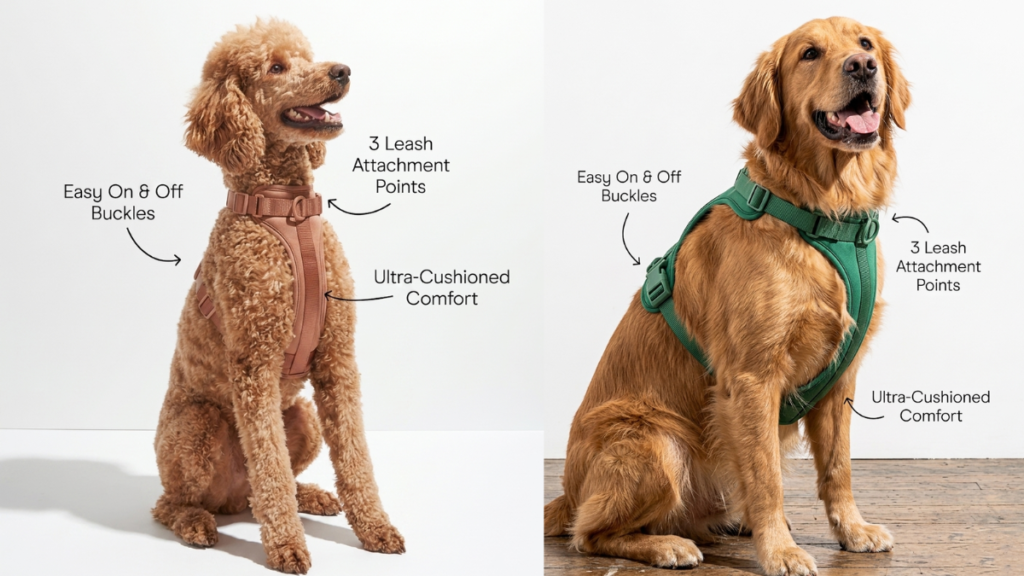
A large dog that pulls is a different problem from a small dog that pulls. The physics are different, the stakes are different, and the harness requirements are different. A 70-pound Husky or German Shepherd putting their full body weight into a leash is not just uncomfortable — it can pull a handler off balance, cause joint strain over time, and make walks genuinely unpleasant for everyone involved.
Most no-pull harnesses are designed and tested on medium-sized dogs. When the same harness is scaled up to a large or extra-large size, the proportions often stop working — the chest piece sits in the wrong place, the straps do not adjust enough to stay snug on a deep chest, and the hardware is not rated for the forces a strong dog generates.
This guide covers what to look for in a no-pull harness for large dogs, which features matter most for strong pullers, and how to get the fit right on common large breeds.
Why Large Dogs Need a Different Approach
The core challenge with large dog harnesses is force management. A 60–80 pound dog pulling at full effort generates forces that a lightweight harness simply cannot handle — buckles flex, straps stretch, and D-rings rotate out of position. What works fine on a 25-pound Beagle becomes a safety issue on a dog three times that size.
Large dogs also tend to have more variation in body shape than smaller breeds. A Golden Retriever and a German Shepherd might both wear a size L, but their chest depth, shoulder width, and neck-to-chest ratio are completely different. A harness that fits one perfectly may not fit the other at all — which is why adjustment range matters more on large dogs than on small ones.
For a full comparison of collar vs harness for large dogs that pull, see our collar vs harness guide. For large pullers specifically, a front-clip no-pull harness is almost always the right choice.
What to Look for in a No-Pull Harness for Large Dogs
These are the features that genuinely matter when you are buying for a large or extra-large breed:
Heavy-duty hardware rated for large dogs
The D-rings, buckles, and adjustment sliders need to be built for the forces a large dog generates. Zinc alloy hardware is significantly stronger than the plastic or lightweight metal used in many standard harnesses. Check that the front D-ring in particular is reinforced — this is the attachment point taking the most stress when a large dog pulls.
Wide adjustment range at chest and neck
Large breeds vary enormously in body shape. The MoonianPet L size adjusts from 28.0–38.6″ chest girth and the XL from 28.0–40.2″ — a wide enough range to accommodate everything from a lean Vizsla to a deep-chested Rottweiler. A harness that only adjusts within a narrow range will never fit correctly on a breed at either end of the spectrum.
A front D-ring that stays centered under load
The no-pull effect depends entirely on the front D-ring staying centered on the chest when the dog pulls. On a large dog generating significant force, a poorly constructed harness will allow the D-ring to rotate sideways — at which point it no longer redirects pulling, it just applies uneven pressure. Look for a harness where the chest strap construction keeps the D-ring locked in the center position.
Padding that covers the right contact areas
On large dogs, the chest piece and the underarm pass-through areas carry the most pressure during a walk. Neoprene padding at these points prevents chafing and makes the harness comfortable for longer walks. Thin mesh padding compresses quickly under the load of a large dog — neoprene holds its shape and cushioning properties significantly longer.

Large Dog Harness Size Chart
Measure chest girth first — wrap the tape around the widest point of the chest, just behind the front legs, with your dog standing. This is the measurement that determines fit. If chest and neck measurements suggest different sizes, always go with the larger.
| Size | Chest Girth ⭐ | Neck Girth | Weight | Best For |
|---|---|---|---|---|
| L | 28.0–38.6″ 71–98 cm |
16.5–20.5″ 42–52 cm |
229g / 8.1oz | Labrador, Border Collie, Dalmatian, Staffy, Vizsla |
| XL | 28.0–40.2″ 71–102 cm |
18.9–27.6″ 48–70 cm |
310g / 10.9oz | Golden Retriever, Husky, German Shepherd, Rottweiler, Great Dane |
* When between sizes, always size up. The tri-glide adjustment system means a larger size can still be tightened to a precise fit.
Breed-Specific Advice for Common Large Breeds
German Shepherd
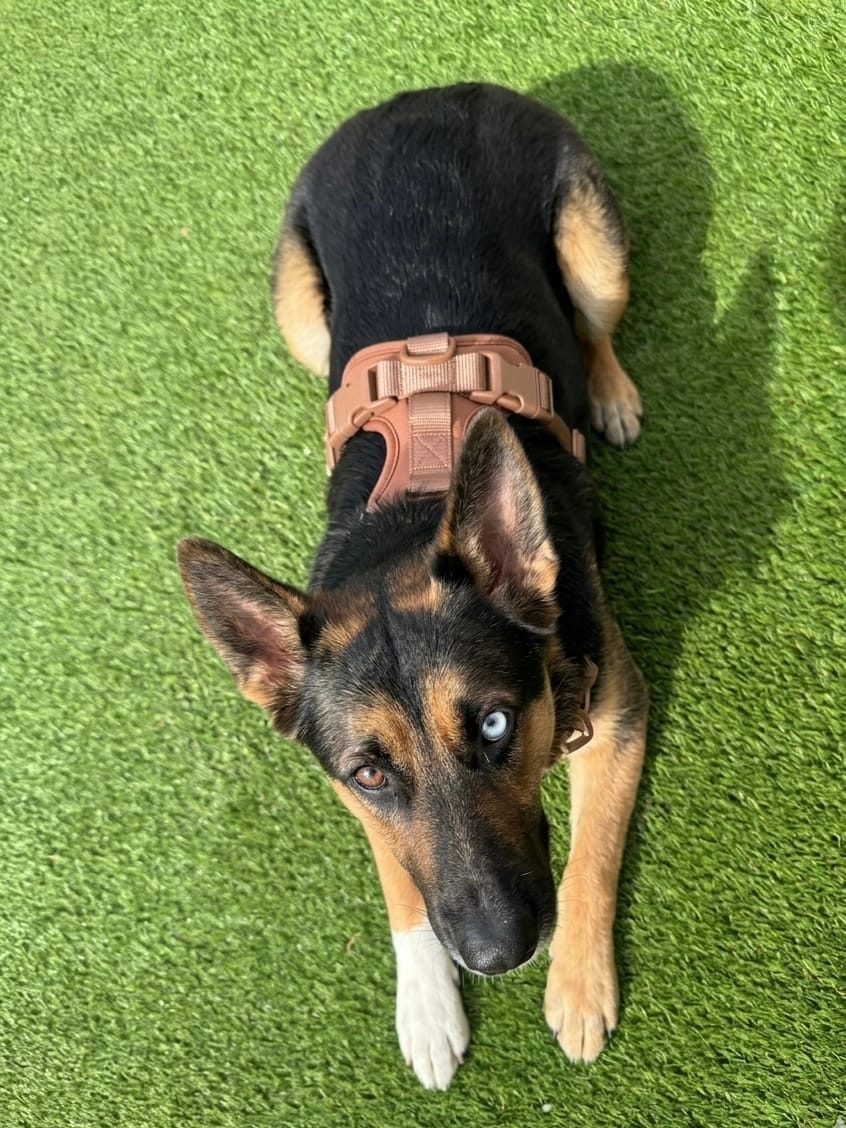
German Shepherds have a deep, sloped chest and a relatively narrow waist. Most fit XL, but measure the chest carefully — some lean-bodied German Shepherds fit L. The front clip is particularly effective on GSDs because their herding instinct makes them responsive to directional cues — the redirection from a front clip aligns with how they naturally process movement feedback.
Husky
Huskies are built to pull — literally. Their body is designed to generate sustained forward force, which means a no-pull harness on a Husky needs to be fitted very precisely and used consistently. Start with the front clip and keep the leash relatively short so the redirection kicks in before momentum builds. Most Huskies fit XL; some females fit L. Their thick double coat can compress significantly, so measure through the fur.
Golden Retriever
Goldens are enthusiastic pullers rather than determined ones — they pull because they are excited, not because they are trying to dominate the walk. The front clip works well because their natural people-orientation means they respond quickly to the redirection cue and look back at the handler. Most Goldens fit XL; the neoprene padding is a good match for their active lifestyle and tendency to swim or get wet on walks.
Labrador Retriever
Labs are strong, food-motivated, and often responsive to training — which makes the front clip harness a good combination with reward-based leash training. Most Labs fit L or XL depending on their build. Male Labs tend to run larger and may need XL; females often fit L comfortably. Check the chest strap is snug enough that it does not slide down the front legs during a walk.
Rottweiler
Rottweilers are heavy, muscular dogs with a very wide, deep chest. Hardware quality matters more on a Rottweiler than on almost any other breed — the forces involved are significant. The XL size with zinc alloy hardware is the right choice. Make sure the chest strap is sitting just behind the front legs, not pressing into the armpits, and that the front D-ring is locked in the center before each walk.
How to Get the Fit Right on a Large Dog
Fitting a harness on a large dog follows the same principles as any size — but the consequences of a poor fit are more significant because the forces involved are larger. Run through these checks every time:
✅ Two fingers under every strap
The two-finger rule applies to every strap — neck, chest, and belly. On a large dog, it is tempting to leave straps slightly looser than they should be because the dog feels so solid. Resist this — a loose harness on a large dog rotates and loses its no-pull effectiveness faster than on a small dog.
✅ Front D-ring centered and flat on the chest
Before you clip the leash, check that the front D-ring is sitting flat and centered on the sternum. Walk your dog a few steps and check again — if it has rotated to one side, tighten the chest strap evenly on both sides before continuing.
✅ Chest strap sits just behind the front legs
The chest strap should pass just behind the front legs — not pressing into the armpits, not sliding down toward the feet. On large breeds with deep chests, this strap can ride up or down depending on how the harness is adjusted. Get it positioned correctly before tightening.
✅ Re-check after the first few walks
Harness straps settle slightly with the first few uses, particularly on large dogs where the material is under more consistent tension. Re-check all three adjustment points after the first three walks and make any small corrections needed.
For the complete step-by-step fitting guide, see our post on how to put on a no-pull dog harness. For measurement instructions, the dog harness size guide covers chest and neck girth in under two minutes.

A No-Pull Harness Built for Large Dogs
The MoonianPet No-Pull Dog Harness is available in L and XL with zinc alloy hardware, a reinforced front D-ring, and 3-point tri-glide adjustment that accommodates the wide range of body shapes found in large breeds. The neoprene padding holds up to the sustained pressure of a large dog’s daily walks without compressing or shifting out of position.
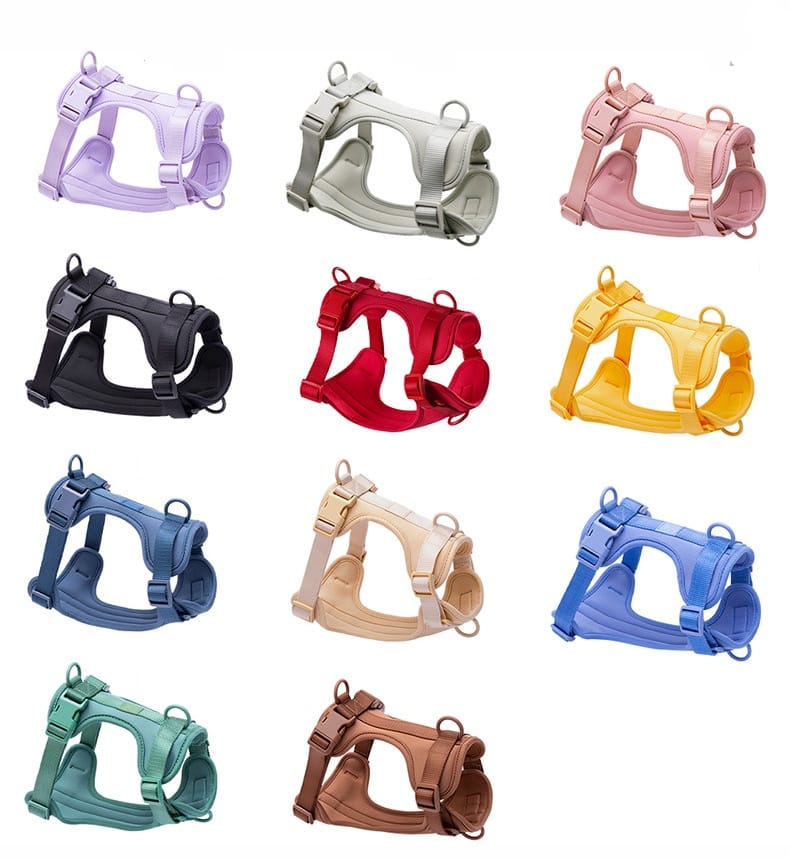
Available in 11 colors. Pair with the MoonianPet Waterproof Leash — rated for large dogs and built from the same heavy-duty coated webbing used in working dog equipment. Or save with the Harness & Leash Set.

Frequently Asked Questions
Will a no-pull harness work on a very strong large dog?
Yes — the front clip works on any size dog because it operates on physics rather than strength. When a dog pulls forward against a front clip, the leash redirects their momentum sideways regardless of how strong they are. The key is that the harness must fit correctly and the front D-ring must stay centered. A loose harness on a strong dog loses its effectiveness because the D-ring rotates out of position under load.
My large dog keeps slipping out of harnesses. What size should I get?
Slipping out usually means the harness is too large or too loose. Measure chest girth first — this is the primary sizing measurement. Make sure you can fit two fingers under the chest strap and the neck strap, but not three. If your dog is consistently escaping, check that the quick-release buckle is fully locked — it should click firmly into place and resist a direct upward pull.
Is L or XL right for my dog?
Measure chest girth and match it to the chart. The L covers 28.0–38.6″ chest girth and the XL covers 28.0–40.2″. If your dog falls in the overlapping range, go XL — the wider adjustment range on XL gives you more room to fine-tune the fit. For specific breeds: most German Shepherds, Huskies, Golden Retrievers, and Rottweilers fit XL; Labradors and Border Collies vary between L and XL depending on their build.
Can I use the harness for running with my large dog?
For running, use the back clip rather than the front clip. The front clip creates a turning force every time the leash goes taut, which is helpful for discouraging pulling on walks but disruptive at running pace. The back clip allows your dog to move freely and naturally at speed. Switch back to the front clip for regular walks if pulling is still an issue.
How long will it take for my large dog to stop pulling?
Most dogs show improvement within the first few front-clip walks as they learn that pulling no longer gets them where they want to go. Consistent improvement typically takes two to four weeks of daily use. Large breeds that have been pulling for years may take longer — the habit is more ingrained. Combining the front clip harness with reward-based training (stopping and rewarding loose leash walking) speeds up the process significantly.
Want to understand the difference between front and back clip harnesses? See our front clip vs back clip guide. Or if you are still finding the right size, our dog harness size guide walks through measuring in under two minutes.
About the Author
Wenyue
Wenyue is the founder of MoonianPet and writes about dog collars, harnesses, waterproof pet gear, and everyday dog care.
Growing up with dogs inspired her lifelong interest in pet care and practical dog gear. Through MoonianPet, she researches dog collars, harnesses, waterproof materials, and everyday solutions that help active dogs stay comfortable during daily adventures.
HarnessFront Clip vs Back Clip Dog HarnessWhich stops pulling better and when to use each.
HarnessDog Harnesses for Small DogsFit guide and breed-specific advice for small breeds.
Fit and UseCollar vs HarnessWhen to use each and what changes for pullers and puppies.
HarnessDog Harness Size GuideFull XS–XL size chart with neck and chest measurements.
HarnessBest Harness for Dogs That PullWhat to look for and why most harnesses fall short.
MaterialsBioThane vs Leather Dog CollarA straight comparison between two premium collar materials.
MaterialsBest Dog Collar MaterialNylon vs leather vs coated webbing — which actually lasts?