
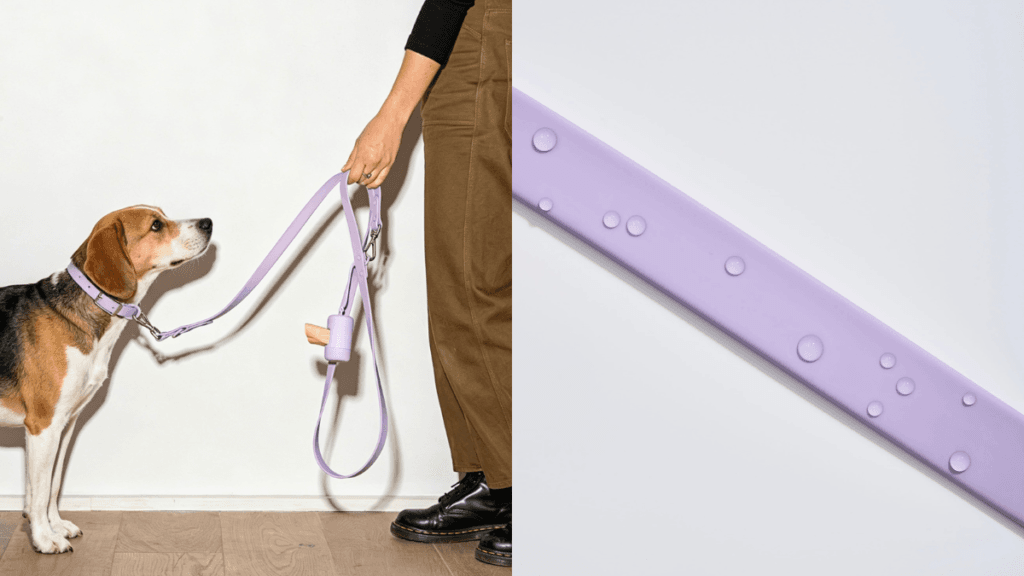
Water resistant and waterproof are not the same thing — but in the dog collar market, the two terms are used almost interchangeably, and the distinction rarely gets explained clearly. A collar listed as water resistant might handle light rain perfectly well and smell within a month of regular use. A collar listed as waterproof might mean the hardware will not rust, but the webbing still absorbs water and odour freely.
For owners of active dogs — dogs that swim, walk in rain, roll in mud, or simply sweat heavily on long summer walks — the difference between a collar that repels water and one that genuinely does not absorb it is significant. It shows up in how the collar smells after two months, how the webbing holds its shape after repeated soaking, and whether you are replacing the collar every year or every three years.
This guide explains what the terms actually mean, how different collar materials perform when wet, and what to look for if you need a collar that handles water properly.

What Water Resistant and Waterproof Actually Mean
In electronics, the terms water resistant and waterproof have standardised IP ratings that define exactly how much water exposure a product can handle. In the dog collar market, there are no equivalent standards — manufacturers use both terms loosely, and the actual performance varies considerably between products using the same label.
As a practical guide:
Water resistant
The collar repels surface moisture to some degree — light rain beads off rather than immediately soaking in. The material may have a DWR (durable water repellent) coating applied to a fabric base, or it may be a tighter weave that resists initial wetting. Water resistance degrades with washing and UV exposure, and the underlying material will eventually absorb water once the surface treatment is compromised. Most nylon collars marketed as water resistant fall into this category.
Waterproof
The material does not absorb water at all — not on the surface, not over time, not after repeated soaking. True waterproofing is a property of the material itself, not a coating applied to it. PVC-coated webbing (BioThane-style coated webbing) is genuinely waterproof in this sense — the PVC coating is non-porous and water cannot penetrate it regardless of how long it is submerged or how many times it gets wet. A collar that is waterproof on day one remains waterproof on day one thousand.
How Different Collar Materials Perform When Wet
Nylon — absorbs water, develops odour
Standard nylon absorbs water readily and takes time to dry. When wet repeatedly — through swimming, rain walks, or simply the moisture from a dog’s coat — nylon traps bacteria in its fibres. This bacterial growth is what produces the characteristic wet dog collar smell that most nylon collar owners know well. Washing helps temporarily but does not eliminate the bacteria embedded in the fibres. Over time, the smell becomes permanent. Nylon collars marketed as water resistant have a surface treatment that slows initial absorption but does not solve the underlying odour problem for active dogs.
Leather — not waterproof, requires maintenance
Untreated leather absorbs water significantly and softens when wet, which can cause it to stretch slightly and affect the fit. Repeated soaking and drying stiffens leather and accelerates cracking without regular conditioning. Waxed or treated leather handles occasional light rain better than untreated leather but is still not suitable for dogs that swim regularly. Leather does not develop the same bacterial odour as nylon but can develop mildew if it stays wet for extended periods without drying properly.
PVC-coated webbing — genuinely waterproof
PVC-coated webbing has a solid polymer coating over a woven core. The coating is non-porous — water cannot penetrate it, bacteria cannot embed in it, and odour cannot accumulate in it. The collar can be submerged, soaked in mud, and exposed to salt water repeatedly without any effect on the material. Cleaning requires nothing more than a wipe with a damp cloth. The colour and texture remain consistent over years of use because there is no surface treatment to degrade. This is why coated webbing is the material of choice for working dog equipment, water sports, and marine applications — and why it is the most durable option for active dogs in wet conditions.

Why It Matters in Practice
The difference between water resistant and waterproof shows up in four practical ways for active dog owners:
Odour
A water resistant nylon collar on a dog that swims twice a week will smell noticeably within four to six weeks. The odour comes from bacteria growing in the damp fibres — washing slows it but does not eliminate it once embedded. A waterproof PVC-coated collar on the same dog does not develop odour at all, because bacteria have no porous surface to colonise. For owners of dogs that get wet regularly, this is the most immediately noticeable difference. For more detail on why collars smell and how material affects it, see our guide on why dog collars smell.
Shape and fit retention
Nylon webbing softens when repeatedly soaked and dried, which causes it to stretch slightly over time. A collar that fit snugly when new may need to be tightened by one or two adjustment holes after six months of regular swimming. PVC-coated webbing does not soften or stretch — the collar maintains its adjusted fit indefinitely because the material does not change with water exposure.
Cleaning effort
A water resistant nylon collar after a muddy walk needs to be soaked, scrubbed, and air-dried — a process that takes time and still leaves residual smell over many washes. A waterproof PVC-coated collar after the same muddy walk needs a thirty-second wipe with a damp cloth. For owners who walk in varied terrain daily, the maintenance difference over a year is significant.
Lifespan
A nylon collar on an active outdoor dog typically needs replacing every twelve to eighteen months as odour becomes permanent, the material stiffens, and the hardware corrodes from repeated moisture exposure. A PVC-coated collar on the same dog can last three to five years with no degradation, because the material is not affected by the conditions that degrade nylon. The higher upfront cost of a coated webbing collar pays for itself within the first replacement cycle.

When Water Resistant Is Enough
Not every dog needs a fully waterproof collar. Water resistance is adequate in some situations:
Indoor dogs or low-activity dogs
A dog that walks briefly on dry days and spends most of its time indoors will not put enough moisture stress on a collar to make waterproofing a priority. A water resistant nylon collar will perform adequately for years under these conditions.
Dry climates with occasional rain
In climates where rain is infrequent and the dog rarely gets fully wet, the odour and degradation issues of nylon develop much more slowly. Water resistance handles light, occasional moisture exposure without the need for full waterproofing.
Dogs that do not swim and are bathed infrequently
Dogs that are bathed every few weeks at most and do not swim will not expose the collar to enough repeated soaking for the odour and shape-retention issues to become pronounced. In this scenario, water resistance is a useful feature but full waterproofing is not essential.
What to Look for in a Truly Waterproof Collar
PVC-coated or BioThane-style webbing
Look for collars that specifically describe the material as PVC-coated webbing, coated webbing, or BioThane-style. These terms indicate a polymer coating over a woven core — the material that is genuinely waterproof rather than water resistant. “Waterproof nylon” is a marketing term for treated nylon, not true waterproofing. For a full material comparison, our collar material guide covers every option in detail.
Rust-proof hardware
Even if the collar material is waterproof, hardware that rusts will fail. Zinc alloy D-rings and buckles resist corrosion even with repeated salt water and fresh water exposure. Stainless steel is also rust-proof. Avoid collars with chrome-plated hardware — the chrome layer chips and the underlying metal rusts from the inside out, particularly with salt water exposure.
Odour-proof claim with material evidence
A collar can only be genuinely odour-proof if the material does not absorb moisture. If a product claims to be odour-proof but the material is nylon or fabric, the claim is not supportable — bacteria grow in any porous wet material. An odour-proof claim on a PVC-coated collar is accurate and verifiable: the material is non-porous and bacteria have nowhere to grow. See our detailed explanation in the guide on why collars smell after swimming.
100% Waterproof — Not Water Resistant
The MoonianPet Waterproof Dog Collar is made from PVC-coated webbing — genuinely waterproof, not water resistant. The non-porous coating means it does not absorb water, does not develop odour, and does not degrade with repeated soaking. Zinc alloy hardware throughout resists corrosion in fresh and salt water. Available in 11 colors and 5 sizes from XS to XL.
For a fully matched waterproof setup, the Collar & Leash Set pairs the collar with a PVC-coated leash in the same color — the same waterproof material, the same hardware, the same odour-free performance on every walk.

Frequently Asked Questions
What is the difference between water resistant and waterproof for dog collars?
Water resistant means the collar repels surface moisture temporarily — usually through a coating applied to a fabric base. Waterproof means the material itself does not absorb water at all. PVC-coated webbing is genuinely waterproof; treated nylon is water resistant. The practical difference shows up in odour, shape retention, and lifespan after repeated soaking.
Why does my waterproof collar still smell?
If a collar marketed as waterproof still develops odour, it is almost certainly water resistant rather than truly waterproof — the underlying material is absorbing moisture and harbouring bacteria even if the surface initially repels water. A PVC-coated collar that is genuinely non-porous does not develop odour because bacteria have no wet porous surface to grow on. For a full explanation, see our guide on why dog collars smell.
Is BioThane waterproof or water resistant?
BioThane and BioThane-style PVC-coated webbing are genuinely waterproof — the polymer coating is non-porous and water cannot penetrate it regardless of exposure duration. This is why BioThane is widely used in working dog equipment, equestrian tack, and marine applications where true waterproofing is a functional requirement rather than a marketing claim. Our BioThane vs leather comparison covers the full material difference.
Can my dog wear a waterproof collar in salt water?
Yes — a PVC-coated collar handles salt water without any material degradation. The coating does not absorb salt, and the collar wipes clean with fresh water after a beach swim. The hardware needs to be rust-proof — zinc alloy or stainless steel — for repeated salt water exposure. Chrome-plated hardware will eventually corrode in salt water even if the collar material is waterproof.
How do I clean a waterproof dog collar?
A PVC-coated waterproof collar needs nothing more than a wipe with a damp cloth. For mud or heavier soiling, a quick rinse under running water and a wipe clean takes under a minute. There is no need to soak, scrub, or machine wash — and because the material is non-porous, there is no embedded odour to remove. For a full comparison of cleaning methods by collar material, see our collar cleaning guide.
Looking for the best waterproof collar for a dog that swims regularly? Our swimming dog collar guide covers what to look for in detail. Or if you want to understand all the collar material options side by side, see our complete collar material guide.
About the Author
Wenyue
Wenyue is the founder of MoonianPet and writes about dog collars, harnesses, waterproof pet gear, and everyday dog care.
Growing up with dogs inspired her lifelong interest in pet care and practical dog gear. Through MoonianPet, she researches dog collars, harnesses, waterproof materials, and everyday solutions that help active dogs stay comfortable during daily adventures.