
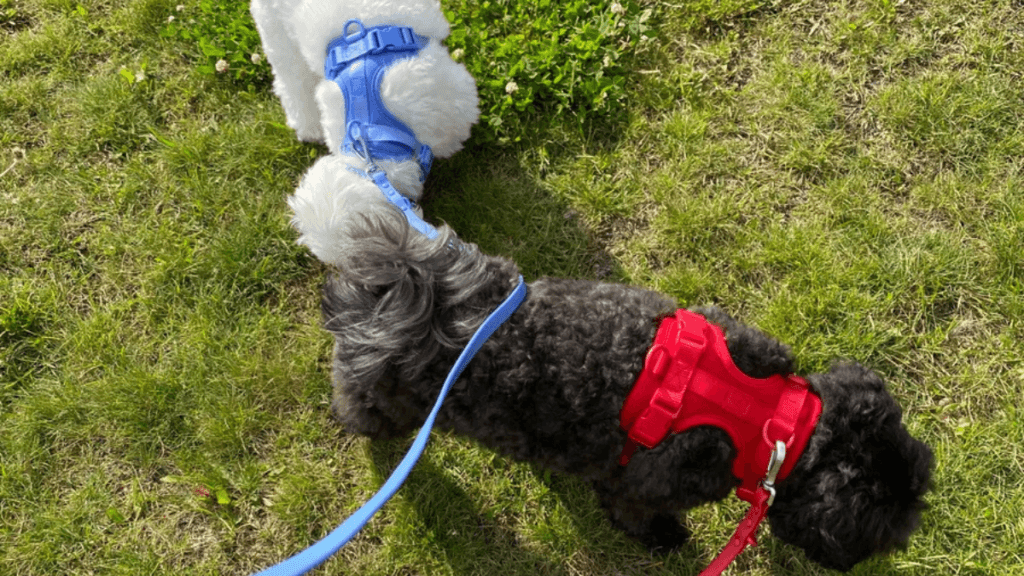
Walking two dogs at once sounds manageable until you are actually doing it — one leash wrapped around your left leg, the other dog lunging at a squirrel, and both leads somehow tangled into a single knot around a lamp post. If this sounds familiar, the problem is almost never the dogs. It is the setup.
Two dogs can be walked together comfortably and without constant chaos — but it requires the right equipment, some thought about how you hold everything, and a bit of individual training before the two dogs are asked to manage the distraction of each other’s presence simultaneously.
Here is what actually works.

Two Leashes or a Coupler: Which Is Better?
The first decision most two-dog owners face is whether to use two separate leashes or a coupler — a short Y-shaped attachment that connects two dogs to a single leash. Both work, but they work differently and suit different situations.
Two separate leashes
Two leashes give you independent control of each dog — you can stop one without stopping the other, correct one without affecting the other, and adjust pace for each dog individually. This is more to manage in your hands, but it is genuinely more versatile. For dogs with different walking speeds, different training levels, or different reactions to triggers, separate leashes are the more practical choice. The challenge is holding both comfortably without them tangling, which is mostly a technique issue covered below.
A coupler
A coupler connects both dogs to one leash, which frees up a hand but means you cannot respond to each dog independently. If one dog stops suddenly, both stop. If one dog pulls, both feel the correction. Couplers work well for two dogs of similar size and similar walking pace who already walk well individually — they are much less effective when the dogs have different energy levels, different training levels, or when either dog pulls. For most multi-dog households, especially in the early stages of walking together, separate leashes give more control.
How to Hold Two Leashes Without Tangling
The tangle problem is almost always a grip problem. Most people hold two leashes the same way they would hold one — looped around the wrist or gripped in a bundle — which gives the dogs too much slack to cross in front of each other and creates tangles within the first hundred metres.
One dog on each side
The most reliable position is one dog on your left and one on your right, each walking at roughly your hip. This keeps the leashes on opposite sides of your body and minimises the angles at which they can cross. It requires both dogs to be comfortable walking on either side, which most dogs adapt to quickly if introduced gradually. The trade-off is that you are walking a wider path — plan for this on narrow pavements.
Both dogs on one side, different hand positions
If one-dog-each-side is not possible — narrow pavements, a dog that will not walk on one side — hold both leashes in one hand but at different lengths. The dog closer to you holds a shorter leash; the dog further out holds a longer one. This keeps them from crossing in front of each other as readily and gives you the other hand free. It is harder to manage a sudden lunge from the outer dog, but workable for calm walkers.
Use shorter leashes than you normally would
The standard 1.8m leash that works fine for one dog gives each of two dogs more slack than you can manage comfortably together. A 1.2m leash for each dog reduces the tangling radius significantly and keeps both dogs closer to you, which is where you want them when managing two. Once the walk is under control, longer leashes are an option — but start shorter.
Train Each Dog Individually First
This is the step that most multi-dog owners skip, and it is the reason walking two dogs together feels so difficult. A dog that pulls when walked alone will pull harder when walked with another dog — the excitement and distraction compound each other. A dog that walks well individually has a behaviour baseline you can build on; a dog that does not walk well individually has nothing to build on when the second dog is added.
Before attempting to walk both dogs together regularly, spend two to three weeks walking each dog separately with focus on loose-leash walking. The stop-and-wait technique — stopping the moment the leash goes taut and only moving again when it slackens — is the most reliable method for this. Once each dog understands the rule independently, introducing the two-dog walk becomes significantly more manageable because you are not trying to teach two dogs simultaneously while managing the physical reality of two leashes.
For the full approach to loose-leash training, our guide on how to stop a dog from pulling on the leash covers the techniques in detail — all of them apply equally to individual training sessions before the dogs walk together.
Introducing the Two-Dog Walk Gradually
Even two dogs that walk perfectly individually may behave differently together — excited by each other’s presence, distracted, or competitive for your attention. A gradual introduction works better than simply putting both dogs on leash and heading out.
Start in a familiar, low-distraction area
Begin the first few two-dog walks on a quiet, familiar route — somewhere neither dog is particularly excited about. This lowers the overall stimulation level and gives you the best chance of establishing the walking pattern before adding complexity. Save the park or the interesting route for when the two-dog walk is already running smoothly.
Keep the first walks short
Ten to fifteen minutes for the first few two-dog walks is enough. You are establishing a pattern, not getting exercise. A short walk that goes well is more useful than a long walk that degenerates into chaos halfway through — the dogs learn the routine from the parts that work, not from the parts where you lost control.
Reward both dogs for walking calmly together
Carry treats for both dogs and reward when both are walking alongside you on a loose leash. The reward needs to go to both dogs simultaneously — rewarding one while the other is ignored creates competition and pulling toward you. A treat in each hand, delivered at the same moment, keeps both dogs rewarded for the same calm behaviour.
What Happens When One Dog Pulls
The most common two-dog walking problem is one dog pulling while the other walks calmly — and the pulling dog affecting the calm dog’s behaviour through leash tension and excitement.
When one dog pulls on two separate leashes, stop walking. Both dogs stop. Wait for the pulling dog to release tension before moving again — the calm dog will quickly learn that the pulling dog causes the walk to stop, which adds a social motivation to the calm behaviour that does not exist when the dogs walk separately.
A front-clip no-pull harness on the pulling dog makes this significantly more manageable — the sideways redirection reduces the physical force of the pull and makes stopping more effective than trying to hold back a dog pulling straight forward. For the calm dog, a standard back-clip attachment is fine. Mixing attachment points between the two dogs is perfectly workable.
The Right Gear for Two-Dog Walks
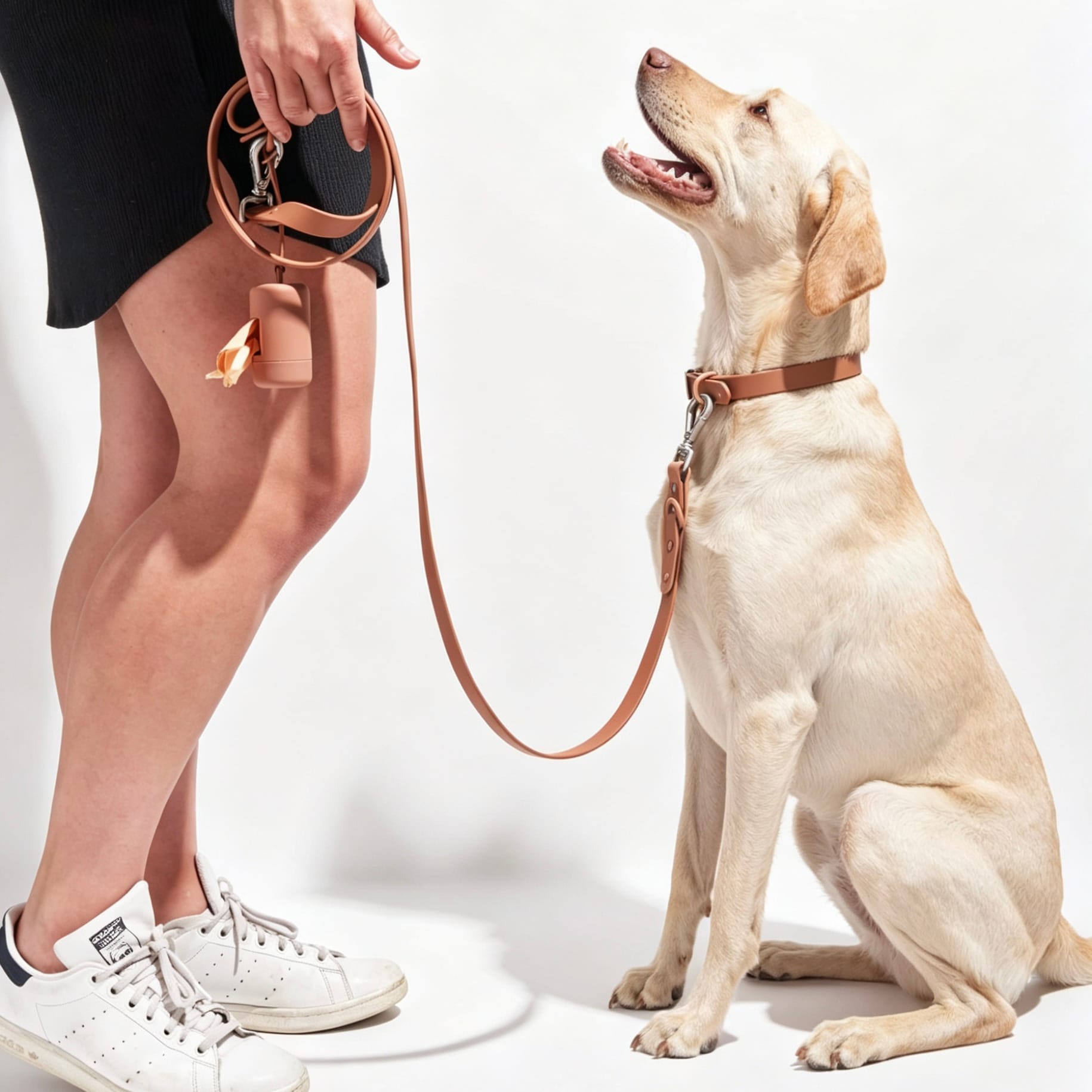
The gear that works best for two-dog walking is the same gear that works for single-dog walking — just doubled up, with a few practical considerations:
Matched leash lengths
Using the same leash length for both dogs keeps the management consistent — you always know which hand has how much slack. Mismatched lengths (one 1.2m, one 1.8m) create a situation where one dog always has more freedom than the other, which typically means the dog on the longer leash pulls more and crosses in front more often.
Comfortable handles for sustained grip
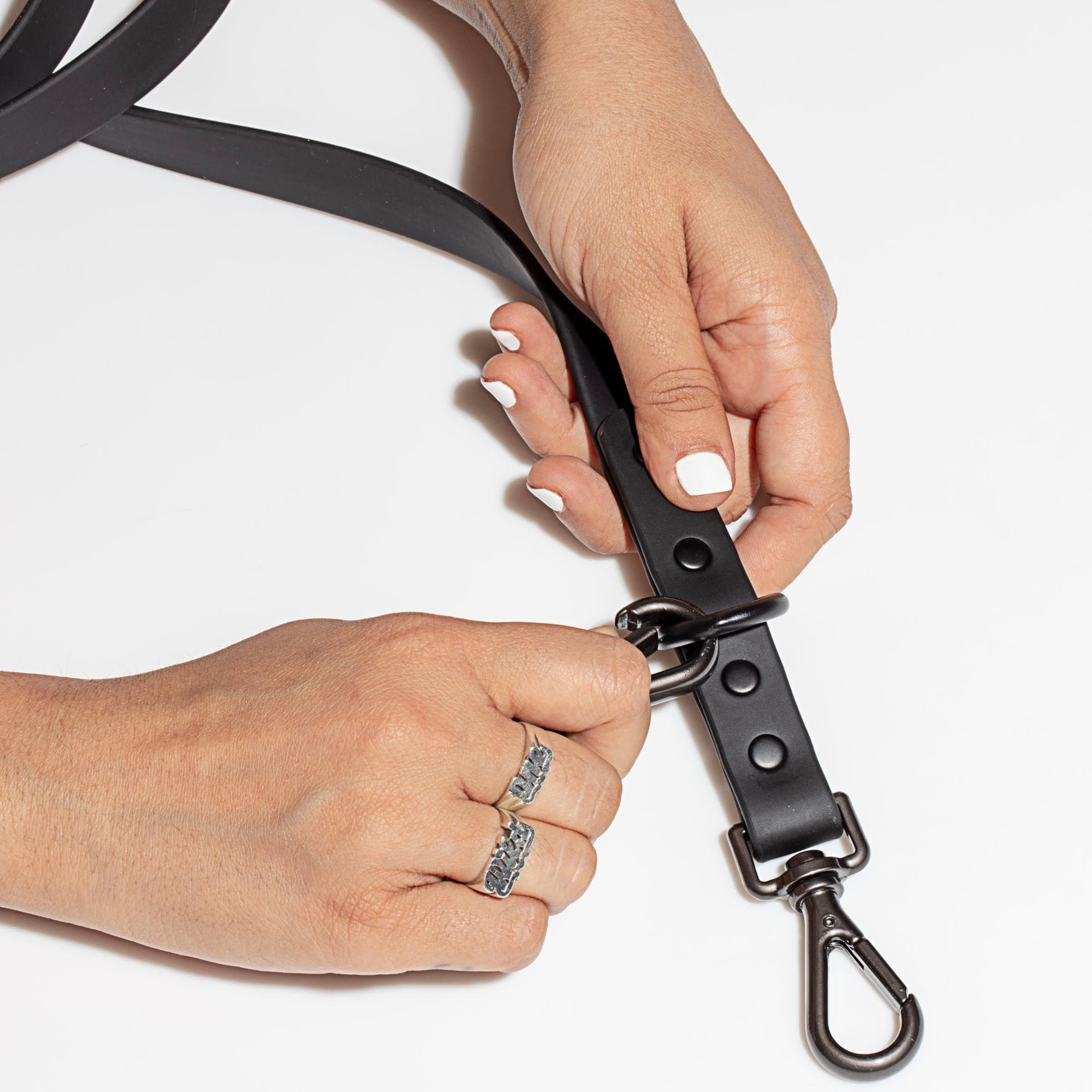
Holding two leashes for a thirty-minute walk puts more pressure on the hands than holding one. A leash with a padded or reinforced handle makes this significantly more comfortable — rope handles and thin fabric handles become uncomfortable quickly when you are managing two dogs simultaneously. The 360-degree rotating clip on the leash also prevents the twisting that accumulates when two active dogs change direction repeatedly.
No-pull harness for the puller
If one dog pulls and the other does not, a front-clip no-pull harness on the pulling dog and a collar or back-clip harness on the calm dog is a practical combination. You are addressing the pulling problem specifically without changing the setup for the dog that is already walking well. The front clip redirects the pulling dog sideways rather than letting them lean into forward pull, which makes the physical management of two leashes considerably easier when one dog is actively working against you.
The MoonianPet Waterproof Leash comes in 1.2m — the length that works best for two-dog walking — with a padded handle and 360-degree rotating zinc-alloy hook. Available in 11 colors, so you can use different colors for each dog to keep track of which leash belongs to which dog at a glance. The MoonianPet No-Pull Dog Harness covers XS through XL — from a Chihuahua to a large Labrador — with dual D-rings so you can use front clip for the puller and back clip as the dog’s behaviour improves. Not sure which size for each dog? The dog harness size guide covers measurement for both.
Frequently Asked Questions
Is it safe to walk two dogs at once?
Yes, with the right setup and some groundwork. The main safety considerations are being able to control both dogs if something unexpected happens — a sudden lunge toward traffic, a reactive encounter with another dog — and being able to stop both dogs quickly if needed. Separate leashes with a dog on each side gives you the most control in these situations. A coupler reduces your ability to respond to each dog independently, which is a safety limitation worth considering before using one.
My two dogs keep tangling their leashes. What should I do?
Tangling almost always comes from too much leash slack and the dogs crossing in front of each other. Switch to 1.2m leashes if you are using 1.8m, position one dog on each side, and keep both dogs walking roughly at your hip level rather than ahead of you. Dogs that cross in front are usually pulling — addressing the pulling makes the tangling problem largely resolve itself, because dogs that are walking alongside you rather than ahead of you have far fewer opportunities to cross each other’s paths.
Should I walk my two dogs together or separately?
Both, ideally — particularly in the early stages. Walking each dog separately keeps their individual leash training progressing and gives each dog one-on-one time with you. Walking them together is a different skill that builds on individual walking manners. The split that works for most multi-dog households is one individual walk and one group walk per day, then transitioning to mostly group walks once both dogs are walking well together.
Can one person walk a large dog and a small dog together?
Yes, but the size difference creates some practical challenges. The large dog’s pace is typically faster, their pulling force is much greater, and a sudden lunge from a large dog while the small dog is underfoot is a trip hazard. A no-pull harness on the large dog significantly reduces the force differential, and keeping the small dog on the side away from the large dog reduces the risk of being stepped on or bowled over. Some owners use a slightly longer leash for the smaller dog to account for the pace difference.
How do I stop my dogs from pulling each other around on walks?
Dogs that pull toward each other on walks are typically over-excited by each other’s proximity — a problem that reduces significantly as the novelty of walking together wears off. In the short term, keeping both dogs focused on you with treats and maintaining a brisk enough pace that they are engaged with the walk rather than each other helps. A front-clip harness on either or both dogs redirects their pulling sideways rather than toward each other. The behaviour usually normalises within a few weeks of regular two-dog walking.
If one of your dogs is still working on leash manners, see our guide on how to stop a dog from pulling on the leash before introducing two-dog walks. For sizing your dogs’ harnesses, the dog harness size guide covers XS through XL with full measurement charts.
Wenyue
Wenyue is the founder of MoonianPet and writes about dog collars, harnesses, waterproof pet gear, and everyday dog care. Growing up with dogs inspired her lifelong interest in pet care and practical dog gear. Through MoonianPet, she researches dog collars, harnesses, waterproof materials, and everyday solutions that help active dogs stay comfortable during daily adventures.