
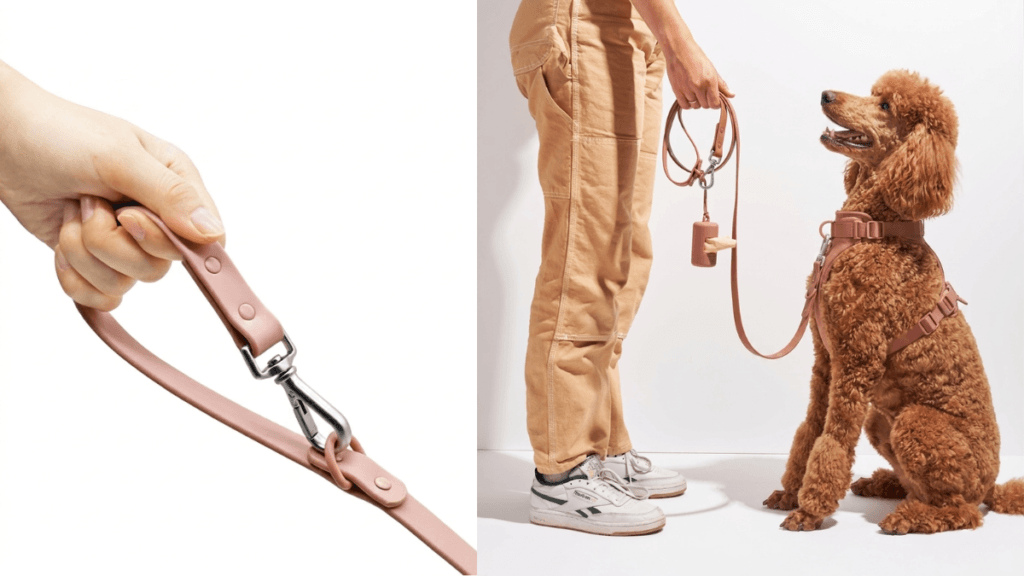
A traffic handle is a second loop handle positioned close to the clip end of a leash — typically 15 to 30cm from where the leash attaches to the dog. It looks like a small grab loop sewn into the leash body near the bottom, and it serves a single purpose: giving the handler a way to hold the dog at extremely close range without crouching down, grabbing the collar, or shortening up on the main handle.
The name comes from traffic situations — moments in busy streets, at road crossings, or in crowded areas where you need the dog immediately next to you with no slack in the system. At those moments, holding the main handle at the top of a 1.5m leash still gives the dog 1.5 metres of potential movement. Grabbing the traffic handle puts the dog within arm’s reach with essentially zero slack.
This guide covers what the traffic handle does, the situations where it makes a genuine practical difference, what to look for in the handle construction, and which dogs and owners benefit most from having one.

How a Traffic Handle Works
On a standard leash, the handler holds the loop at the top and controls the dog through the length of the leash. To bring the dog closer, the handler has to either shorten up by looping the leash over their wrist — which is awkward and imprecise — or pull the dog in by gathering slack in their hand, which leaves a bundle of leash to manage.
The traffic handle changes this. It is a fixed loop sewn into the leash at a specific point — usually 20 to 30cm from the clip — so that when the handler grabs it, the dog is immediately pulled to within arm’s length with no gathering, no loop-over-wrist, and no slack to manage. The transition from normal walking hold to traffic handle can happen in a single motion.
Most leashes with a traffic handle are designed so the handler uses the main handle during normal walking and switches to the traffic handle when close control is needed. Some handlers walk with the main handle in one hand and the traffic handle loosely in the other, so the close-control grip is already in place before it is needed — rather than requiring a reactive grab when a hazard appears.
When a Traffic Handle Makes a Real Difference
Road crossings and traffic
At a road crossing, you want the dog against your leg with no slack — not 1.5 metres away at the end of a loose leash. The traffic handle lets you bring the dog immediately to heel position without having to reorganise the leash while also watching for traffic. For dogs that are generally well-behaved but unpredictable near moving vehicles, this is the primary use case the handle is named for.
Passing other dogs or people in tight spaces
On a narrow pavement, in a doorway, or in a lift, there is often not enough space to manage a dog on a full-length loose leash. The traffic handle lets you compress the dog to your side for the duration of the squeeze without shortening the whole leash or putting it into an awkward gathered grip.
Reactive dogs near triggers
For a dog that lunges at specific triggers — other dogs, cyclists, skateboards — the traffic handle allows the handler to shorten up before the trigger comes into view, rather than reacting to a lunge already in progress. Holding the traffic handle with one hand while the dog walks normally on the main handle with the other means the close-control grip is already in place when needed. The response time is the difference between anticipating a lunge and reacting to one.
Urban walking with high pedestrian density
In a busy city environment — markets, shopping areas, public transport — being able to compress the dog to your side quickly and then release them back to a normal walk position as the crowd thins is a practical daily convenience. The traffic handle makes this a one-motion action rather than a leash management operation.
Getting in and out of vehicles
When a dog exits a car into a car park or roadside — a moment where the dog is often excited and the environment is immediately hazardous — the traffic handle lets you control the dog at arm’s reach from the moment the door opens. No reorganising the leash while the dog is already moving; one hand on the traffic handle as the door opens keeps the dog in a controlled position through the transition.
What to Look for in the Traffic Handle
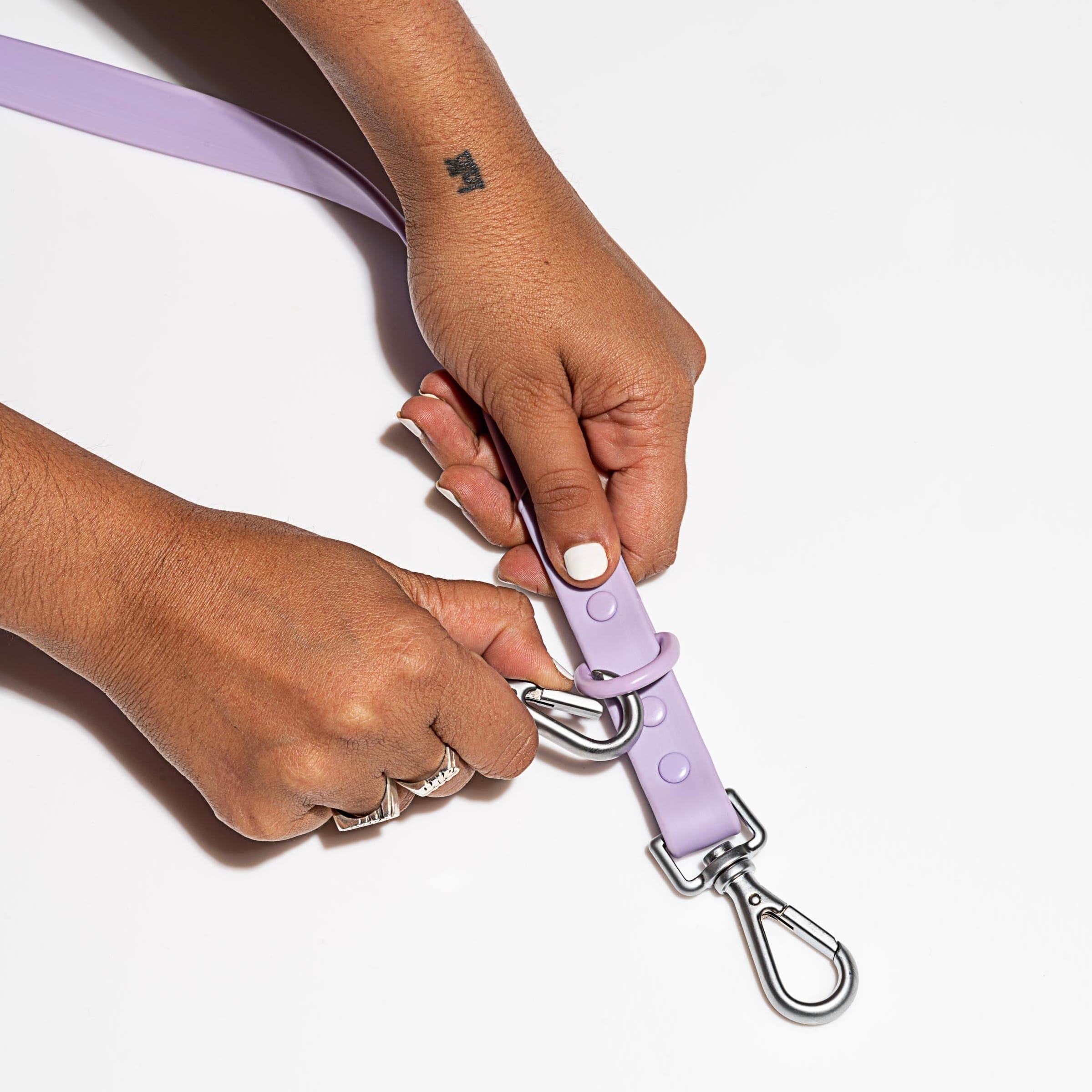
Reinforced stitching at both ends of the loop
The traffic handle takes sudden, high-force loads — the whole point is to use it when the dog lunges or needs to be stopped quickly. The stitching at both ends of the loop must be bar-tacked or box-stitched to handle this dynamic load without peeling. A traffic handle attached only with a single line of stitching along its length will eventually fail at the join under repeated high-force use. Check that the attachment points look reinforced — multiple rows of stitching crossing the join — before relying on it.
Handle size appropriate to the hand
The traffic handle loop needs to be large enough to get a full hand grip on quickly — fumbling with a small loop while a dog is mid-lunge is not useful. Most traffic handles are sized for a four-finger grip. Padding on the loop improves grip under load and reduces the discomfort of a hard stop on a large dog. A bare webbing loop is functional but unpleasant when used forcefully.
Position relative to the clip
The distance from clip to traffic handle determines how close the dog is when the handle is held. Most are positioned 20 to 30cm from the clip — close enough to keep the dog tight against the handler’s leg, far enough that normal collar movement does not pull the handle taut. A traffic handle positioned too close to the clip keeps the dog uncomfortably close; too far up the leash and it does not achieve close-control positioning effectively.
Compatibility with the leash body material
A traffic handle on a soft nylon leash will flex and move with the leash, which makes it slightly harder to grab quickly. On a firmer leash body — PVC-coated or thick rope — the handle holds its shape and position better, making it easier to locate and grip in a reactive moment. The firmer the leash material, the more reliably the traffic handle sits in a grabbable position during normal walking.
Traffic Handle vs Double Handle Leash
The terms are sometimes used interchangeably, but there is a distinction worth noting. A traffic handle leash has one main handle at the top and one short grab loop near the clip — two total handles, positioned at opposite ends of the leash. A double handle leash sometimes refers to a leash with two handles positioned at different points along the leash body — for example, at the 60cm and 120cm marks — giving the handler multiple grip options along the length rather than just at the extremes.
For most practical purposes, a traffic handle leash — one main handle plus one close-range grab loop — covers the use cases described in this guide. A full double handle design offers more grip options along the leash length, which some handlers find useful for managing a dog through variable-density environments where the ideal working distance changes frequently.
The MoonianPet Waterproof Dog Leash
The MoonianPet Waterproof Dog Leash is a PVC-coated webbing leash with a padded main handle and a zinc alloy 360-degree swivel clip. The firm coated body holds its shape during walking, making the handle easier to locate and grip quickly compared to a soft nylon leash.
For owners who specifically need a traffic handle, the MoonianPet leash pairs well with a no-pull harness that includes a top handle on the harness itself — combining the close-range leash grip with the harness handle gives two independent close-control points for reactive or large dogs. The Harness & Leash Set pairs both in matching colours.
Available in 11 colours and two lengths. For the collar and leash combination without a harness, the Waterproof Collar & Leash Set is available in all 11 colours.

Frequently Asked Questions
Is a traffic handle leash only for large dogs?
No — the traffic handle is useful for any dog in situations that require close control, regardless of size. For large dogs, the mechanical advantage of having the dog at arm’s reach rather than at the end of a full leash is more significant because the force involved is greater. For small dogs, the traffic handle is more of a convenience feature — it makes close positioning easier without requiring the handler to crouch or gather the leash. The use case applies to any dog in a high-density or high-hazard environment.
Can I walk my dog from the traffic handle the whole time?
Technically yes, but it is not what the handle is designed for. Walking a dog constantly at traffic handle distance — immediately next to your leg with no leash slack — is effectively a forced heel position the entire walk. For most dogs, a walk that allows some freedom of movement and sniffing is more enriching and less tiring than a tight-heel walk for the full duration. The traffic handle is most useful as a tool you move to and from as the environment requires, not as a permanent walking position.
Does a traffic handle replace a no-pull harness?
No — they address different things. A no-pull harness with a front clip reduces the mechanical advantage of forward pulling, making the dog easier to redirect. A traffic handle gives the handler a close-control grip option when needed. They work best together: the harness reduces pulling during normal walking, and the traffic handle (or the harness’s own top handle) provides the close-control grip at road crossings and in reactive moments. For dogs that both pull and need close control in traffic, both pieces of equipment are useful.
Where should I hold the traffic handle — is there a correct technique?
Grip the traffic handle with the hand closest to the dog, keeping your arm slightly bent rather than rigid. A rigid straight arm transfers more shock force to your shoulder and wrist if the dog lunges; a bent arm absorbs some of the impact. Keep your grip firm but not white-knuckle — a relaxed firm grip is more sustainable and gives better feel for the dog’s movements than a tense one. For reactive dogs near known triggers, resting your hand loosely on the traffic handle in advance puts you in position before you need it.
How is a traffic handle different from a harness top handle?
A traffic handle is part of the leash — a grab loop near the clip end. A harness top handle is sewn onto the back of the harness itself, above the dog’s shoulders. Both give the handler a close-range grip, but from different positions: the traffic handle is approached from below the dog (via the clip-end of the leash), while the harness handle is approached from above. The harness handle is better for lifting and for downward restraint; the traffic handle is better for lateral close-control positioning during walking. Used together, they give the handler control from two independent points on the dog — which is the setup many handlers of reactive or large dogs use.
For a full guide on harness handles and close-control features, see our post on dog harnesses with handles. For leash options for dogs that pull, see our hands free dog leash guide.
Wenyue
Wenyue is the founder of MoonianPet and writes about dog collars, harnesses, waterproof pet gear, and everyday dog care. Growing up with dogs inspired her lifelong interest in pet care and practical dog gear. Through MoonianPet, she researches dog collars, harnesses, waterproof materials, and everyday solutions that help active dogs stay comfortable during daily adventures.