
Walk into any pet store and the default leash on the shelf is almost always 6 feet. Ask a trainer what length they recommend for everyday walking and they’ll say 6 feet. It’s such a consistent answer that most dog owners never question it — they just buy a 6 foot leash and get on with it. But there’s actual reasoning behind that number, and understanding it helps you know when the standard is right for your dog and when a different length would serve you better.
Six feet — roughly 1.8 metres — gives a dog enough freedom to move naturally on a walk without pulling the handler around. It keeps the dog close enough for the handler to maintain awareness and react quickly if needed. And it’s short enough that excess leash doesn’t become a tripping hazard or tangle around legs and posts. It’s a practical compromise that happens to work well for the widest range of dogs, handlers, and environments.
This guide covers why 6 feet became the standard, what to look for when choosing one, which material holds up best for regular use, and when you should genuinely consider a different length.
Why 6 Feet Became the Standard Leash Length
It matches the handler’s natural walking pace
Six feet places the dog roughly one to two metres ahead of a walking adult. That gap is close enough for the handler to read the dog’s body language — if the dog stiffens, slows, or redirects toward something, the handler can react before the situation escalates. It’s also short enough that the leash doesn’t sag to the ground and become a tripping hazard. A 4 foot leash keeps the dog too close for comfortable side-by-side walking; an 8 foot leash gives the dog enough range to get into trouble before the handler has time to respond.
It works in urban and suburban environments
Most dog walking happens in environments with some level of traffic, other pedestrians, other dogs, and narrow footpaths. Six feet is short enough to keep a dog from reaching across a pavement to greet — or lunge at — a passing dog without warning. It’s long enough that the dog can move to the side to sniff a post or investigate a patch of grass without pulling the handler off balance. In a busy park or on a city street, a 6 foot leash is the length that causes the fewest management problems.
It’s the standard in most training contexts
Obedience training, leash manners work, and most group dog training classes use a 6 foot leash as standard. The length allows trainers to demonstrate loose-lead walking, heel position, and recall without the dog getting too far ahead. When a dog has been trained on a 6 foot leash, switching to a very different length changes the spatial relationship the dog has learned — which is why 6 feet tends to be the default recommendation even outside formal training contexts.
What to Look for in a 6 Foot Dog Leash
Width matched to your dog’s size
Leash width — the thickness of the webbing — should be proportional to the dog. A 25mm (1 inch) wide leash is appropriate for large and strong dogs; a 15mm (5/8 inch) leash works well for medium dogs; a 10mm (3/8 inch) or narrower leash suits small breeds. A leash that is too wide for a small dog is heavy and stiff, which affects how comfortably it drapes and how responsive it feels in the hand. A leash too narrow for a large, strong dog can cut into the palm under load. Most standard 6 foot leashes come in 15mm or 20mm widths, which covers the mid-range of dogs well.
A handle you can actually hold comfortably
The handle is the part of the leash that takes the most wear — it’s constantly in your hand, looped around your wrist, or stuffed into a pocket. A handle with some padding or a soft outer surface reduces hand fatigue on longer walks and is more comfortable if the dog lunges suddenly. Avoid handles that are very stiff or have hard edges; they’re fine when the leash is slack but uncomfortable when there’s any tension on it. A reinforced stitched loop is more durable than a simple folded handle — check that the stitching at the handle is tight and even.
A hook that won’t accidentally release
The clip that attaches the leash to the collar or harness ring is a critical safety point — a clip that fails mid-walk means a loose dog. Spring-loaded bolt snaps are the most common and reliable type; they require deliberate pressure to open. Avoid very lightweight clips on heavy dogs — the spring tension may not be sufficient to hold against sustained pulling. The clip should open and close smoothly without stiffness, and the swivel at the base of the clip should rotate freely so the leash doesn’t twist up during walking.
Material that suits your walking conditions
Standard nylon webbing is lightweight and inexpensive but absorbs water, holds odour over time, and softens and frays with repeated wetting. Leather develops a good feel with use but requires maintenance, can stiffen when wet, and takes time to dry. PVC-coated webbing — the same material used in BioThane-style leashes — is waterproof, odour-resistant, easy to wipe clean, and maintains its feel regardless of weather. For daily walking in any conditions, a coated webbing leash outlasts nylon and requires significantly less maintenance than leather.
When a Different Length Makes More Sense
Six feet is the right choice for most everyday walking — but there are situations where a shorter or longer leash genuinely works better.
4 foot leash — busy urban environments and crowded spaces
A 4 foot leash keeps the dog closer in situations where you need more immediate control — busy streets, crowded markets, or walking past café seating. It reduces the gap between you and the dog, which means less reaction time is needed if the dog spots something. Some handlers use a 4 foot leash as their default in city environments and a 6 foot leash for quieter suburban walks. The trade-off is that a 4 foot leash gives the dog less room to explore, which suits reactive or highly distracted dogs but can feel restrictive for calmer ones.
Long line (15–30 feet) — recall training and open spaces
A long training line is not a substitute for a 6 foot walking leash — it serves a completely different purpose. Long lines are used for recall training in open spaces, allowing a dog to range further while remaining safely attached. They’re also useful for dogs that aren’t yet ready for off-leash freedom in unfenced areas. A long line should never be used in urban environments, around other people or dogs, or on any surface where it can tangle. It’s a training tool, not a daily walking leash.
Hands-free leash — running, hiking, and active walking
A hands-free leash attaches around the waist and allows the handler to walk or run without holding anything. Most hands-free leashes are around 4 to 6 feet when extended, with a bungee section to absorb sudden pulls. They work well for active owners who want both hands free — but they remove the handler’s ability to shorten the leash quickly if needed. A standard 6 foot leash held in the hand gives better control in any situation that might require a quick response.
The MoonianPet Waterproof Dog Leash
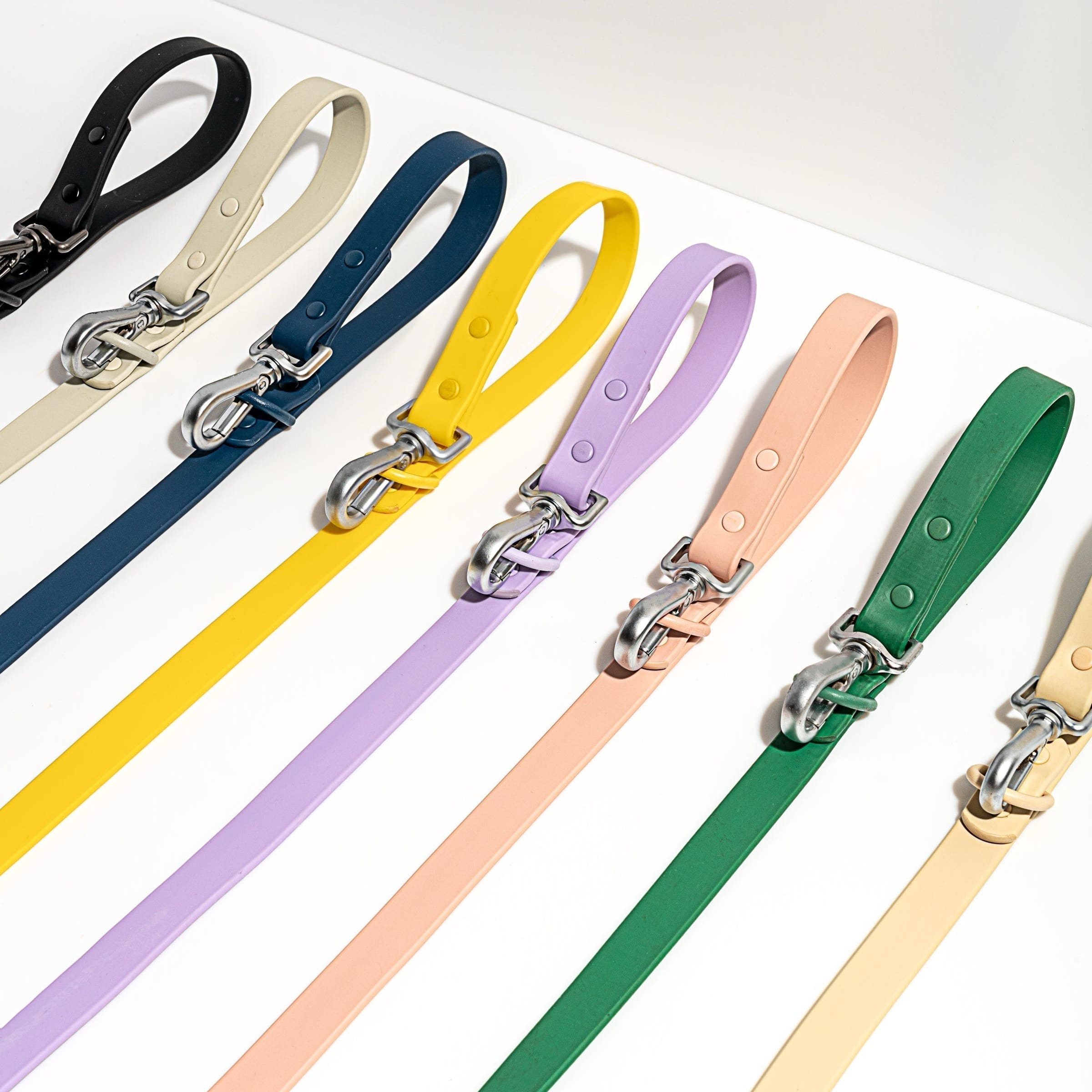
The MoonianPet Waterproof Dog Leash is a 6 foot PVC-coated webbing leash built for daily use in any weather. The coated surface is 100% waterproof and odour-resistant — it wipes clean after muddy walks and dries in seconds after rain or swimming, with none of the residual damp smell that builds up in nylon leashes over time.
The zinc alloy 360° swivel hook prevents twisting during walking and clips securely to any standard D-ring. The handle is reinforced with double stitching and padded for comfortable grip on longer walks. Available in 10 colours across two widths — 15mm for small and medium dogs, 20mm for large breeds — and pairs with the matching waterproof collar and leash set if you want a coordinated setup.
I started recommending coated webbing leashes to everyone who asked me about gear after noticing how quickly standard nylon leashes develop that persistent wet-dog smell — especially in humid climates or with dogs that love water. The difference in day-to-day maintenance is significant. For anyone walking daily in any kind of weather, the waterproof material is worth it.
Frequently Asked Questions
Is 6 feet the right leash length for a large dog?
Yes — 6 feet works well for large dogs in most everyday walking environments. The key variable for large dogs isn’t length so much as width and hardware strength. A 6 foot leash for a large strong dog should be 20–25mm wide with a heavy-duty bolt snap rated for the dog’s weight. A leash that is the right length but too narrow or with a lightweight clip is a safety issue for big dogs. Width and hardware first, then length.
Can I use a 6 foot leash for a puppy?
A 6 foot leash is fine for a puppy, though a lighter, narrower leash is more appropriate than a full-weight adult leash. For very small puppies, a 6 foot leash may feel long initially — many people find it easier to manage excess length by gathering it in the hand rather than buying a shorter leash, since the puppy will grow into the full length quickly. The important thing for puppies is that the leash is light enough not to drag their head down and that the clip is small enough to attach to a puppy-sized collar or harness ring without being bulky.
What’s the difference between a 6 foot leash and a standard leash?
They’re the same thing — 6 feet is the standard leash length. When manufacturers or trainers refer to a “standard leash” without specifying length, they almost always mean 6 feet (approximately 1.8 metres). Some markets use slightly different defaults — 120cm or 150cm are common metric equivalents — but 6 feet (182cm) is the widely accepted standard in North American and UK dog care contexts.
Should a 6 foot leash attach to a collar or a harness?
Either works, and the choice depends on your dog rather than the leash length. For dogs that pull, a harness distributes leash force across the chest and shoulders rather than concentrating it on the throat — particularly important for small breeds or any dog with a history of neck or tracheal issues. For calm dogs that walk on a loose lead, a collar attachment is perfectly fine. The 6 foot length is appropriate with either attachment point. See our dog collar vs harness guide for a full comparison.
How do I stop my dog from chewing the leash?
Leash chewing is usually a behaviour issue rather than a gear issue — dogs chew the leash when bored, anxious, or when the leash-chewing gets them a reaction from the handler. That said, a coated webbing or steel cable leash is significantly more resistant to chewing than standard nylon. A PVC-coated leash doesn’t give the dog the satisfying texture of nylon fibres to bite through, which removes some of the appeal. For persistent chewers, see our chew proof dog leash guide for material options that hold up better under determined chewing.
For guidance on choosing between leash types and lengths for different situations, see our how to choose a dog leash guide. For matching leash and collar sets, see our matching dog collar and leash set guide.

Wenyue
Wenyue is the founder of MoonianPet and writes about dog collars, harnesses, waterproof pet gear, and everyday dog care. Growing up with dogs inspired her lifelong interest in pet care and practical dog gear. Through MoonianPet, she researches dog collars, harnesses, waterproof materials, and everyday solutions that help active dogs stay comfortable during daily adventures.