
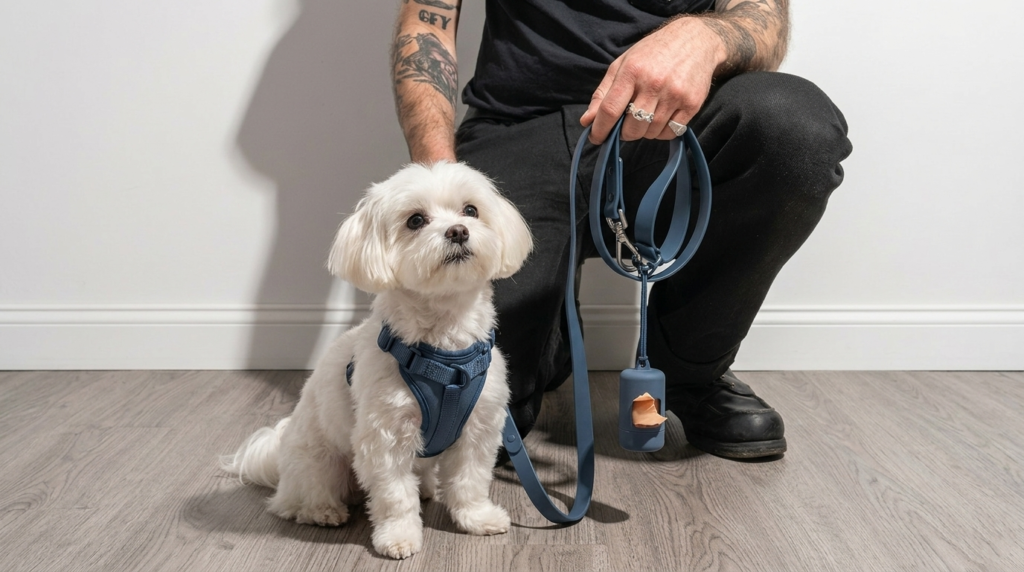
The Maltese is one of the oldest toy breeds in the world, and its coat is central to the breed’s identity — a long, silky, pure white single coat that drapes to the ground in show dogs and is kept at various practical lengths in most pet Maltese. That coat is also one of the main reasons choosing and fitting a harness requires more thought for a Maltese than for many other small breeds.
Unlike double-coated breeds where a harsh outer coat provides some protection against friction, the Maltese single coat is fine, silky, and delicate. Harness straps with textured surfaces, rough webbing edges, or poorly positioned contact points cause matting and coat breakage at the contact points with very little friction required. In the armpit area — where the harness straps pass under the front legs and create continuous rubbing during walking — this damage accumulates quickly and is the most common complaint Maltese owners have about harnesses.
Beyond the coat, Maltese share the tracheal collapse predisposition common in toy breeds, making collar walking inadvisable for the same reasons as other small breeds. This guide covers how to measure a Maltese for a harness, what material and design choices protect the coat, and what to avoid.
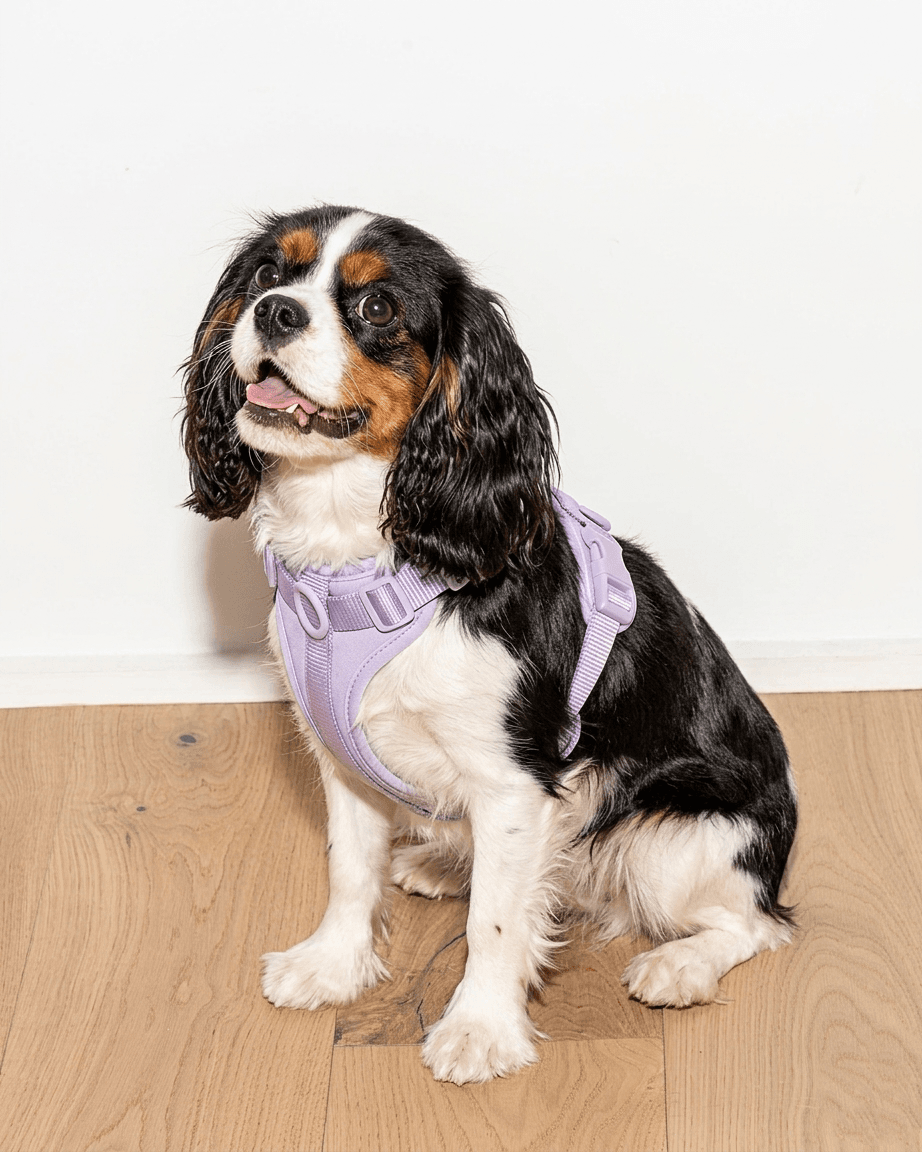
Why Collar Walking Is Not Suitable for a Maltese
Tracheal collapse risk
The Maltese is among the toy breeds with a documented predisposition to tracheal collapse — the progressive weakening of the cartilage rings that support the windpipe. The characteristic honking cough is the most recognisable sign, and while genetics is the primary driver, collar pressure on the throat during walking is a known aggravating factor. Most veterinary guidance recommends harness walking for Maltese as a precautionary measure regardless of whether the dog has shown any airway symptoms. See our full dog harness for tracheal collapse guide for more detail on the condition and what it means for gear choice.
Coat damage from collar wear
A collar worn around a Maltese’s neck creates a ring of permanent compression on the coat. Over time, this causes the fine, silky coat at the collar contact line to break, flatten, and develop a visible wear mark — particularly noticeable on a pure white coat. For a Maltese kept in a longer coat style, this collar line becomes increasingly apparent and difficult to grow out. Switching to a harness for walking — and using a lightweight collar only for ID tags without a leash attached — allows the neck coat to grow and sit naturally.
Proportional sensitivity of the neck
A typical adult Maltese weighs between 3 and 4kg. At this weight, the tracheal structures are proportionally delicate — the force a Maltese exerts against a collar during a lunge or sustained pull is small in absolute terms but significant relative to the size of the windpipe. This is the same physics that makes all toy breeds more vulnerable to collar-related tracheal pressure than larger dogs, and the Maltese’s confirmed predisposition to tracheal issues makes harness walking a clear recommendation for this breed.
How to Measure a Maltese for a Harness
Chest girth
Part the coat at the widest point of the chest — directly behind the front legs — and measure at skin level rather than over the coat surface. For most adult Maltese, chest girth at skin level falls between 28 and 38cm. As with all long-coated breeds, measuring over the coat will produce a larger number and result in a harness that’s too large. Always measure at skin level and size to that measurement.
Neck girth
Part the neck coat and measure at skin level at the base of the neck where the harness neck opening will sit. For most adult Maltese, neck girth is between 18 and 26cm. The neck opening of the harness should sit low — at the base of the neck rather than high toward the larynx — both for tracheal safety and to minimise the amount of neck coat the strap contacts.
Checking fit after putting the harness on
Two fingers should slide under the chest strap comfortably. Part the coat around the strap edges after fitting to check the fit at skin level rather than on top of the coat. Walk the dog for a few minutes and recheck — a harness that shifts position on a Maltese after a few minutes of walking was fitted against the coat rather than the body. If the harness has moved, tighten slightly and recheck. Inspect the armpit area specifically — the strap should clear the armpit without pressing into it when the dog walks with a normal stride.
What to Look for in a Maltese Harness
Smooth contact surfaces — this is the most important feature for a Maltese
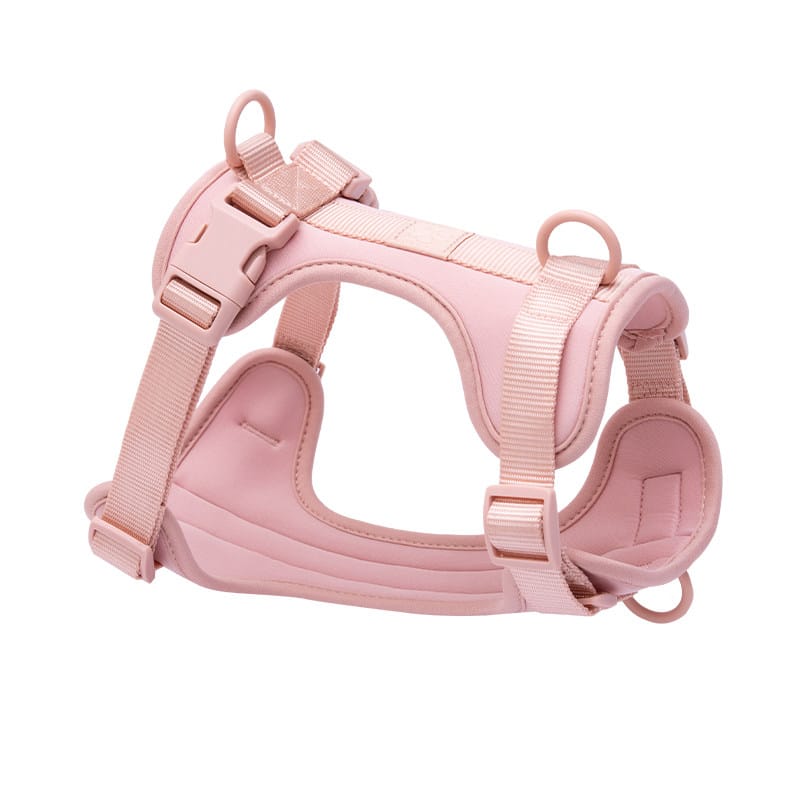
The single silky coat of a Maltese has no protective outer coat to resist friction. Any harness material with texture — nylon webbing with a fibrous surface, rough-edged padding, or abrasive lining at the contact points — will grab the coat and cause matting and breakage at the armpit and chest contact areas. A harness with a smooth surface at the contact points — neoprene padding or smooth-finished webbing — slides against the coat rather than gripping it. This is the most important material characteristic for any harness worn on a long silky coat, and it’s the feature that separates harnesses that work for a Maltese from those that gradually damage the coat.
Lightweight construction
A Maltese typically weighs 3–4kg. A harness that feels trivially light to an adult human hand adds proportionally significant weight to a small dog’s frame. Heavy hardware, thick foam padding, and wide webbing create a harness that is out of proportion for a Maltese both visually and physically. Narrow webbing (10–15mm), small-format hardware, and a lightweight body material keep the harness proportional and prevent it from dragging the dog’s posture or shifting during walking due to its own weight.
Low neck opening positioned away from the trachea
The neck opening must sit at the base of the neck — not high toward the larynx. For a Maltese with tracheal considerations, this positioning is non-negotiable. A neck strap that presses against the front of the throat when the leash is taut places pressure in exactly the area a collar would, defeating the purpose of the harness. The lower the neck strap sits on the neck (while still fitting securely), the less coat it contacts and the further it stays from the trachea.
Independent adjustment at neck and chest
Maltese vary in build — some are finely boned and lightly built; others are more compact for their weight. Independent adjustment at the neck and chest allows the harness to be fitted precisely to the individual dog’s measurements rather than an average. At XS sizes where the margin between correct and incorrect fit is narrow, this adjustability matters more than at medium or large sizes.
No Velcro
Velcro and silky single coats are incompatible. Any contact between Velcro and a Maltese coat causes immediate, severe tangling that requires patient, time-consuming detangling to resolve. Some harnesses designed for small dogs include Velcro panels for sizing adjustment or closure — avoid any Velcro on a harness for a long silky-coated breed. Buckle closures and tri-glide adjusters are the only appropriate fastening types for a Maltese harness.
The MoonianPet No-Pull Harness for Maltese
The MoonianPet No-Pull Dog Harness in XS fits a chest girth of 30–40cm at skin level — covering most adult Maltese. The neoprene body has a smooth surface that slides against the silky coat rather than gripping it, significantly reducing the friction-driven matting at the armpit and chest contact points that textured webbing causes.
The neck opening positions low at the base of the neck, away from the trachea. Three-point independent adjustment allows precise fitting at both neck and chest to the Maltese’s individual measurements. No Velcro — all fastening is via positive-click ABS safety buckles and tri-glide adjusters. Available in 11 colours including lilac, pink, and sky blue, and pairs with the matching Harness & Leash Set.
Measure chest girth at skin level with the coat parted before ordering. Use our dog harness size guide to confirm the right size — if your Maltese falls between XS and S, size down and use the adjustment to fine-tune.
Frequently Asked Questions
What size harness does a Maltese need?
Most adult Maltese need an XS harness with a chest girth adjustment range starting at 28–30cm. Measure chest girth at skin level with the coat parted — measuring over the coat will produce a larger number and result in a harness that’s too large. Match your measurement to the brand’s specific size chart rather than relying on the XS label, as minimum sizes vary between brands. Our dog harness size guide has the full measurement chart.
Why does my Maltese’s harness cause matting?
Matting from a harness is caused by friction between the harness material and the coat at the contact points — most commonly the armpit area where the strap passes under the front leg and rubs continuously during walking. The main causes are a harness with a textured or rough contact surface that grabs the silky coat, a harness that’s too loose and shifts during walking (creating more friction than a static harness), and infrequent brushing of the contact areas after walks. Switching to a harness with a smooth neoprene contact surface, ensuring the fit is snug enough that it doesn’t shift, and brushing the contact areas after each walk will together eliminate most harness-related matting.
Can my Maltese wear a collar instead of a harness?
A lightweight flat collar is appropriate for ID tags and is fine to wear without a leash attached. The concern is leash attachment to a collar for walking — given the Maltese’s tracheal collapse predisposition and the coat damage that sustained collar wear causes, harness walking is the better choice for this breed. The standard setup is a lightweight collar for ID and a harness for all walks. See our small dog collar guide for what to look for in a lightweight ID collar for a silky-coated toy breed.
Should I use the front or back clip on my Maltese’s harness?
For a Maltese that pulls or reacts on the walk, the front clip redirects the dog toward the handler and reduces the intensity of pulling episodes — particularly useful for a breed with tracheal considerations where reducing overall walk exertion is beneficial. For a calm Maltese that walks on a loose lead, the back clip provides comfortable freedom without the leash crossing over the dog’s body. One consideration specific to Maltese: the back clip leash attachment lies across the dog’s back coat during walking, which some owners find causes tangling in longer coat styles. The front clip keeps the leash in front of the dog’s body and away from the back coat entirely.
How do I stop my Maltese’s harness from slipping?
A harness that slips or shifts on a Maltese is almost always a fit issue — either it’s too large for the dog, or it was fitted over the coat rather than to the body beneath it. Refit with the coat parted so the straps sit against the skin, and tighten until two fingers slide under the chest strap but no more. If the harness still shifts after correct fitting, it may be the wrong size — check the brand’s chest girth range and size down if your dog’s measurement is at the bottom of the current size’s range.
For more on tracheal collapse and harness choice for toy breeds, see our dog harness for tracheal collapse guide. For similar fitting challenges in other silky-coated small breeds, see our Yorkie harness guide.
Wenyue
Wenyue is the founder of MoonianPet and writes about dog collars, harnesses, waterproof pet gear, and everyday dog care. Growing up with dogs inspired her lifelong interest in pet care and practical dog gear. Through MoonianPet, she researches dog collars, harnesses, waterproof materials, and everyday solutions that help active dogs stay comfortable during daily adventures.