
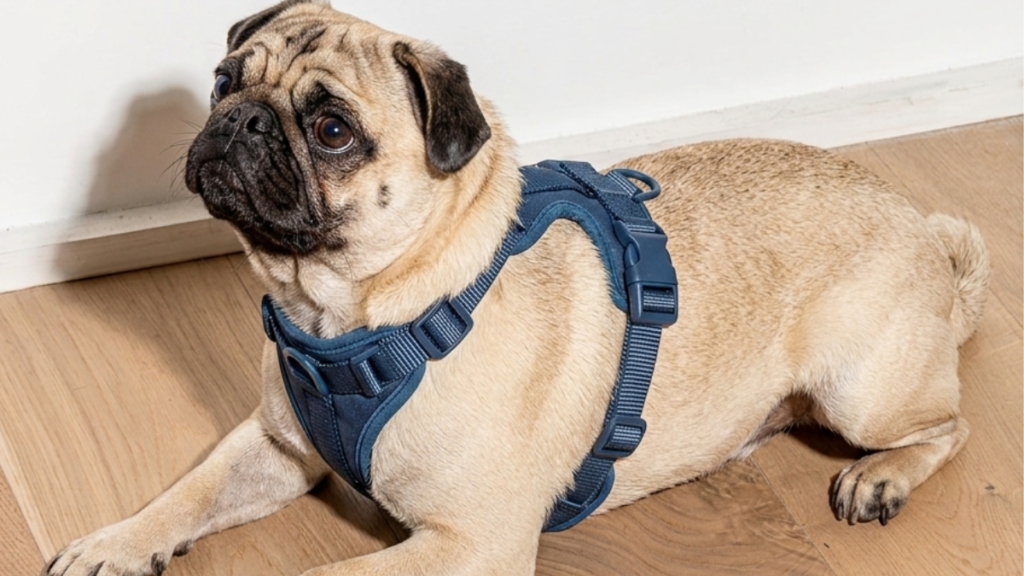
French Bulldogs present a specific harness challenge that most generic sizing guides do not address: they are brachycephalic, barrel-chested, and built with a body shape that does not fit neatly into standard small or medium harness categories. A Frenchie with a wide, deep chest and a relatively narrow neck can have measurements that pull in opposite directions on a size chart — and a harness that fits one body dimension poorly enough will either slip, rotate, or sit uncomfortably on every walk.
Beyond fit, there is a health consideration that applies specifically to brachycephalic breeds. French Bulldogs already have compromised airways due to their flat facial structure and elongated soft palate. Any pressure on the neck and trachea — from a collar used as the leash attachment point — adds to that respiratory load. A harness is not just a preference for French Bulldogs; it is a meaningful health choice.
This guide covers what makes a harness work well on a French Bulldog specifically, how to measure and size correctly for the breed’s proportions, and why neoprene padding is the right material choice for this body type.
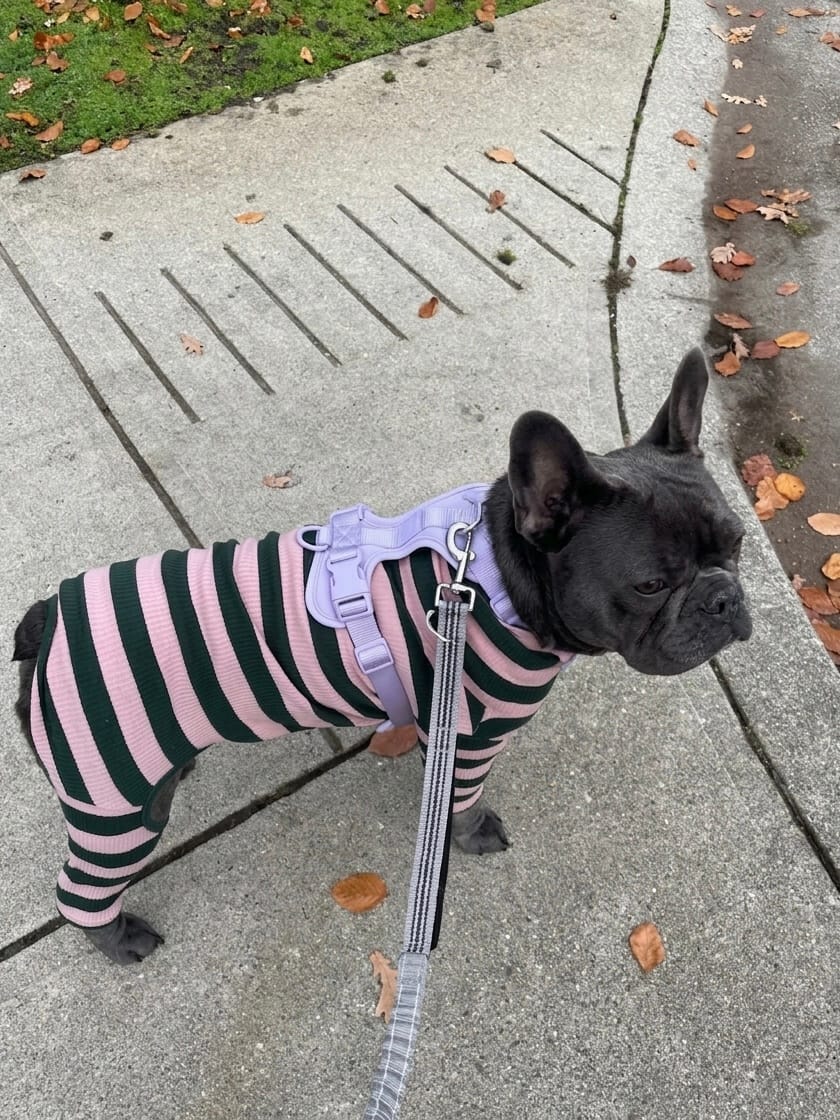
Why French Bulldogs Need a Harness, Not a Collar
The case for a harness on most dogs is about walking control and pressure distribution. For French Bulldogs, it goes further.
Brachycephalic breeds have a narrowed airway by default — shorter nasal passages, an elongated soft palate, and sometimes a narrowed trachea contribute to the breathing effort that Frenchies make even at rest. Any additional pressure on the trachea and neck during walks compounds this. A collar that fits correctly and causes no visible distress can still be adding resistance to an airway that is already working harder than a non-brachycephalic dog’s.
A harness moves the leash attachment point to the chest or back, away from the neck entirely. For a French Bulldog, this means every walk happens without tracheal pressure — which makes a practical difference in how much the dog tires, particularly in warm weather when Frenchies already struggle with thermoregulation. For a full comparison of when each is the right choice, see our collar vs harness guide.
The French Bulldog Fit Challenge
French Bulldogs are consistently one of the most challenging breeds to fit in a standard harness. The specific issues:
Wide, deep chest relative to overall size
A French Bulldog’s chest girth is disproportionately large relative to their neck and body length. A Frenchie that looks like a small dog by weight and height often measures into a medium harness based on chest girth alone. If sized by weight or visual impression rather than chest measurement, the harness ends up too small — the chest strap pulls tight while the neck loop sits loose. Always measure chest girth first and size from that number, not from weight or breed assumptions.
Short back length
Frenchies have a compact, short body. Harnesses designed for longer-bodied dogs of similar chest girth can have a back panel that extends past the hindquarters or sits awkwardly over the spine. A harness with a compact back design — where the back D-ring sits between the shoulder blades rather than extending further along the spine — fits Frenchies more naturally.
Narrow neck relative to chest
The neck-to-chest ratio on a French Bulldog is more extreme than on most other breeds — the chest is very wide and the neck is relatively narrow. Harnesses that size by chest girth and have a fixed neck loop size often produce a neck loop that is too wide for a Frenchie, which allows the harness to slip forward toward the skull. A harness with independent neck and chest adjustment is essential — one that lets you tighten the neck loop separately from the chest fit.
Why Neoprene Padding Matters for French Bulldogs
French Bulldogs have a wide, prominent sternum and chest — the exact area that the harness chest panel sits against. On a dog with less pronounced chest architecture, a thin chest strap causes mild discomfort at worst. On a Frenchie, a narrow or poorly padded chest strap that sits against the sternum on every walk causes chafing and skin irritation noticeably faster.
Neoprene padding addresses this in two ways. First, it is soft and flexible — it conforms to the chest shape rather than sitting rigidly against it. Second, it does not compress flat with use. Foam padding and thin mesh flatten within weeks of daily use on a Frenchie whose chest is actively pressing against the panel on every walk. Neoprene maintains its cushioning over months of use because the material is inherently resilient.
Neoprene also does not absorb moisture — which matters for French Bulldogs, who tend to drool and sweat around the chest area more than longer-muzzled breeds. A nylon-padded chest strap on a Frenchie develops odour from chest moisture quickly. Neoprene stays fresh because it has no porous surface for bacteria to colonise. For more on how material affects harness performance over time, see our lightweight harness guide.
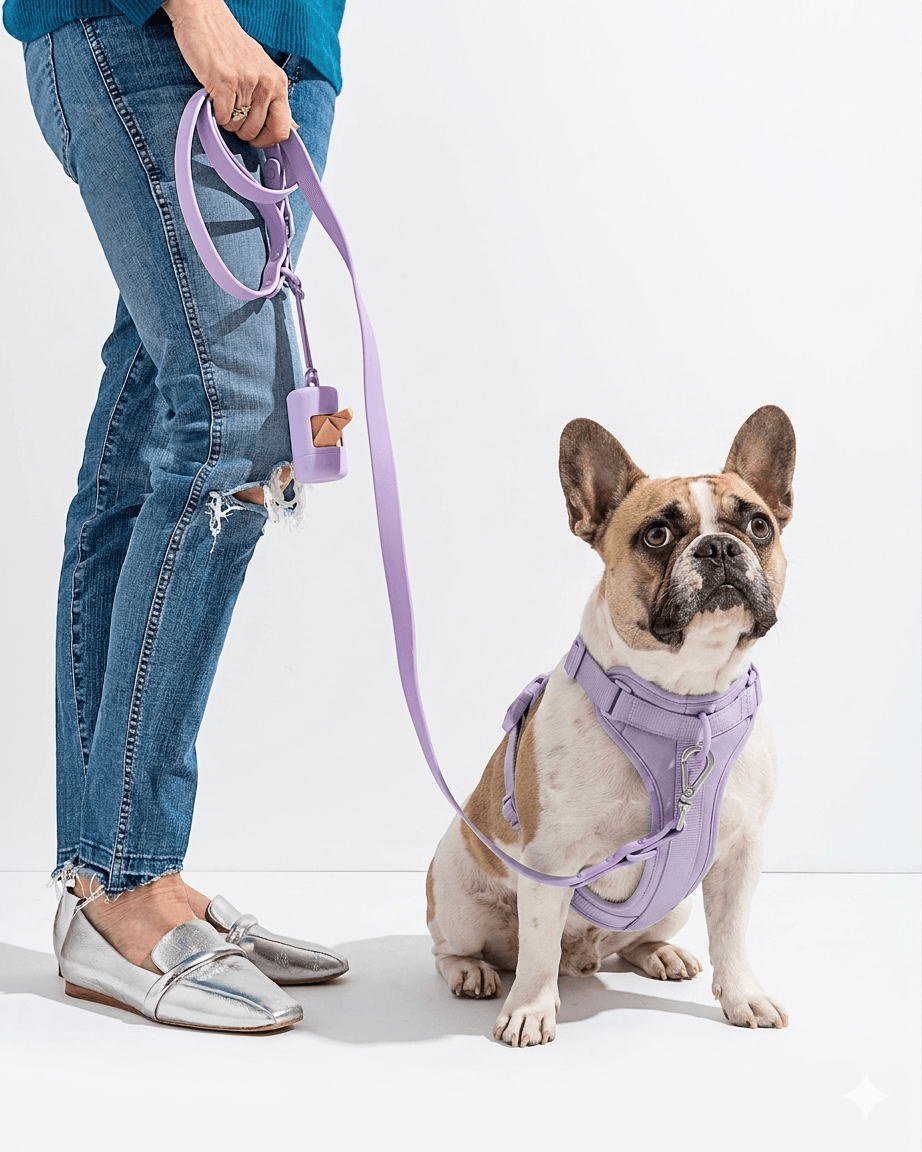
How to Measure and Size a Harness for a French Bulldog
Follow these steps rather than relying on breed size guides, which are frequently inaccurate for Frenchies:
Step 1: Measure chest girth
Wrap a soft tape measure around the widest point of the chest — just behind the front legs — with your Frenchie standing. This is the number that determines size. Most adult French Bulldogs measure between 20 and 26 inches chest girth, which typically puts them in size M on the MoonianPet harness. Do not be surprised if your Frenchie measures into a medium — their chest is genuinely wide relative to their overall size.
Step 2: Measure neck girth
Measure the circumference of the neck at its widest point. On a French Bulldog, this will be noticeably smaller than the chest measurement — this is normal and expected. Check that the neck measurement falls within the harness adjustment range for the size you have chosen based on chest girth. If the neck measurement is too small for the neck loop adjustment range of that size, you will need a harness with a wider neck adjustment range or a different design.
Step 3: When between sizes, go up
If your measurements put your Frenchie between S and M, choose M. The three-point adjustment on the MoonianPet harness means a larger size can be tightened to a snug fit — and having the neck loop large enough to tighten correctly is more important than having the chest strap at the middle of its range.
Step 4: Check fit with the two-finger rule on all three straps
Once the harness is on, check two fingers under the neck loop, chest strap, and belly strap. On a Frenchie, pay particular attention to the chest strap sitting just behind the front legs — not pressing into the armpits, which is a common fit error on barrel-chested breeds. The front D-ring should sit flat and centered on the sternum. Full fitting guidance in our how to put on a no-pull harness guide.
What to Avoid in a French Bulldog Harness
Step-in harnesses
Step-in harnesses — where the dog steps both front legs into separate loops — are notoriously difficult to fit on barrel-chested breeds. The loops either fit the chest width and are too wide to pass around the legs correctly, or they fit the legs and are too narrow to sit flat across the wide chest. The back-clip-only design of most step-in harnesses also provides no pulling control. For a full comparison of harness types, see our step-in vs overhead guide.
Narrow chest straps
A narrow chest strap on a Frenchie’s prominent sternum concentrates pressure on a small contact area — the opposite of what a harness is designed to do. A wide chest panel that distributes pressure across the sternum is essential for comfortable daily use. Avoid harnesses where the chest contact is a single narrow strap rather than a padded panel.
Single-point adjustment
A harness with only one adjustment point cannot accommodate the Frenchie’s extreme neck-to-chest ratio. A single adjustment that fits the chest will leave the neck loop too wide; one that fits the neck will be too tight on the chest. Three-point adjustment — neck, chest, and belly independently — is not optional for this breed.

Built for Barrel-Chested Breeds
The MoonianPet No-Pull Dog Harness covers the French Bulldog fit requirements: a wide neoprene chest panel that sits flat across the sternum, three-point tri-glide adjustment for neck, chest, and belly independently, and a quick-release buckle that goes on in seconds. The front D-ring eliminates tracheal pressure on walks — particularly important for brachycephalic breeds. Available in size M for most adult Frenchies, with XS and S for puppies and smaller individuals.
Pair with the Harness & Leash Set for a matched waterproof walking setup in 11 colors.
Frequently Asked Questions
Should French Bulldogs wear a harness or collar?
A harness is strongly recommended for French Bulldogs as the leash attachment point. Their brachycephalic airway means any neck pressure during walks adds to an already compromised respiratory system. A harness distributes leash force across the chest and back, with no pressure on the trachea. A collar can still be worn for ID tags, but the leash should attach to the harness.
What size harness does a French Bulldog need?
Most adult French Bulldogs fit size M, which covers chest girths of 20.9–28.0 inches. However, always measure chest girth rather than relying on breed size guides — Frenchies vary considerably and their chest is disproportionately wide relative to their overall size. A Frenchie that looks small may still measure into a medium based on chest girth alone.
Why does the harness keep slipping on my French Bulldog?
Harness slippage on Frenchies is almost always a neck loop fit issue — the neck loop is too wide and allows the harness to slide forward toward the skull. Tighten the neck strap until it passes the two-finger rule snugly. If the neck strap is already at its tightest setting and still too wide, the harness needs an independent neck adjustment or a different design. A harness with three-point adjustment that lets you tighten the neck loop independently of the chest fit resolves this.
Is neoprene good for French Bulldogs?
Yes — neoprene is an excellent material for French Bulldogs specifically. It is soft and flexible, conforming to the barrel chest shape; it does not compress flat with daily use; and it does not absorb moisture or odour, which matters for a breed that tends to drool and sweat around the chest. Neoprene padding on the chest panel and underarm straps makes a significant difference in comfort on daily walks.
Do French Bulldogs pull on the leash?
Many do — Frenchies are enthusiastic and curious, which translates to pulling toward interesting things on walks. The front D-ring on a no-pull harness is effective for Frenchies because it redirects their momentum sideways when they pull forward, without putting any pressure on the neck. Given the respiratory considerations, a front-clip no-pull harness is a particularly good choice for brachycephalic breeds that pull.
Looking for harness advice for other small breeds? Our small dog harness guide covers fit and recommendations across toy and small breeds. Or if you are comparing harness types before buying, see our step-in vs overhead comparison.

About the Author
Wenyue
Wenyue is the founder of MoonianPet and writes about dog collars, harnesses, waterproof pet gear, and everyday dog care.
Growing up with dogs inspired her lifelong interest in pet care and practical dog gear. Through MoonianPet, she researches dog collars, harnesses, waterproof materials, and everyday solutions that help active dogs stay comfortable during daily adventures.