

Most dog owners secure their dog in the car by clipping the leash to the dog’s collar and tying it to the headrest or seatbelt. This is the most common method — and it is also the most dangerous. In a sudden stop at 50km/h, a dog wearing a collar secured to the seatbelt experiences concentrated force on the trachea and cervical spine that can cause permanent injury or death. The dog’s entire body weight is decelerated by a strip of webbing pressed against the throat. The fix is not complicated: use a harness instead of a collar, and the force distributes safely across the chest and shoulders. But the details of how to do this correctly matter.
I see the collar method constantly — in car parks at trailheads, at the vet, at dog parks. Owners who would never walk their dog on a collar because of pulling concerns will still secure them on a collar in the car, where the forces involved are orders of magnitude higher than anything a walk produces. The inconsistency comes from a reasonable place: people assume that a seatbelt-rated dog harness costs $200 and requires a special car tether, when in reality a well-fitted no-pull harness with neoprene padding and a standard leash is a safe and effective car restraint when used correctly.
This guide covers why collars are dangerous in cars, how to secure a dog in the car using a harness and leash, what type of harness works for car safety, and the three common mistakes that make a harness-based restraint ineffective.
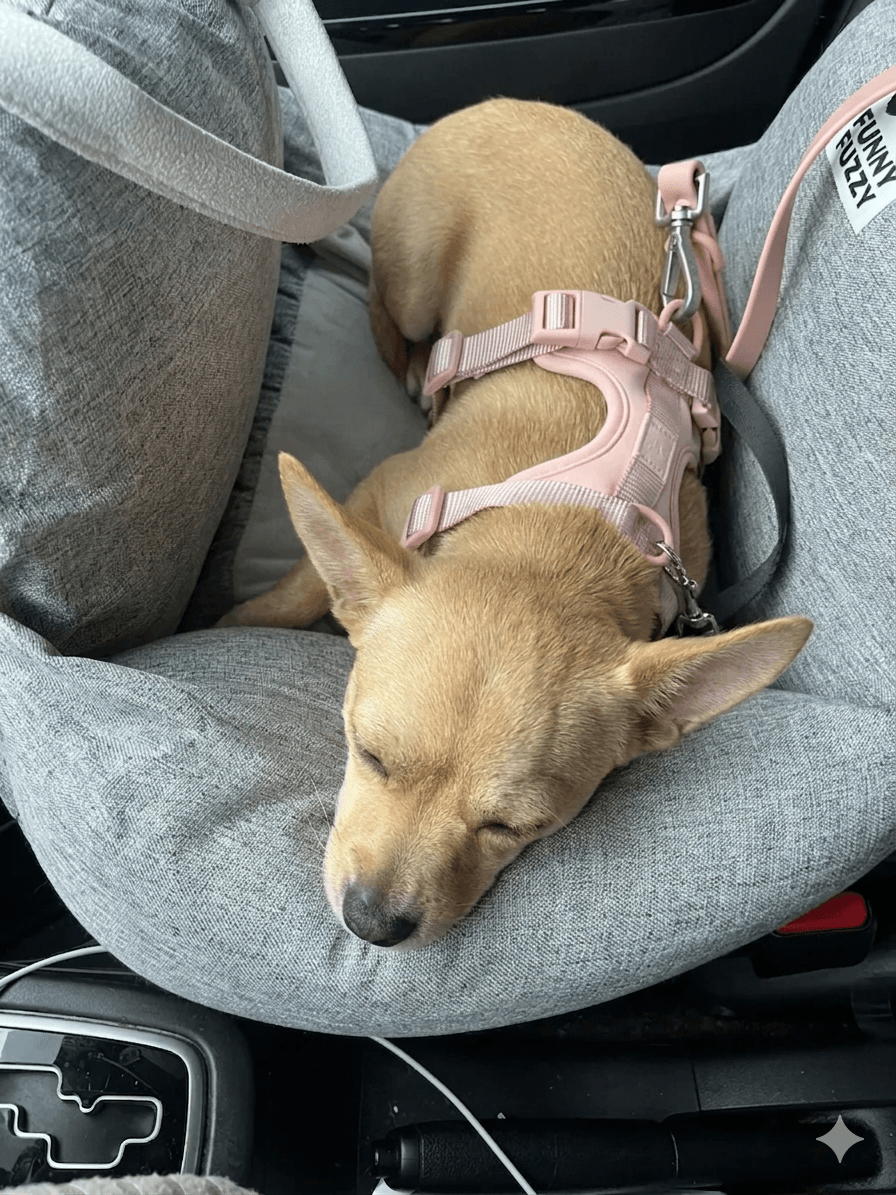
Why a Collar Is Dangerous in a Car
The physics of a sudden stop make a collar the worst possible restraint point for a dog in a car. Here is what happens in each scenario:
Tracheal compression under deceleration force
In a sudden stop at 50km/h, a 20kg dog generates approximately 400kg of forward force. If that dog is secured by the collar, all of that force is concentrated on a 2cm-wide strip of webbing pressed against the trachea. The trachea is a flexible tube of cartilage rings — it compresses, and in severe cases, fractures. Even in a moderate stop where the dog is not injured, the coughing and throat pain from tracheal compression can last for days. This is the same reason harnesses are recommended over collars for walking dogs that pull — but the forces in a car stop are 10–20 times higher than any pulling force on a walk.
Cervical spine whiplash
Even if the trachea is not compressed enough to cause immediate injury, the dog’s head continues forward while the body is restrained by the collar. This creates a whiplash effect on the cervical spine — the same mechanism that causes neck injuries in humans in car accidents. Dogs have more vertebrae in their necks than humans do, and the ligament structure is not designed for sudden deceleration force applied from a collar. Long-backed breeds (Dachshunds, Corgis, Basset Hounds) are particularly vulnerable because the spine is already elongated and any whiplash force is amplified.
Collar can slip over the skull under force
A collar that fits correctly at rest — two fingers under the strap — can stretch and slide over the dog’s skull under the sudden tension of a car stop. If the collar slides off, the dog is unrestrained entirely — free to hit the front seats, the dashboard, or leave the vehicle through a broken window. This is the same failure mode that allows dogs to back out of loose collars on walks, but at car-deceleration force, it happens faster and with more severe consequences. A harness cannot slip off in the same way because it secures around the chest and belly, not just the neck.
How to Secure a Dog in the Car with a Harness and Leash
Securing a dog in the car with a harness and leash is straightforward. The method below works with any no-pull harness that has a back D-ring and any standard leash with a metal clasp — no special car tether required.
Step 1: Put the harness on and check the fit
Fit the harness exactly as you would for a walk — neck strap snug above the shoulders, chest strap flat across the sternum, belly strap just behind the front legs. The two-finger rule applies at each strap. A loose harness in a car is as ineffective as a loose collar — the dog can slip out of it under deceleration force. For the full fitting process, see our harness tightening guide.
Step 2: Clip the leash to the back D-ring
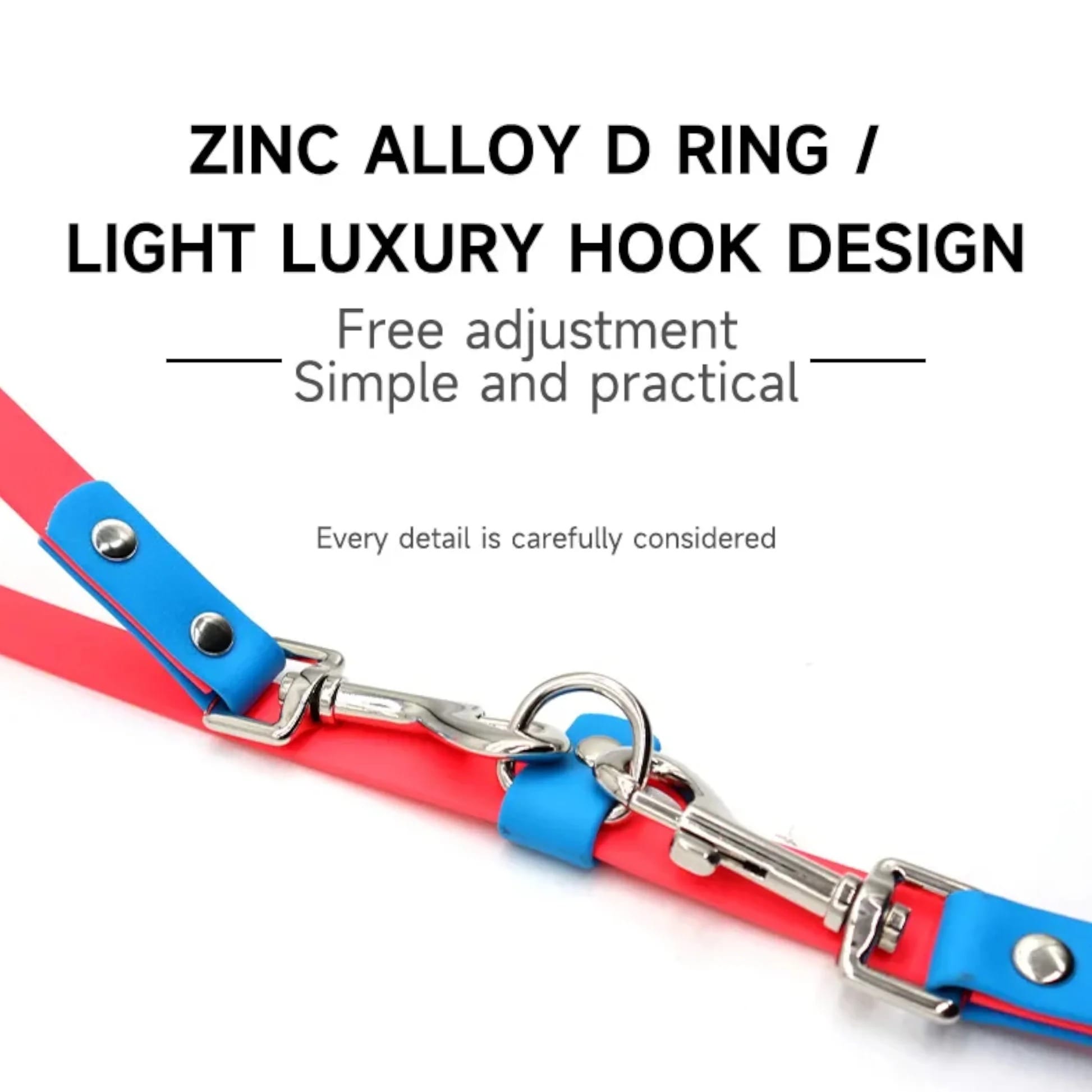
Use the back D-ring — not the front D-ring. The front D-ring is for pulling redirection on walks; in a car, the front clip is in the wrong position to distribute deceleration force. The back D-ring sits between the shoulder blades and distributes force across the entire chest panel of the harness, which is the broadest and most padded contact area. A leash with a 360° swivel metal hook is ideal because it prevents the leash from twisting as the dog moves in the seat. The MoonianPet Waterproof Leash has a zinc alloy swivel hook designed for exactly this kind of sustained load.
Step 3: Secure the other end to the seatbelt or headrest
Thread the handle end of the leash through the seatbelt buckle (loop it through the closed belt, not the buckle tongue) or around the headrest post. The goal is to create a fixed attachment point that will not release under force. A headrest post is stronger than a seatbelt loop — seatbelts are designed to release under certain load patterns, while a headrest post is a fixed steel bar. Adjust the leash length so the dog can sit, lie down, and shift position, but cannot reach the front seats or the driver’s arm. This is usually 30–50cm of slack — enough for comfort, not enough for the dog to become a projectile in a stop.
Step 4: Test the restraint
Before driving, pull the leash hard from the dog’s end. The harness should hold the dog in position without the straps shifting, and the attachment point should not slide or release. If the harness rotates, the chest strap is too loose — tighten it. If the dog can reach the front seats, shorten the leash. The test takes 10 seconds and catches the two most common problems before they become dangerous on the road.
Car Restraint Method Comparison
Why the harness method is safer than the alternatives.
| Method | Force Distribution | Risk Level |
|---|---|---|
| Collar + leash | Concentrated on trachea and cervical spine | High |
| Unrestrained | No restraint — dog becomes projectile | Critical |
| Harness + leash (back D-ring) | Distributed across chest, shoulders, and back | Low |
| Crated (secured) | Force absorbed by crate walls and seatbelt | Low |
What Type of Harness Works for Car Safety
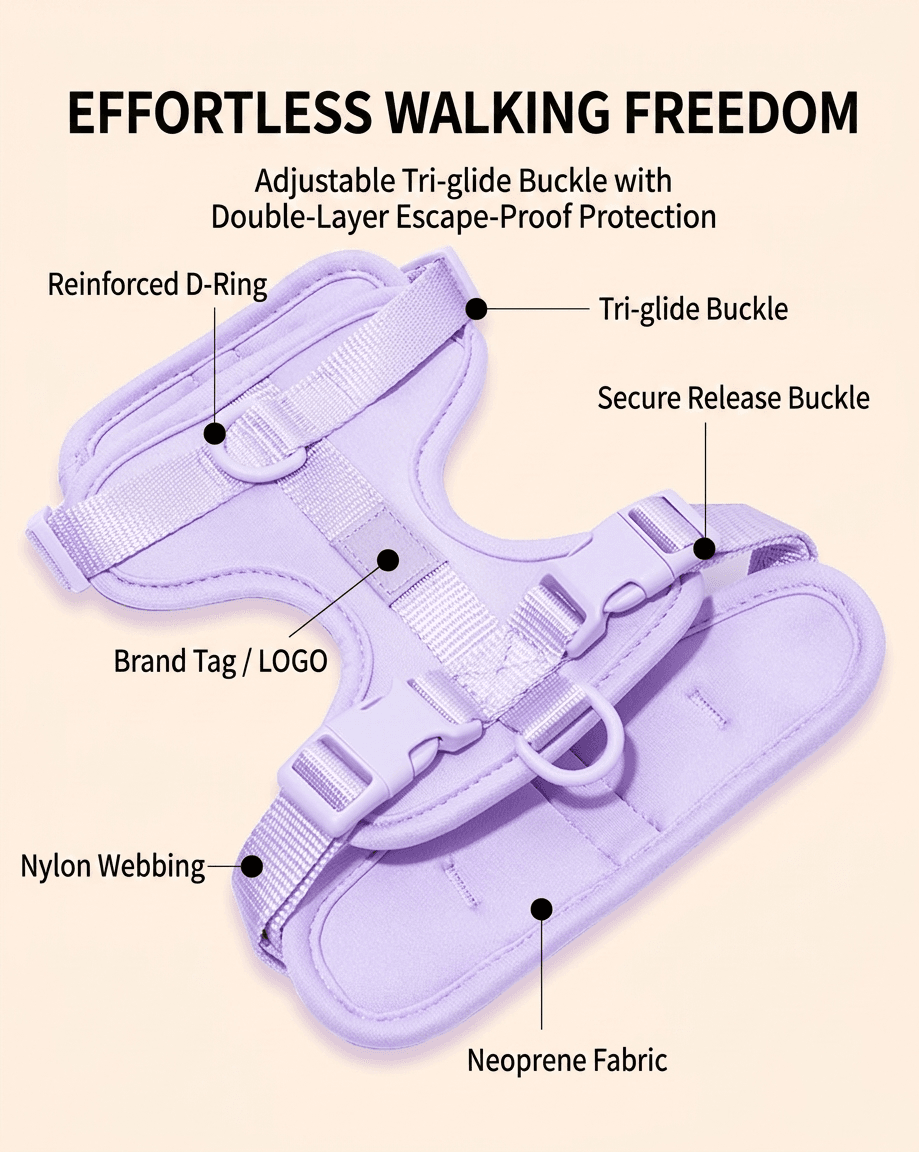
Not every harness is suitable for use as a car restraint. A harness that works for walking may not have the structural features needed to safely distribute deceleration force. Here is what to look for:
Neoprene padding at the chest panel
The chest panel is where the deceleration force concentrates when the leash pulls against the back D-ring. A harness with thin mesh padding at the chest will compress under sudden load, transferring force to the sternum and the soft tissue behind it. Neoprene padding — the same material used in wetsuits — maintains its cushioning under impact and distributes force across the full contact area rather than concentrating it at the strap edges. The MoonianPet No-Pull Harness has neoprene padding at the chest panel and underarm straps specifically for this kind of sustained and sudden load.
Back D-ring positioned between the shoulder blades
The back D-ring is the correct attachment point for car restraint because it sits above the broadest part of the chest. When force is applied through the back D-ring, it pulls the entire harness backward against the chest panel, distributing load across the sternum, the shoulders, and the belly strap. A harness with only a front D-ring is unsuitable for car use — the front clip pulls the harness forward, which can rotate it and concentrate force at the throat strap. If your harness has both front and back D-rings, always use the back one for the car.
Three-point independent adjustment
A harness used for car restraint must fit precisely — looser than walking fit is not acceptable because the deceleration forces are higher. Three-point independent adjustment at the neck, chest, and belly lets you achieve the two-finger standard at each strap without compromising another. Harnesses with only one or two adjustment points cannot achieve a precise enough fit for car safety. For the full fitting process, see our harness tightening guide.
Metal hardware — not plastic
The D-rings and buckles on a car-safety harness must be metal — zinc alloy or stainless steel. Plastic hardware, which is fine for walking, can shatter under the sudden load of a car stop. Check your harness: if the D-rings are plastic, do not use it for car restraint. The MoonianPet harness uses zinc alloy D-rings and a high-strength ABS-reinforced buckle at the back — the buckle is not the load-bearing point (the D-ring is), but the hardware overall is rated for sustained pulling force that exceeds car-deceleration loads.
Three Common Mistakes That Make Harness Restraint Ineffective
Even with the right harness, the method can fail if these three mistakes are made:
Leash too long
The most common mistake is leaving too much slack in the leash. A 6-foot leash used at full length gives the dog enough room to build momentum before the leash stops them — which means the force at the moment of restraint is much higher than if the leash were short. Keep the leash at 30–50cm of slack — enough for the dog to sit and lie down, but not enough to reach the front seats. If your leash is too long, loop it through the headrest post and back to the harness clasp to shorten it. The MoonianPet hands-free leash’s D-ring system allows short-traffic configuration, which is also the correct length for car use.
Harness too loose
A harness that passes the two-finger test for walking may still be too loose for car use — because the forces are higher. In a car stop, the harness needs to hold the dog without shifting. If the chest strap can move more than a centimetre sideways when you press it, it is too loose for car safety. Tighten each strap half a notch tighter than walking fit — not enough to restrict breathing, but enough that the harness does not shift under sudden force. The two-finger rule and walk test still apply, but aim for the tighter end of the acceptable range.
Attaching to the seatbelt buckle tongue
The seatbelt buckle tongue — the metal tab that clicks into the buckle — is not a safe attachment point. It is designed to release under specific load patterns, and a dog pulling against it can trigger the release mechanism. Loop the leash through the closed seatbelt webbing (the belt itself, not the tongue) or around the headrest post. The headrest post is the safest attachment point because it is a fixed steel bar that does not release under any load. If your car does not have adjustable headrests (some older models do not), use the seatbelt webbing loop method instead.
Why Not Use a Car Seat or Crate?
Car crates and dedicated car seats are both excellent options — and in some cases safer than a harness restraint. A properly secured travel crate is the gold standard for car safety because it contains the dog entirely, preventing contact with the car interior in any direction. If you have a SUV or estate with enough cargo space and a dog that is comfortable in a crate, this is the safest option.
However, not every car has the space for a crate, and not every dog is crate-trained. For owners who need their dog on the back seat — for space reasons, for dogs that get anxious in crates, or for multi-dog households — the harness-and-leash method is the practical alternative. It is not as safe as a secured crate in a severe accident, but it is dramatically safer than a collar restraint or an unrestrained dog. The harness method is also the one that works with gear you already own — no additional purchases beyond a harness and leash you should have for walking anyway. For more on when to use a harness vs collar in different scenarios, see our collar vs harness guide.

The Car Safety Setup That Works
The MoonianPet No-Pull Dog Harness is designed to work as a car restraint when used with a standard leash. The neoprene chest panel distributes deceleration force across the full contact area rather than concentrating it at strap edges. The back D-ring sits between the shoulder blades — the correct attachment point for car use. Three-point independent adjustment lets you achieve a precise fit that will not shift under sudden force. Zinc alloy hardware handles sustained and impact loads that plastic hardware cannot.
For the leash, the MoonianPet Waterproof Leash with its zinc alloy 360° swivel hook is rated for the sustained pulling force involved in car restraint, and the PVC-coated webbing does not absorb moisture or odour from the car seat. For a matched setup, the Harness & Leash Set pairs both in the same colour — one purchase, walk and car use covered. For harness fitting before you use it in the car, see our no-pull harness fitting guide.
Frequently Asked Questions
How do you secure a dog in the car?
Put a properly fitted no-pull harness on the dog, clip a leash to the back D-ring (not the front), and secure the other end of the leash to a fixed point in the car — preferably the headrest post, or looped through the closed seatbelt webbing. Keep 30–50cm of slack so the dog can sit and lie down but cannot reach the front seats. Test the restraint by pulling hard on the leash before driving. Never secure a dog by the collar — a sudden stop concentrates all deceleration force on the trachea.
Is it safe to use a collar to secure a dog in the car?
No. In a sudden stop at 50km/h, a 20kg dog generates approximately 400kg of forward force. If secured by the collar, this force is concentrated on a 2cm-wide strip of webbing against the trachea — causing tracheal compression, cervical spine whiplash, or in severe cases, fracture. The collar can also stretch and slide over the dog’s skull under sudden tension, leaving the dog entirely unrestrained. Always use a harness that distributes force across the chest and shoulders.
Can I use my walking harness for car safety?
Yes, if it meets three criteria: it has a back D-ring between the shoulder blades (the correct attachment point for car use), it has neoprene or similarly resilient padding at the chest panel (to distribute force without compressing), and it has metal hardware (zinc alloy D-rings, not plastic). The MoonianPet No-Pull Harness meets all three criteria and is designed for both walking and car restraint use. Tighten the straps half a notch tighter than walking fit for car use.
How much slack should the leash have in the car?
30–50cm of slack. Enough for the dog to sit, lie down, and shift position comfortably — but not enough to reach the front seats or the driver’s arm. Too much slack allows the dog to build momentum before the restraint engages, which increases the force at the moment of restraint. If your leash is too long, loop it through the headrest post and back to the harness clasp to shorten it. The short-traffic configuration on the MoonianPet hands-free leash is approximately the correct length for car use.
Should I use the front or back D-ring for car safety?
Always use the back D-ring. The back D-ring sits between the shoulder blades and distributes deceleration force across the full chest panel. The front D-ring is designed for walking pulling redirection — in a car, the front clip pulls the harness forward, which can rotate it and concentrate force at the throat strap. If your harness has only a front D-ring, it is not suitable for car restraint. The MoonianPet harness has both, but use the back one for the car.
Is a car crate safer than a harness restraint?
Yes — a properly secured travel crate is the gold standard for car safety because it contains the dog entirely, preventing contact with the car interior in any direction. However, not every car has the space for a crate, and not every dog is crate-trained. For owners who need their dog on the back seat, a harness restraint is the practical alternative — dramatically safer than a collar or no restraint, though not as safe as a crate in a severe accident. The harness method has the advantage of using gear you already own for walking.
Looking for more harness and safety advice? Our harness tightening guide covers the two-finger rule and walk test for getting a precise fit before car use. Or if you are deciding between harness and collar for daily walks, see our collar vs harness guide for the full comparison.
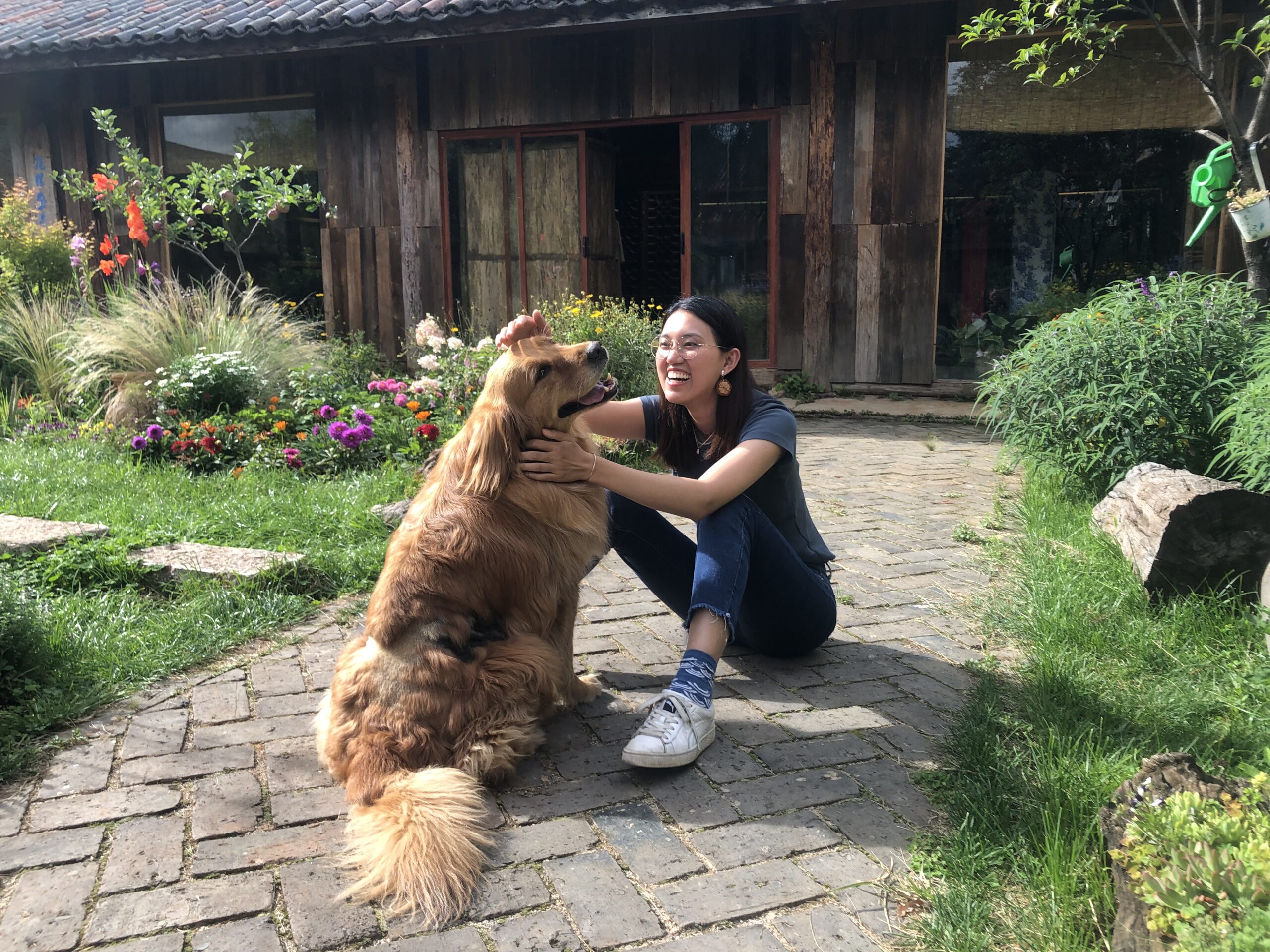
Wenyue
Wenyue is the founder of MoonianPet and writes about dog collars, harnesses, waterproof pet gear, and everyday dog care. Growing up with dogs inspired her lifelong interest in pet care and practical dog gear. Through MoonianPet, she researches dog collars, harnesses, waterproof materials, and everyday solutions that help active dogs stay comfortable during daily adventures.