
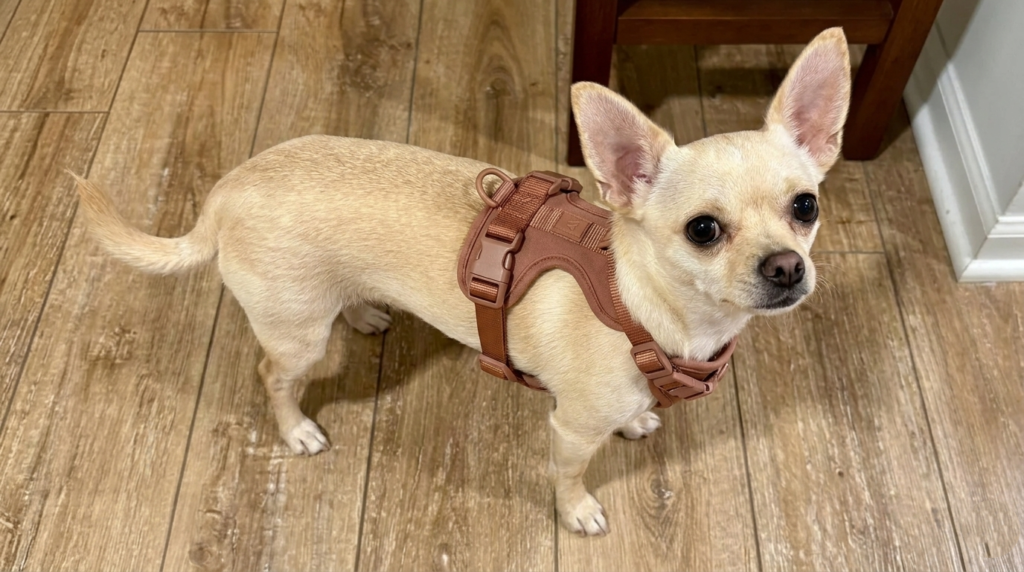
If you have ever stared at a dog harness size chart and wondered what “chest girth” actually means, you are not alone. It is the single most confusing term on most size charts — and the term that causes the most sizing mistakes. Size charts list chest girth in centimetres or inches, give a range for each size, and assume you already know what to measure and where. Most owners do not. The result is a harness that is one size too big, one size too small, or fits the chest but not the neck — and a return process that takes longer than the original purchase.
The confusion is understandable. “Girth” is not a word most people use in everyday life, and “chest” on a dog means something different than “chest” on a human. A human’s chest is the upper torso around the ribs. A dog’s chest, for harness sizing purposes, is a specific point further forward — directly behind the front legs. Understanding this distinction is the difference between buying the right harness first time and joining the 30% of online harness orders that get returned for size issues.
This guide explains exactly what chest girth is on a dog, where to find the measurement point, why it matters for harness sizing, and how it differs from the other measurements you will see on size charts. If you already understand the concept and just need to measure, jump straight to our step-by-step measuring guide.
What Is Chest Girth on a Dog?
Chest girth is the circumference of a dog’s body measured immediately behind the front legs, at the widest part of the chest. It is the distance around the dog’s body — not the length, not the height, and not the weight. Harness manufacturers use chest girth as the primary sizing measurement because it corresponds to where the harness’s belly strap actually sits on the dog’s body when fitted correctly.
In plain language
Imagine wrapping a tape measure around your dog’s body, just behind its front legs, like putting a belt around its chest. The number where the tape meets its starting point — that is the chest girth. If the tape reads 55cm, your dog’s chest girth is 55cm. That is the number you compare against the size chart when buying a harness.
What girth actually means
“Girth” is a measurement term that means the distance around something — its circumference. Horse owners use it for the strap that goes around a horse’s belly. Sailors use it for the circumference of a rope. In dog sizing, girth always refers to a circumference measurement, never a length. So when you see “chest girth,” “neck girth,” or “belly girth,” you are always measuring around the dog, not along it.
Why it is measured behind the front legs
The point immediately behind the front legs is the widest part of the dog’s chest, and it is also where the harness’s belly strap needs to sit. Measuring anywhere else gives you a number that does not match how the harness is designed to fit. If you measure too far back toward the ribcage, you get a larger number and buy a harness that is too big. If you measure too far forward over the shoulders, you get a smaller number and the harness will be too tight. The “behind the front legs” point is not arbitrary — it is the harness’s actual contact point.
Where Exactly Is the Chest Girth Measurement Point?
The measurement point is the source of almost all sizing mistakes. Here is how to find it on your dog:
Step 1: Find the front leg armpit
Place your hand on the front of one of your dog’s front legs. Slide your hand down the leg toward the body. Where the leg meets the body — the crease where the leg folds against the chest — is the armpit. This is your landmark. The chest girth measurement point is just behind this armpit, on the side of the dog’s body.
Step 2: Move one finger’s width back
From the armpit, move back (toward the tail) by about one finger’s width. This is the exact measurement point. The reason for the one-finger offset is that the harness’s belly strap does not sit directly in the armpit crease — it sits just behind it, where the chest is at its widest and where the strap can wrap around the body without pinching the leg.
Step 3: Wrap a tape around the dog at that point
The tape should circle the entire body — passing under the dog, up the other side, and meeting where you started. The tape should be level, not twisted, and flat against the dog’s body. The number where the zero end of the tape meets the rest of the tape is your dog’s chest girth. For the full measuring walkthrough, see our step-by-step measuring guide.
What it is NOT
Chest girth is not the widest part of the ribcage (which is 5–10cm further back). It is not the length of the dog’s back. It is not the circumference around the neck. And it is not the dog’s weight. Each of these measurements serves a different purpose — weight is for feeding and medication, length is for coats, neck girth is for collars. Chest girth is specifically for harness and clothing sizing where the garment wraps around the chest.
Why Chest Girth Matters for Harness Sizing
Chest girth is the primary sizing measurement for almost every dog harness on the market. Understanding why explains why other measurements — like weight — are unreliable on their own:
The belly strap is the load-bearing strap
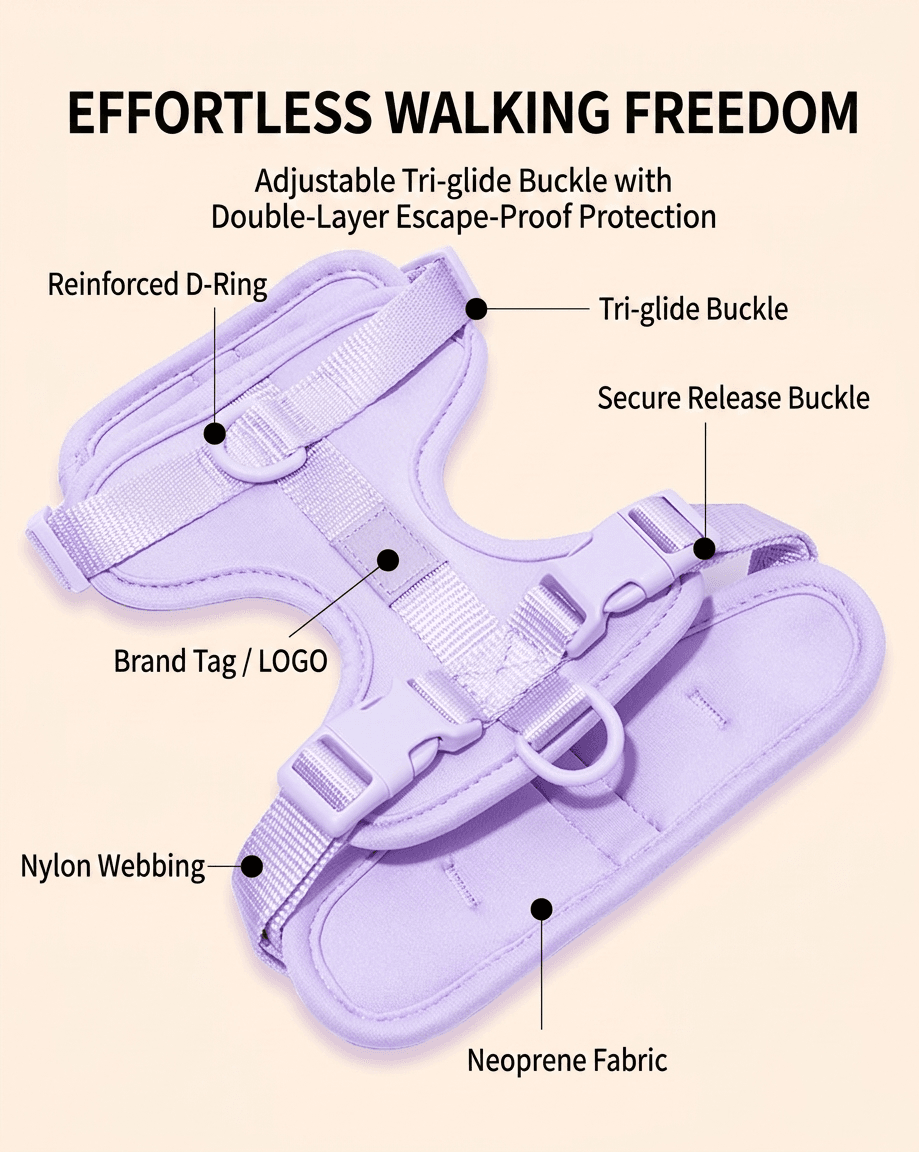
On a harness, the belly strap is the one that takes the pulling force when the dog is on leash. The neck strap holds the harness in position; the chest strap keeps it centred; the belly strap does the actual work. Because the belly strap sits at the chest girth point, the chest girth measurement determines whether the strap can wrap around the dog’s body at the correct tension. A harness sized to the wrong chest girth cannot do its job — the strap will be either too tight (restricting breathing) or too loose (allowing the harness to rotate and the dog to escape).
Weight alone cannot predict chest girth
Two dogs of the same weight can have chest girths that differ by 10cm or more. A 15kg Staffordshire Terrier has a broad, muscular chest measuring around 60cm. A 15kg Whippet has a deep but narrow chest measuring around 50cm. Both weigh the same; both need different harness sizes. This is why weight-based size charts are unreliable — they only work for “average” proportions, and very few dogs are perfectly average. Chest girth is the measurement that actually predicts whether the harness will fit.
Chest girth accounts for body shape
Different breeds have dramatically different body shapes — deep-chested (Greyhounds, Setters), barrel-chested (Bulldogs, Pugs), or slab-sided (Labradors, Shepherds). Weight and length do not capture these differences; chest girth does. A harness sized by chest girth fits a deep-chested breed and a barrel-chested breed of the same weight correctly, because the measurement reflects the actual circumference the harness needs to wrap around.
Chest Girth vs Other Measurements
Each measurement serves a different purpose. Here is when to use which.
| Measurement | What It Means | Used For |
|---|---|---|
| Chest girth | Circumference behind the front legs | Harness sizing (primary) |
| Neck girth | Circumference at the base of the neck | Collar sizing; harness sizing (secondary) |
| Body length | From base of neck to base of tail | Coats, pyjamas, clothing |
| Weight | Body mass in kg or lbs | Feeding, medication dosage |
| Height at withers | Ground to top of shoulder blade | Breed standard, agility classes |
Typical Chest Girth by Dog Size
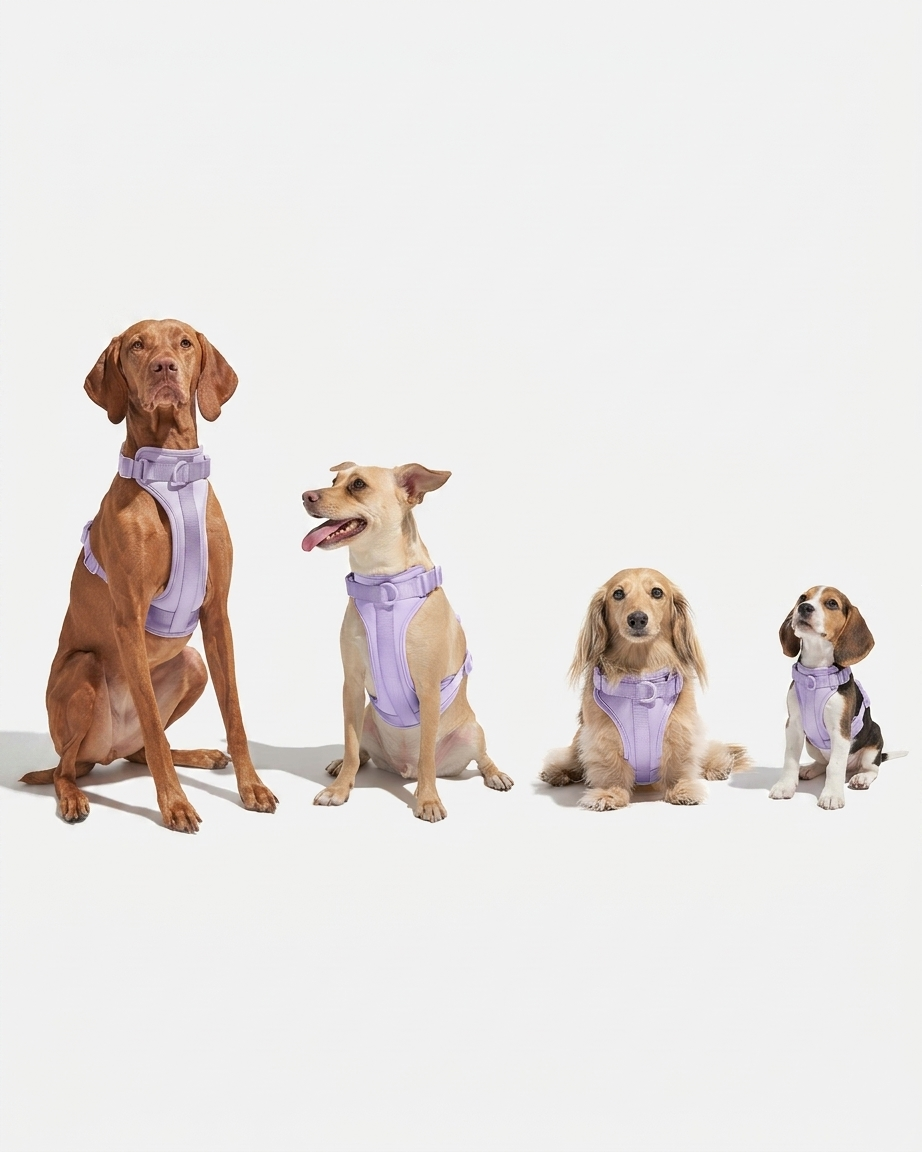
While you should always measure your individual dog, here are the typical chest girth ranges for different dog sizes. Use this as a sanity check on your measurement — if your Chihuahua measures 70cm, something went wrong.
| Dog Size | Typical Weight | Typical Chest Girth | Example Breeds |
|---|---|---|---|
| Toy | 2–5 kg | 30–38 cm / 12–15 in | Chihuahua, Yorkie, Toy Poodle |
| Small | 5–10 kg | 38–53 cm / 15–21 in | Cavalier, Pug, Mini Schnauzer |
| Medium | 10–20 kg | 53–66 cm / 21–26 in | Corgi, Beagle, Border Collie |
| Large | 20–35 kg | 66–81 cm / 26–32 in | Labrador, Golden, GSD |
| Extra Large | 35+ kg | 81–96+ cm / 32–38+ in | Great Dane, Mastiff, Rottweiler |
These are typical ranges, not guarantees — individual dogs within a breed can vary significantly. A working-line Labrador will have a larger chest girth than a show-line Labrador of the same weight, because working lines are bred for broader, more muscular chests. Always measure your individual dog rather than relying on breed averages. For the full measurement walkthrough, see our step-by-step measuring guide.
Common Questions About Chest Girth
Is chest girth the same as chest size?
In most dog sizing contexts, yes. “Chest girth,” “chest size,” and “chest circumference” all refer to the same measurement — the distance around the dog’s body immediately behind the front legs. However, on some size charts, “chest size” can be ambiguous, so always check whether the chart specifies “girth” or “circumference.” If a chart just says “chest” without specifying, assume it means the circumference behind the front legs.
Does chest girth change over time?
Yes. Dogs gain and lose weight, build or lose muscle, and change coat thickness seasonally. A dog’s chest girth can vary by 2–4cm over the course of a year — more in double-coated breeds that grow a thick winter coat. Puppies change the most, with rapid growth in the first 12–18 months. Adult dogs of stable weight may still see small changes due to muscle development from exercise. Re-measure your dog every 6 months, or whenever you are buying a new harness.
What if my dog’s chest girth is between two sizes?
For most dogs, choose the larger size. A harness that is slightly too large can be tightened down to fit, but a harness that is too small cannot be loosened beyond its adjustment range. The MoonianPet harness has a wide adjustment range — size M covers 53–71cm, giving plenty of room to tighten to a precise fit. The exception is dogs with proportionally large heads (Pugs, Pomeranians) — for these breeds, the smaller size may be needed to prevent the dog backing out of the harness. For more on this, see our harness tightening guide.
Do I need to measure neck girth too?
For most dogs, no. Harness manufacturers design the neck opening to match the chest size within each size range, so choosing by chest girth alone usually gives you a harness that fits both the chest and the neck. However, if your dog has unusual proportions — a large head on a narrow chest (Pugs, French Bulldogs) or a narrow head on a deep chest (Greyhounds, Whippets) — measure neck girth as well and verify it falls within the harness’s range. See our dog harness size guide for both measurements.
From Chest Girth to the Right Harness
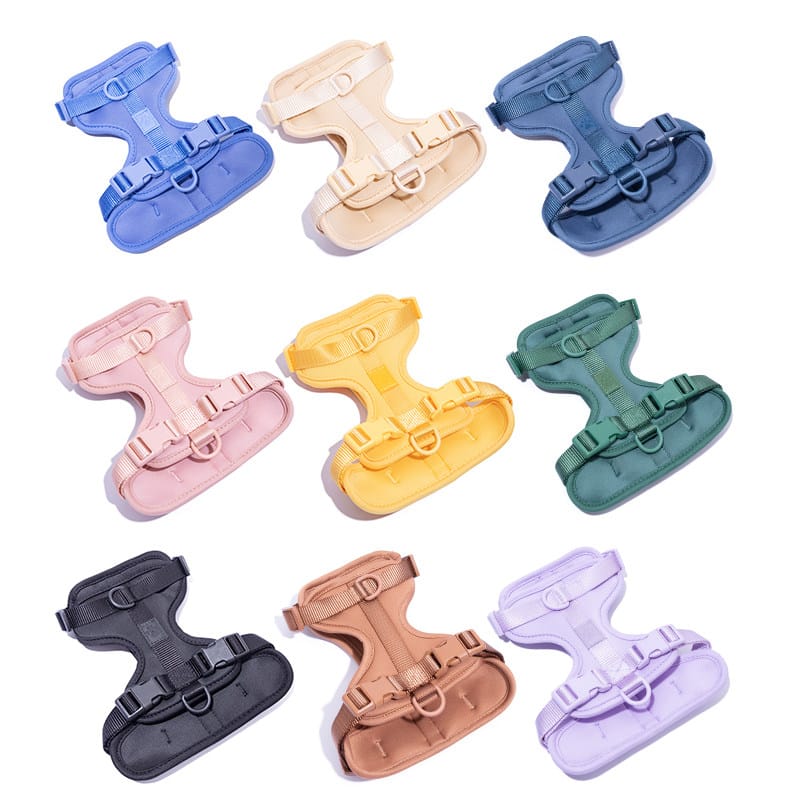
Once you understand what chest girth is, the rest of the harness buying process is straightforward. The MoonianPet No-Pull Dog Harness is sized by chest girth across five sizes (XS to XL, covering 30–96cm), with each size offering a wide adjustment range so a dog whose measurement falls mid-range has room to tighten or loosen as needed. Three-point independent adjustment at the neck, chest, and belly means the harness accommodates different body shapes within the same chest girth range — deep-chested, barrel-chested, and slab-sided dogs can all achieve a correct fit from the same size.
To find your dog’s chest girth, see our step-by-step measuring guide. To match that measurement to a harness size, see our dog harness size guide for the full XS–XL chart. And once the harness arrives, see our no-pull harness fitting guide for the step-by-step fitting process.
Frequently Asked Questions
What does chest girth mean on a dog?
Chest girth is the circumference of a dog’s body measured immediately behind the front legs, at the widest part of the chest. It is the distance around the dog’s body — not its length or weight. Harness manufacturers use chest girth as the primary sizing measurement because it corresponds to where the harness’s belly strap sits on the dog. If a size chart says “chest girth: 53–71cm” for size M, that means the harness fits dogs whose chest circumference behind the front legs is between 53 and 71cm.
Where do you measure chest girth on a dog?
Immediately behind the front legs, at the point where the harness’s belly strap will sit. Find the armpit crease where the front leg meets the body, then move one finger’s width back toward the tail. Wrap a soft measuring tape around the dog at that point — the tape should be level, flat against the body, and snug but not tight. The number where the tape meets its starting point is your dog’s chest girth. For the full walkthrough, see our measuring guide.
Is chest girth the same as chest size?
In most dog sizing contexts, yes. “Chest girth,” “chest size,” and “chest circumference” all refer to the same measurement — the circumference behind the front legs. However, “chest size” can be ambiguous, so always check whether the size chart specifies “girth” or “circumference.” If a chart just says “chest” without clarification, assume it means the circumference behind the front legs.
Can I use my dog’s weight instead of chest girth?
Not reliably. Two dogs of the same weight can have chest girths that differ by 10cm or more, depending on breed and body shape. A 15kg Staffordshire Terrier and a 15kg Whippet need different harness sizes despite weighing the same. Weight-based sizing only works for “average” proportions, and most dogs are not perfectly average. Always measure chest girth for harness sizing — weight is useful for feeding and medication, not for harness fit.
Does chest girth change as my dog ages?
Yes. Puppies grow rapidly in their first 12–18 months and their chest girth can change by centimetres per month. Adult dogs of stable weight may still see 2–4cm variation over the year due to muscle gain or loss, weight changes, and seasonal coat thickness. Double-coated breeds (Huskies, Golden Retrievers, Samoyeds) typically have a larger chest girth in winter when their undercoat is full. Re-measure every 6 months or before buying a new harness.
What is the difference between chest girth and neck girth?
Chest girth is the circumference behind the front legs (the harness belly strap position). Neck girth is the circumference at the base of the neck (the collar position). Both are used for harness sizing, but chest girth is the primary measurement — the harness’s load-bearing strap is the belly strap at the chest girth point. Most dogs fit a harness sized by chest girth alone, but dogs with unusual proportions (large head, narrow chest or vice versa) should verify both measurements against the size chart.
Now that you understand what chest girth is, the next step is measuring it. See our step-by-step measuring guide for the full walkthrough, or jump straight to our dog harness size guide if you already have your measurement.

Wenyue
Wenyue is the founder of MoonianPet and writes about dog collars, harnesses, waterproof pet gear, and everyday dog care. Growing up with dogs inspired her lifelong interest in pet care and practical dog gear. Through MoonianPet, she researches dog collars, harnesses, waterproof materials, and everyday solutions that help active dogs stay comfortable during daily adventures.