
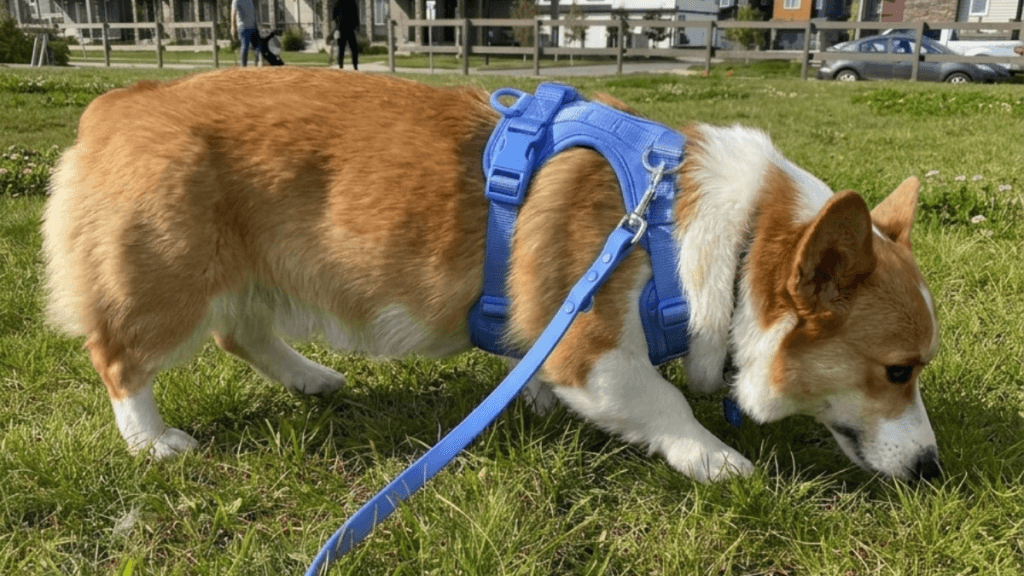
Corgis are deceptively challenging to fit in a harness. They look like small dogs — and by weight, they are — but their proportions are unlike almost any other breed in the small-to-medium category. A Pembroke Welsh Corgi has a long, low body, short legs, a wide deep chest, and a relatively large head for their size. Standard harnesses sized for small dogs by weight alone rarely fit Corgis well, and the consequences of poor fit on a low-to-the-ground dog show up faster than on taller breeds.
The underarm straps on a poorly fitted harness sit directly against the short front legs of a Corgi on every stride. Chafing develops quickly when the chest strap is too far forward or the belly strap too tight, because these contact points move with every step rather than staying still. Getting the fit right from the start saves significantly more discomfort than on a longer-legged dog where the contact points are less active.
This guide covers the specific fit considerations for Corgis, how to measure correctly for their unusual proportions, and what features to prioritise when choosing a harness for this breed.

Why Corgis Are Different to Fit
The Corgi’s body shape creates three specific harness fit challenges that do not apply to most other small breeds:
Wide, deep chest relative to leg length
A Corgi’s chest is wide and deep for a dog that weighs 10–14kg. The chest girth measurement on a Corgi is often closer to a medium-sized dog than the weight would suggest. This means harnesses sized purely by weight frequently end up with a chest strap that is too tight — the strap cuts into the chest rather than sitting flat against it. Always measure chest girth and size from that number, ignoring weight-based size guides entirely for this breed.
Short front legs mean the underarm straps are very close to the ground
On a tall dog, the belly strap and underarm contact points sit well above the ground and are relatively inactive — they stay in position as the dog walks. On a Corgi, the same contact points are just centimetres above the ground and move with every stride as the short legs swing through. A strap that is slightly too far forward, or slightly too tight, rubs in a way that would be imperceptible on a taller breed but causes visible chafing on a Corgi within a single walk.
Long back means back D-ring position matters
Corgis have a notably long back relative to their leg length. A harness designed for a compact-bodied small dog may have a back panel that ends too far forward on a Corgi, placing the back D-ring over the mid-back rather than between the shoulder blades. The back D-ring should sit between the shoulder blades — not further back — for both comfort and correct leash attachment. On a long-bodied dog, check this position specifically after fitting.
What to Look For in a Corgi Harness
Wide adjustment range at the chest
The chest adjustment needs to accommodate a Corgi’s disproportionately wide chest within a size that also fits their relatively shorter neck. A harness with independent neck and chest adjustment is essential — one that lets the chest strap sit correctly without forcing a compromised neck fit. The MoonianPet M size covers chest girths of 20.9–28.0 inches, which accommodates most adult Corgis comfortably.
Neoprene padding at underarm contact points
Because Corgi legs are short and active, the underarm contact points of the harness are under more friction than on taller breeds. Neoprene padding — soft, resilient, and non-porous — reduces friction at these points and does not flatten with use the way mesh or thin foam padding does. For a dog walked daily, this is the difference between a harness that causes no skin issues and one that requires padding adjustment or removal every few weeks. For more on why neoprene matters for smaller breeds, see our lightweight harness guide.
Front D-ring for pulling control
Corgis were bred as herding dogs — active, driven, and often enthusiastic pullers on a leash. A front D-ring is worth having for walks in distracting environments. The redirecting mechanism works on Corgis as on any other breed, and for a low-to-the-ground dog whose collar would sit against the trachea under pulling force, moving the leash attachment to the chest is also a health consideration. For the full comparison of clip positions, see our front clip vs back clip guide.
Overhead slip design rather than step-in
Step-in harnesses — where each front leg is threaded through a loop — are particularly problematic for Corgis. The short legs and wide chest make it difficult to position the loops correctly without the strap sitting too high under the armpits or the chest piece pulling sideways. An overhead slip-and-clip design that goes over the head and clips under the belly is both easier to put on and more likely to sit in the correct position on a Corgi. For a full comparison of harness types, see our step-in vs overhead guide.
How to Measure a Corgi for a Harness
Corgis need careful measuring rather than size-by-weight guessing. Follow these steps:
Step 1: Measure chest girth
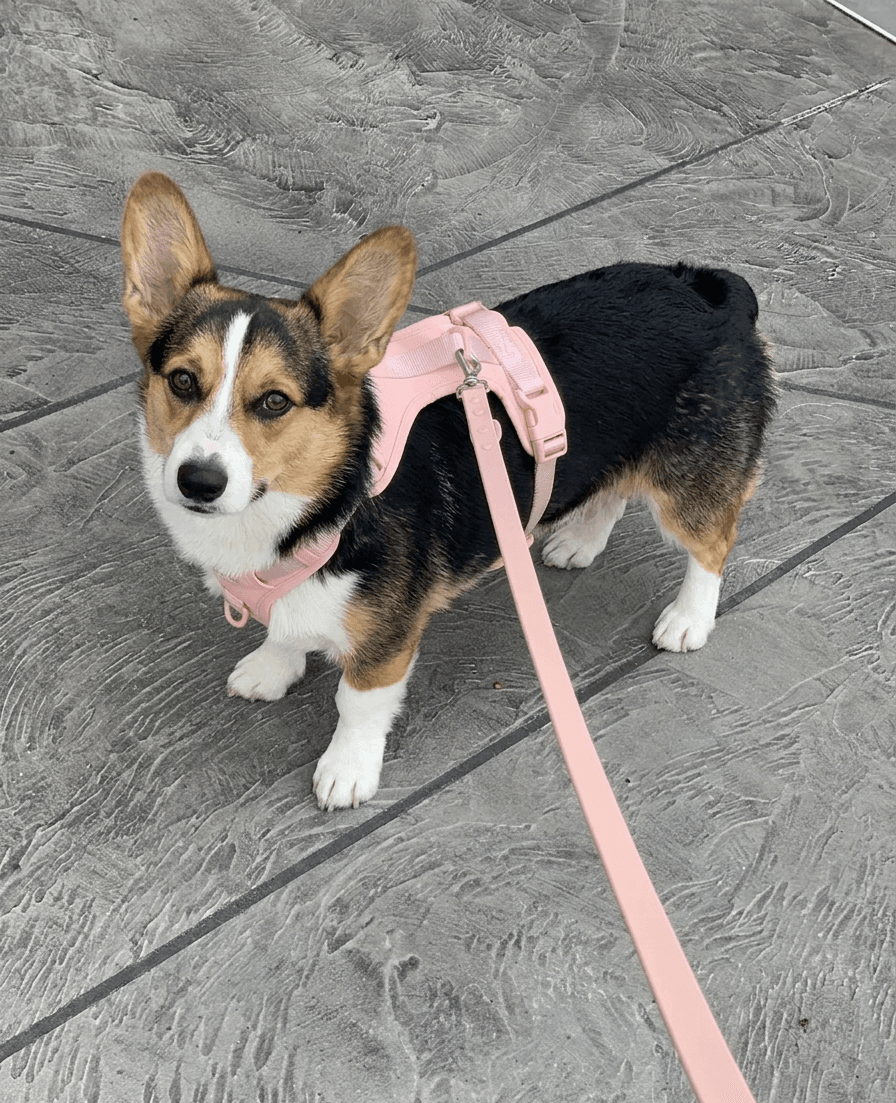
Wrap a soft tape measure around the widest point of the chest — just behind the front legs — with your Corgi standing. This is the primary sizing number. Most adult Pembroke Welsh Corgis measure 22–27 inches chest girth, placing them solidly in size M. Do not be surprised if your Corgi measures larger than expected — their wide chest consistently exceeds weight-based expectations.
Step 2: Measure neck girth
Measure the circumference of the neck at its widest point — where the harness neck loop will sit. Verify this falls within the adjustment range of the size you have chosen from the chest measurement. Most Corgis have a neck girth of 14–17 inches, which falls comfortably within the M size neck range.
Step 3: When between sizes, go up
If your Corgi measures at the top of S or the bottom of M, choose M. The three-point adjustment allows the larger size to be tightened to a precise fit. For Corgis specifically, having the chest strap able to open wide enough to sit flat across the sternum is more important than having a compact fit. Full size chart in our dog harness size guide.
Corgi Harness Size Quick Reference
Always measure your individual dog — these are typical ranges, not guarantees.
| Corgi Type | Typical Chest Girth | Typical Neck Girth | Recommended Size |
|---|---|---|---|
| Pembroke Welsh Corgi (adult) | 22–27 in / 56–69 cm | 14–17 in / 36–43 cm | M |
| Cardigan Welsh Corgi (adult) | 23–28 in / 58–71 cm | 15–18 in / 38–46 cm | M |
| Corgi puppy (4–6 months) | 15–20 in / 38–51 cm | 10–14 in / 25–36 cm | S |
| Corgi mix / larger build | 27–30 in / 69–76 cm | 17–20 in / 43–51 cm | L |
Fit Check Points Specific to Corgis
Standard fit checks apply — two fingers under each strap — but these additional points matter specifically for short-legged breeds:
Belly strap position — just behind the front legs, not against them
The belly strap should pass cleanly just behind the front legs without pressing against the upper leg at any point in the stride. On a Corgi, slide a finger between the belly strap and the back of each front leg while the dog is standing — there should be clear space. If the strap is touching the leg, slide it slightly rearward or loosen it slightly until there is no contact.
Walk three steps and recheck
Walk your Corgi a few steps and observe the underarm contact points during movement. On a short-legged dog, it is easier to see whether the chest strap or belly strap is rubbing during the stride than on a taller dog. Any lateral movement of the chest strap as the front legs swing through indicates it is too far forward or not fitted snugly enough.
Back D-ring between shoulder blades
Check that the back D-ring sits between the shoulder blades — not further back along the spine. On a long-bodied Corgi, a harness that sizes correctly by chest girth can still have the back panel sit further rearward than intended. If the D-ring is sitting past the mid-back, the harness is not the right design for a long-bodied breed. For full fitting guidance, see our no-pull harness fitting guide.
Health Considerations for Corgis
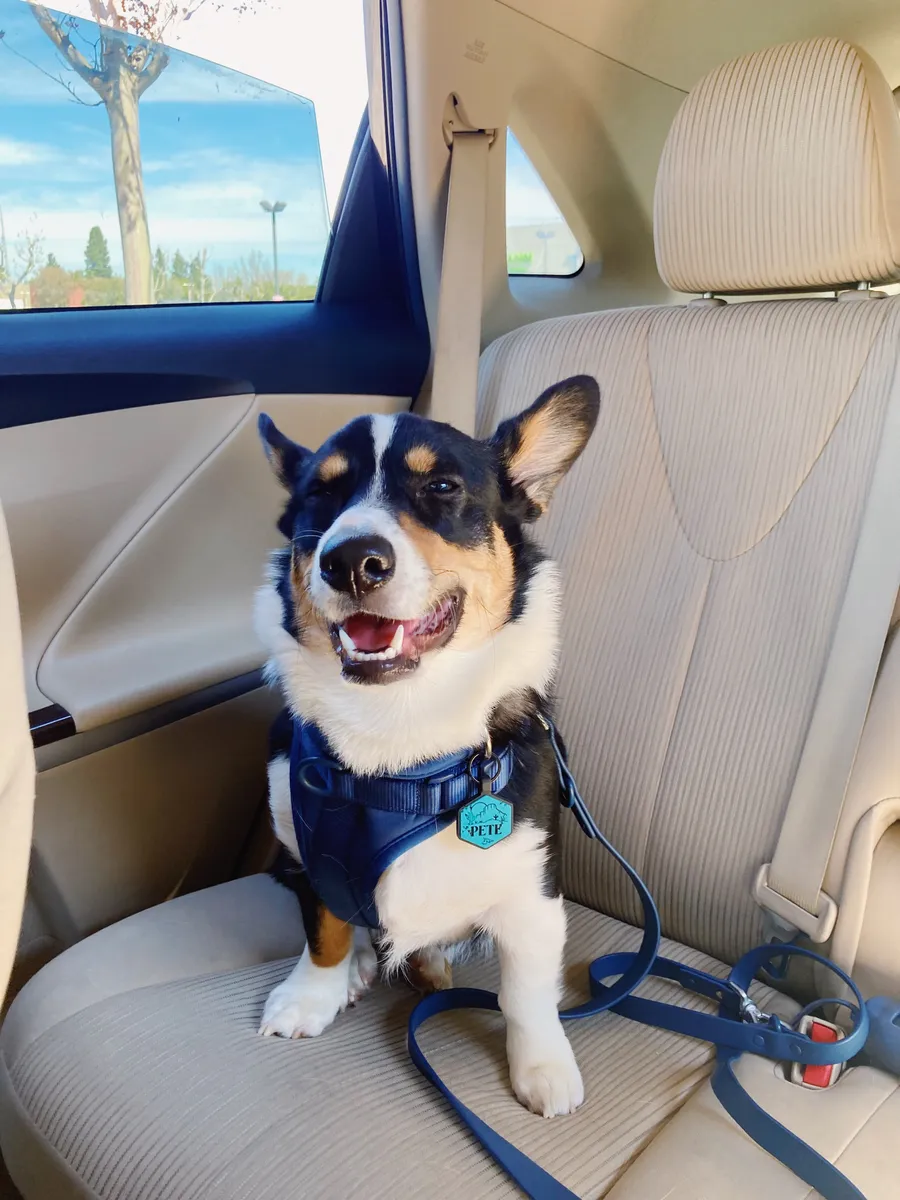
Corgis are predisposed to intervertebral disc disease (IVDD) — a spinal condition more common in chondrodystrophic breeds with long backs and short legs. A harness is generally recommended over a collar for Corgis for the same reason it is recommended for other breeds prone to neck and spinal sensitivity — removing tracheal and neck pressure from leash attachment reduces the load on the cervical spine over time.
For Corgis with diagnosed IVDD or spinal history, a back clip rather than front clip is the more conservative choice — the turning force from a front clip can create a twisting motion through the spine that is worth avoiding in at-risk dogs. Consult your vet about leash management if your Corgi has any history of disc issues. For the full comparison on when to use collar vs harness, see our collar vs harness guide.
Fitted for Every Body Shape — Including Corgis
The MoonianPet No-Pull Dog Harness in size M covers the chest girth range that fits most adult Corgis, with three-point independent adjustment for neck, chest, and belly. The neoprene padding at the chest panel and underarm straps reduces friction at the contact points that Corgi legs move against on every stride. Dual front and back D-rings give flexibility for pulling control walks and calmer outings. Available in 11 colors across XS to XL.
For a matched waterproof walking setup, the Harness & Leash Set pairs the harness with a waterproof PVC-coated leash in the same color — odour-proof and easy to wipe clean after muddy walks.
Frequently Asked Questions
What size harness does a Corgi need?
Most adult Pembroke and Cardigan Welsh Corgis fit size M, which covers chest girths of 20.9–28.0 inches. Always measure chest girth before ordering — Corgis consistently have a wider chest than their weight suggests, and weight-based size guides frequently recommend sizes that are too small. When between sizes, choose the larger one.
What size harness for a Corgi — S, M, or L?
For most adult Pembroke Welsh Corgis, size M is correct (chest 20.9–28.0 inches). Size S fits younger Corgis or very small adults under 20 inches chest girth. Size L is occasionally needed for larger Cardigan Welsh Corgis or heavier builds measuring 28 inches and above. The key is to measure chest girth at the widest point — behind the front legs — rather than going by weight or age. See the size table above for a full breakdown by Corgi type.
Are step-in harnesses good for Corgis?
Generally no. The wide chest and short legs of a Corgi make step-in harnesses difficult to position correctly — the loops either sit too high against the upper leg or the chest piece pulls sideways. An overhead slip-and-clip harness with independent neck and chest adjustment is easier to fit correctly and stays in position more reliably on a Corgi’s body shape.
Should Corgis wear a harness or collar?
A harness is recommended for Corgis as the leash attachment point, particularly given the breed’s predisposition to IVDD and spinal sensitivity. Removing neck and tracheal pressure from daily walk loading reduces long-term strain on the cervical spine. A collar can still be worn for ID tags. For a full comparison, see our collar vs harness guide.
Why does my Corgi’s harness rub under the front legs?
Underarm rubbing on a Corgi usually means the belly strap is sitting too far forward — against the back of the front legs rather than just behind them. Slide the belly strap rearward until there is clear space between it and the back of each front leg when the dog is standing. Also check that the padding is adequate — thin mesh padding compresses quickly on an active dog and offers little protection after a few weeks of daily use.
Do Corgis pull on the leash?
Many do — Corgis are herding dogs with strong working instincts, which translates to enthusiasm and forward drive on walks. A front-clip no-pull harness is effective for Corgis that pull, redirecting momentum sideways without putting pressure on the neck. For Corgis with any spinal history, use the back clip rather than front clip and consult your vet about leash management.
Looking for harness advice for other small breeds with unusual proportions? Our small dog harness guide covers fit considerations across toy and small breeds. Or if you are comparing harness types before buying, see our step-in vs overhead comparison.

Wenyue
Wenyue is the founder of MoonianPet and writes about dog collars, harnesses, waterproof pet gear, and everyday dog care. Growing up with dogs inspired her lifelong interest in pet care and practical dog gear. Through MoonianPet, she researches dog collars, harnesses, waterproof materials, and everyday solutions that help active dogs stay comfortable during daily adventures.