

The most common complaint about dog harnesses is not fit or durability — it is that they are difficult to put on. A dog that wriggles, spins, or simply refuses to stand still while you thread their legs through loops is enough to make many owners give up on harnesses altogether and go back to a collar.
Step-in harnesses were designed to solve exactly this problem. Instead of going over the dog’s head, the dog steps into two loops, and the harness clips over the back. The idea sounds simpler — but in practice, step-in harnesses have their own complications, and for dogs that pull, they carry a significant functional limitation.
This guide covers how each harness type works, which is genuinely easier to use day to day, and which is the better choice for your dog’s size, temperament, and walking behaviour.

How Each Harness Type Works
Step-in harness
The harness is laid flat on the ground in a figure-eight or triangular shape. The dog steps one front foot into each loop, and the harness is lifted up and clipped over the back. No part of the harness goes over the dog’s head. The leash attaches to a D-ring on the back, between the shoulder blades. Most step-in designs have one or two adjustment points and a single back clip.
Overhead harness (slip-over or vest style)
The neck loop is slipped over the dog’s head, the belly strap passes underneath, and a quick-release buckle clips closed on the side. The harness sits on the dog rather than requiring the legs to be threaded through loops. Most overhead harnesses — including no-pull designs — have multiple adjustment points and offer both front and back D-ring clip positions.
Which Is Actually Easier to Put On?
The answer depends entirely on your dog’s behaviour during dressing — and the two harness types present very different challenges:
Dogs that hate things going over their head
For dogs that duck, spin, or become anxious when anything approaches their head from above, a step-in harness eliminates that stress entirely. The dog never has to lower their head or have anything passed over their face. This is the main scenario where a step-in genuinely has a practical advantage — and it is a real one for dogs with a history of head sensitivity or who were not socialised to harnesses as puppies.
Dogs that wriggle or will not stand still
For wriggly dogs, a step-in harness is actually harder to use than an overhead design. Threading a moving dog’s legs simultaneously through two separate loops requires the dog to stand still with both front feet in the correct position — which wriggly dogs rarely do voluntarily. An overhead harness with a quick-release buckle can be put on with the dog in motion: slip the loop over the head, bring the belly strap under, and click the buckle. The whole process takes under ten seconds once practiced.
Daily use over time
A walking harness gets put on and taken off every day. Over time, the overhead-plus-buckle method becomes genuinely fast — most owners can put on an overhead harness in five to ten seconds. A step-in harness requires placing it on the floor, positioning both loops correctly, and waiting for the dog to step into both simultaneously — a process that rarely gets faster with repetition on an uncooperative dog. For daily use, the overhead design is quicker for most owners once the dog is comfortable with it.
Which Is Better for Dogs That Pull?
This is where the two harness types diverge most significantly — and where the step-in harness has a genuine functional limitation.
Step-in harnesses almost always have only a back clip. The leash attaches between the shoulder blades, which means a dog pulling forward has the leash running in the same direction as their momentum. The handler is effectively behind the dog with no mechanical advantage. For calm walkers this is fine. For dogs that pull, a back-clip step-in harness provides no redirection — it is simply a more comfortable way to be dragged down the street.
An overhead no-pull harness with a front D-ring on the chest redirects pulling momentum sideways when the leash goes taut — interrupting the pull before it builds. This is the mechanism that makes no-pull harnesses effective, and it is only available on overhead-style harnesses. If your dog pulls at all, an overhead harness with a front clip is the correct choice. For the full breakdown on clip positions, see our guide on front clip vs back clip harnesses.

Fit and Adjustment
Step-in harness fit
Most step-in harnesses adjust at one or two points — typically the back strap. This limited adjustment range means that dogs with non-standard proportions (deep-chested breeds, very lean breeds, or dogs with a large neck-to-chest ratio) often cannot get a snug fit. The loops that pass around each front leg are the most critical fit point — too loose and the harness rotates; too tight and it chafes under the armpits. Getting this right on a dog that will not stand still during adjustment is genuinely difficult.
Overhead harness fit
A well-designed overhead harness adjusts at neck, chest, and belly independently. Three adjustment points accommodate a much wider range of body shapes within a given size — the same harness can fit a deep-chested Boxer and a lean Border Collie of similar weight, because each strap adjusts separately. This is why overhead harnesses generally have lower return rates for sizing issues than step-in designs. For full measurement instructions, our dog harness size guide covers chest and neck girth in under two minutes.
Which Harness Type Suits Different Dogs
Dogs with strong head sensitivity — step-in may suit better initially
If your dog has a strong negative reaction to things going over their head and you do not have the time or inclination to desensitise them, a step-in gets the harness on without that stress. For small, calm dogs that rarely pull, this may be all you need. For dogs that pull, you will eventually need to address the head sensitivity to access a front-clip overhead harness — the step-in will not solve pulling.
Small dogs and toy breeds — either works, overhead preferred
Small dogs generate less pulling force, which reduces the functional disadvantage of a back-clip step-in. For very small toy breeds under about 5kg, a lightweight step-in is a reasonable choice if the dog is calm on a leash. For small dogs that pull consistently — and many do, particularly terrier breeds — the front clip on an overhead harness is still the more effective tool. See our guide on harnesses for small dogs for breed-specific advice.
Medium and large dogs — overhead no-pull harness
For any medium or large dog, the overhead no-pull harness is the correct choice. The step-in’s limited adjustment range fits medium and large breeds poorly, the back-only clip provides no pulling control, and the hardware on most step-in designs is not rated for the forces a larger dog generates. A three-point adjustment overhead harness with a front D-ring and metal hardware is both easier to fit correctly and more effective on a walk.
Puppies — overhead with early socialisation
Puppies that are introduced to an overhead harness early — with treats and positive associations — typically accept it without difficulty and never develop head sensitivity in the first place. Starting a puppy on a step-in because it seems simpler can create a habit of avoiding overhead harnessing that becomes harder to address as the dog grows. The overhead design has better long-term adjustability as a puppy grows through sizes, making it the more practical starting point.

What to Look For in an Overhead No-Pull Harness
If the overhead design is the right choice for your dog — which it is for most — these are the features that determine how well it works in practice:
Quick-release buckle with a clear click
The buckle is what makes an overhead harness fast to put on and take off every day. A quality quick-release buckle snaps shut with a clear, definitive click and does not open under lateral pressure. ABS-reinforced buckles maintain this click mechanism through years of daily use; lightweight plastic buckles become loose and unreliable over months.
Front and back D-rings
A dual-clip overhead harness gives you the option to use the front clip for pulling control and the back clip for calmer walks. This is the feature that step-in harnesses cannot offer and that makes the overhead design more versatile over the life of the harness. As your dog’s leash manners improve through training, you can gradually transition to the back clip without needing a new harness.
Neoprene padding on chest and underarm straps
The chest panel and the straps that pass under the front legs are the highest-pressure contact points on a walk. Neoprene padding prevents chafing, does not compress flat after a few weeks of use, and does not absorb moisture. For a harness used daily, neoprene is meaningfully more comfortable than mesh or bare webbing over time.
Three-point adjustment
Neck, chest, and belly adjustment independently. This is what allows one harness to fit the range of body shapes within a size category without requiring exact sizing. For the full fitting process once you have the harness, our guide on how to put on a no-pull dog harness covers each step with fit checks.
An Overhead Harness That Goes On in Seconds
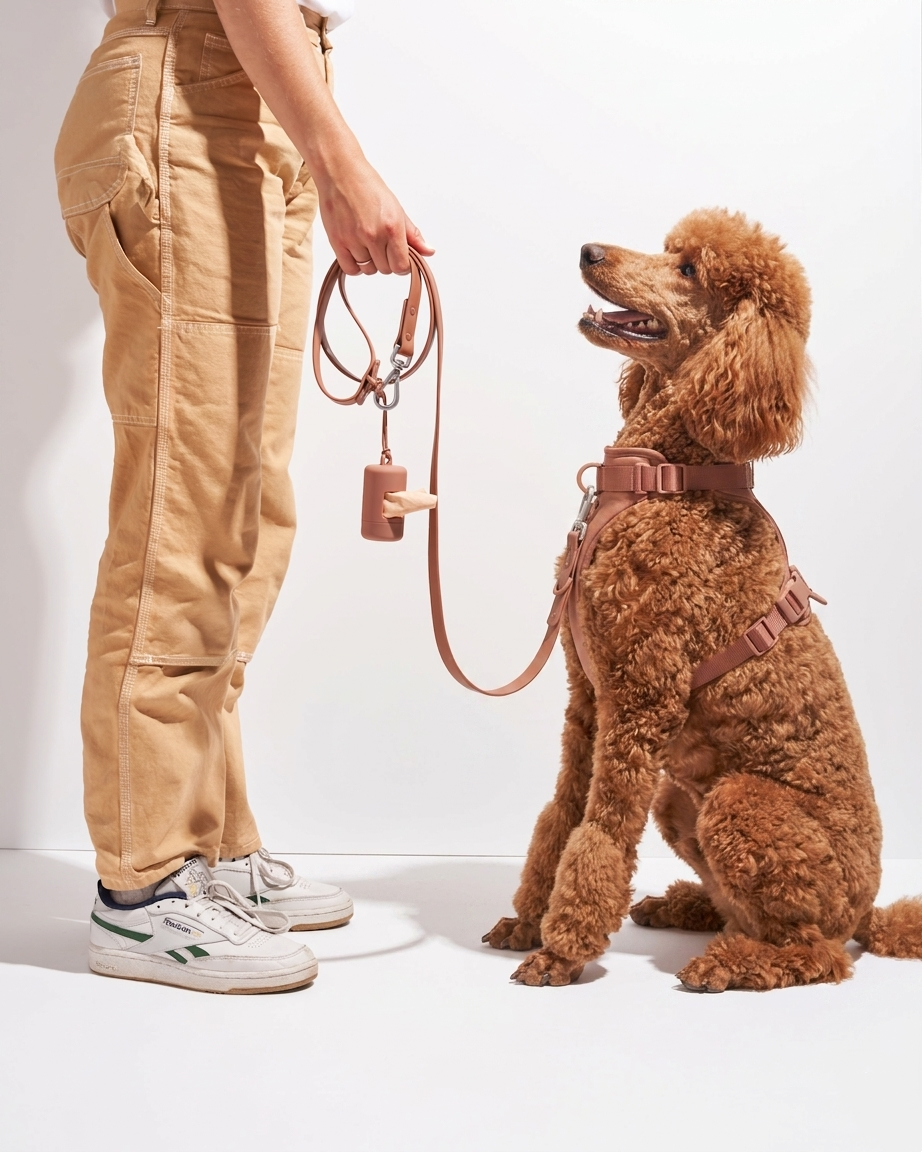
The MoonianPet No-Pull Dog Harness uses an overhead slip-and-clip design — neck loop over the head, belly strap under, quick-release buckle clicks closed. Under ten seconds from start to finish. Three-point tri-glide adjustment, neoprene padding on all contact points, zinc alloy hardware, and dual front and back D-rings. Available in XS to XL across 11 colors.
Pair it with the Harness & Leash Set for a matched waterproof walking setup, or add the leash separately if you already have a harness you are happy with.
Frequently Asked Questions
Is a step-in harness easier to put on than an overhead harness?
It depends on the dog. For dogs that dislike things going over their head, yes — a step-in removes that stress entirely. For dogs that wriggle and will not stand still, an overhead harness with a quick-release buckle is usually faster because it does not require the dog to step into two separate loops simultaneously. Once a dog is comfortable with the overhead design, most owners find it quicker for daily use than a step-in.
Can a step-in harness stop a dog from pulling?
No — not effectively. Step-in harnesses only have a back clip, which means the leash runs in the same direction as the dog’s pulling momentum. There is no redirecting mechanism. For pulling control, you need a harness with a front D-ring on the chest — which is only available on overhead-style no-pull harnesses. See our best no-pull harness guide for the full comparison.
My dog hates having things put over their head. What should I do?
This is usually a desensitisation issue that can be resolved relatively quickly with food rewards. Hold the harness loop open at your dog’s nose level and let them put their own head through for a treat. Repeat over several short sessions, gradually increasing how far through the loop their head goes before they get the reward. Most dogs accept the overhead design within a few days of this approach — and once they do, it is faster to use every day than a step-in.
Do step-in harnesses fit well on all breeds?
Step-in harnesses fit most reliably on small dogs with fairly standard proportions. Deep-chested breeds, barrel-chested breeds, and larger dogs often find the loops sit awkwardly — either too tight under the armpits or too loose to stay in position. The limited adjustment range of most step-in designs is the main fitting challenge. An overhead harness with three-point adjustment accommodates a much wider range of body shapes within a size.
How do I put on an overhead no-pull harness correctly?
Slip the neck loop over the dog’s head so the chest panel sits flat on the sternum. Bring the belly strap under the chest and click the quick-release buckle closed on the dog’s side. Check the two-finger rule under each strap — neck, chest, and belly — and confirm the front D-ring is sitting flat and centered before clipping the leash. Full step-by-step instructions in our guide on how to put on a no-pull dog harness.
Still deciding between harness types for your specific dog? Our best no-pull harness guide covers all the main options by dog size. Or if your dog is a smaller breed, see our small dog harness guide for breed-specific advice.
About the Author
Wenyue
Wenyue is the founder of MoonianPet and writes about dog collars, harnesses, waterproof pet gear, and everyday dog care.
Growing up with dogs inspired her lifelong interest in pet care and practical dog gear. Through MoonianPet, she researches dog collars, harnesses, waterproof materials, and everyday solutions that help active dogs stay comfortable during daily adventures.