
A matching collar and leash set is one of those purchases that seems straightforward until you are actually choosing — and then the number of color options, material decisions, and sizing combinations involved makes it feel more complicated than expected.
Beyond aesthetics, buying a collar and leash as a matched set has practical advantages: the hardware is designed to work together, the material ages at the same rate, and the set stays visually consistent over time rather than developing the mismatched look of separately purchased items that fade differently. For owners who care about how their dog looks on a walk — which is most owners — a set is also simply easier than trying to match two separately purchased items.
This guide covers how to choose the right color for your dog’s coat, what to look for in terms of material and construction, and what separates a good set from a cheap one that looks right in the product photo but falls apart in six months.
Set vs Buying Separately: Which Makes More Sense?
Both approaches work, but a matched set has a few practical advantages worth considering:
Consistent material ageing
A collar and leash from the same manufacturer and same material batch age at the same rate. Separately purchased items — even from the same brand — can develop slightly different shades over months of UV exposure and washing. For owners who care about the visual consistency of the set over time, buying together is the more reliable approach.
Hardware compatibility
The leash clip needs to work smoothly with the collar D-ring. In a matched set, the clip size and D-ring diameter are designed together — the clip opens wide enough to attach easily and sits securely without rattling or rotating. Mismatched clips and D-rings from different manufacturers sometimes fit awkwardly or require more force to operate, which adds up over hundreds of daily clip-and-unclip cycles.
Better value
A matched set is almost always priced lower than buying the collar and leash separately from the same brand. The saving is typically 10–20% depending on the brand. For a purchase you will use every day for years, the material and construction quality matter more than the price difference — but the set pricing removes the trade-off entirely.
How to Choose the Right Color for Your Dog’s Coat
The right color depends on your dog’s coat color and the visual effect you want — contrast or complement. Both approaches work; the choice is a matter of preference:
Golden and cream coats — Golden Retrievers, Labradors, Cocker Spaniels
Deep jewel tones contrast beautifully against warm golden fur: navy, purple, forest green, and burgundy/red all read clearly against a light coat. Sky blue and yellow are complementary rather than contrasting — they sit harmoniously without strong visual pop. Black is a clean, classic choice that works on any coat color. Avoid sand and brown tones, which can disappear against a golden coat.
Black and dark coats — Black Labs, German Shepherds, Rottweilers
Bright, saturated colors stand out most against a dark coat — yellow, red, sky blue, and pink all create strong contrast. Navy and black tend to disappear against dark fur unless there is strong light. For a more subtle look, gray or sand creates a softer tonal contrast. Purple works particularly well on black dogs — the color reads clearly without being stark.
White and light coats — Westies, Bichons, White Poodles, Samoyeds
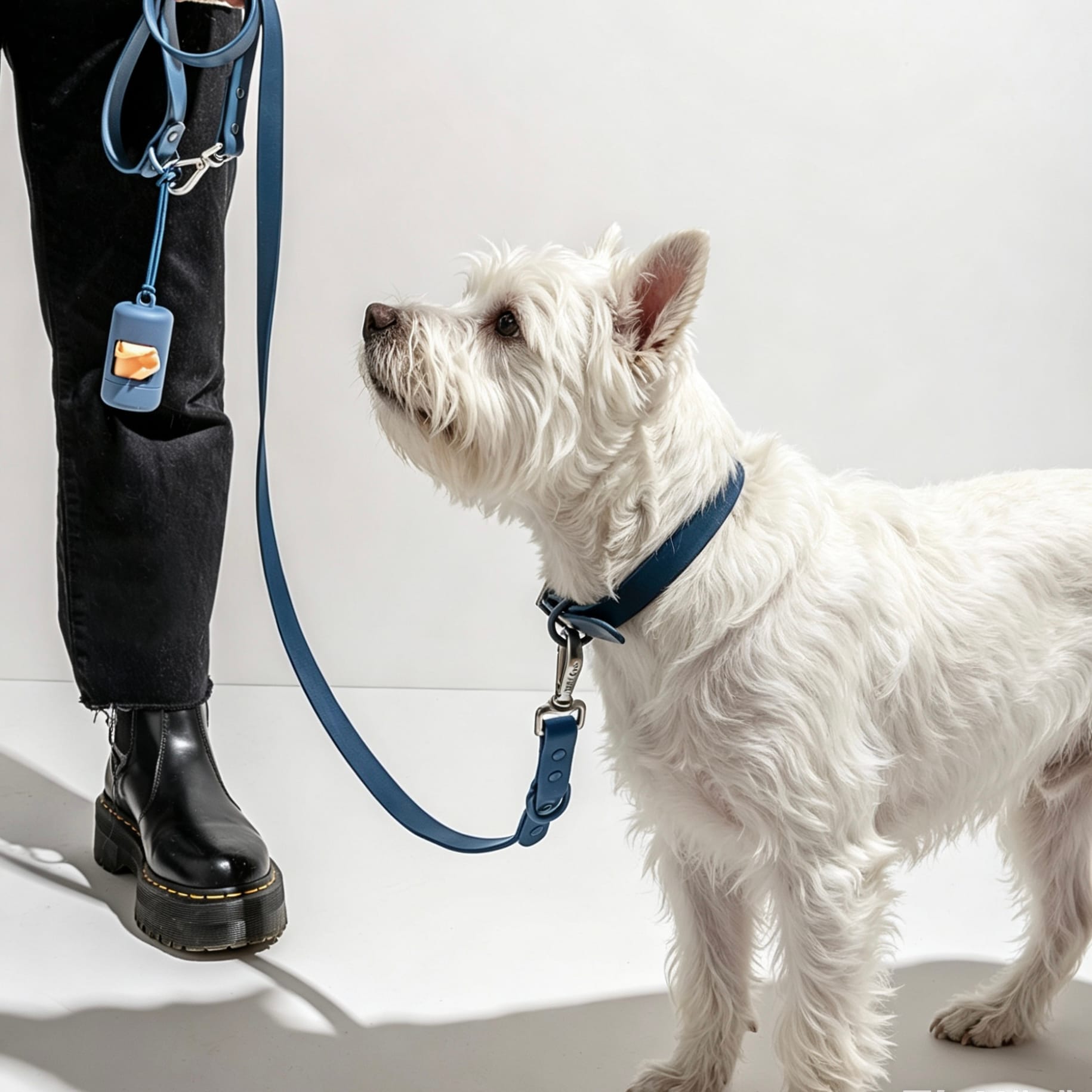
Almost any color works against a white coat — the contrast is built in. Rich tones like navy, green, and red look particularly striking. Pink and sky blue have a classic look on white dogs. Black is clean and graphic. The main consideration on white coats is that dark colors show fur transfer more visibly — if shedding is an issue, mid-tones like gray, sand, or purple are more forgiving.
Brown and liver coats — Chocolate Labs, Dachshunds, Vizslas
Warm tones complement brown coats — red, orange-adjacent yellow, and sand all sit naturally against warm brown fur. Cool tones create stronger contrast: sky blue, purple, and green all pop clearly. Navy is a classic choice on chocolate dogs. Avoid dark brown, which disappears, and black, which can read as severe against warm-toned fur.
Gray and merle coats — Huskies, Weimaraners, Australian Shepherds
Cool tones complement gray fur naturally — navy, sky blue, and purple all look considered rather than random against a gray coat. Warm tones like red, yellow, and sand create stronger contrast. Pink reads softly and works well on lighter gray dogs. Black is a clean neutral choice that works on any coat.

What to Look For in a Collar and Leash Set
Color is the starting point, but material and construction determine how long the set actually lasts and how it performs day to day:
Waterproof material — especially for active dogs
Nylon collar and leash sets are the most common and the cheapest — and the most likely to smell within a few months. Nylon absorbs water, mud, and body oils, and once the smell is embedded in the fibres it does not wash out fully. PVC-coated webbing (BioThane-style) does not absorb anything — it wipes clean with a damp cloth, dries instantly, and stays odour-free indefinitely. For a set used on daily outdoor walks, the material difference is noticeable within the first few months. See our full breakdown in the dog collar material guide.
Metal hardware throughout
The leash clip, collar D-ring, and collar buckle should all be metal — zinc alloy is the standard for durability. Plastic clips and D-rings are adequate for very small, calm dogs but deform under pulling force on any medium or large dog. Metal hardware also maintains its appearance better over time — plastic hardware develops surface wear and discoloration faster than zinc alloy.
A leash length suited to your walking style
Standard leash lengths are 120cm (4ft) and 150cm (5ft). A shorter leash gives more control in busy environments — city walking, crowded parks, training walks. A longer leash gives the dog more freedom to move naturally on quiet routes. Most owners find 150cm the more versatile everyday length. Check that the set specifies leash length rather than leaving it ambiguous.
A padded or comfortable handle on the leash
The leash handle is the contact point between you and the dog — on a long walk with a dog that pulls occasionally, a handle that digs into the palm becomes uncomfortable quickly. A looped handle with a soft exterior, or a handle with a traffic loop near the clip for close-control moments, makes a meaningful difference on longer walks. PVC-coated leashes with a loop handle are generally more comfortable than bare webbing handles of the same width.

Why Waterproof Matters for a Matched Set
A matching set looks best when both pieces age at the same rate. The fastest way for a set to look mismatched is for one piece to fade, stiffen, or develop odour before the other — which happens when the collar and leash are made from fabric that absorbs moisture differently based on how much contact each piece has with water and sweat.
PVC-coated webbing eliminates this problem entirely. Because neither piece absorbs anything, both stay looking the same as the day you bought them with nothing more than an occasional wipe. For dogs that swim, walk in rain regularly, or simply have active outdoor lives, a coated webbing set stays matched in appearance for significantly longer than a nylon set.
For more on waterproof collar options specifically — including what to look for if your dog swims — see our guide on the best dog collar for swimming. For a full material comparison including leather and nylon, our BioThane vs leather comparison covers the trade-offs in detail.
11 Colors, Fully Matched, 100% Waterproof
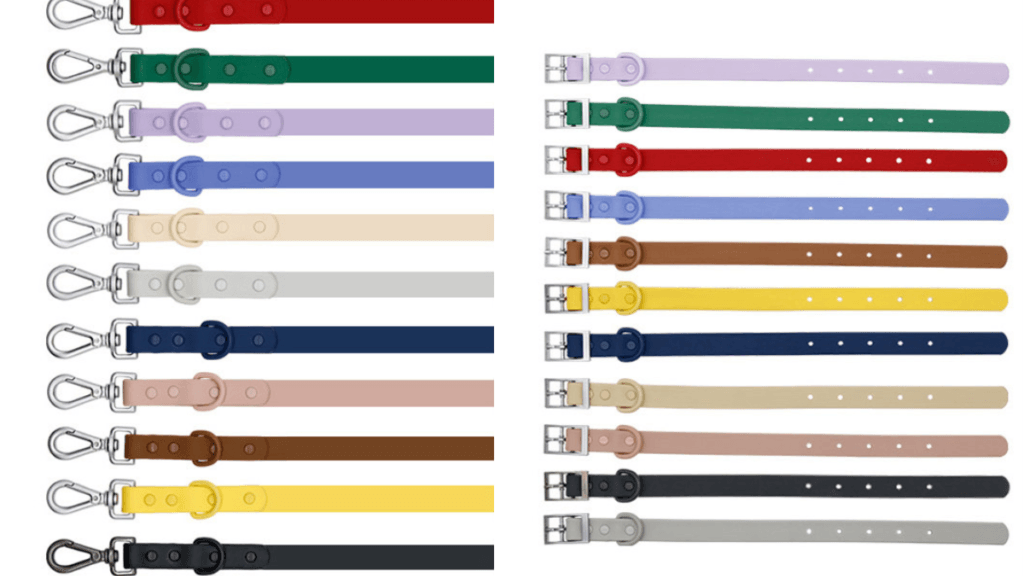
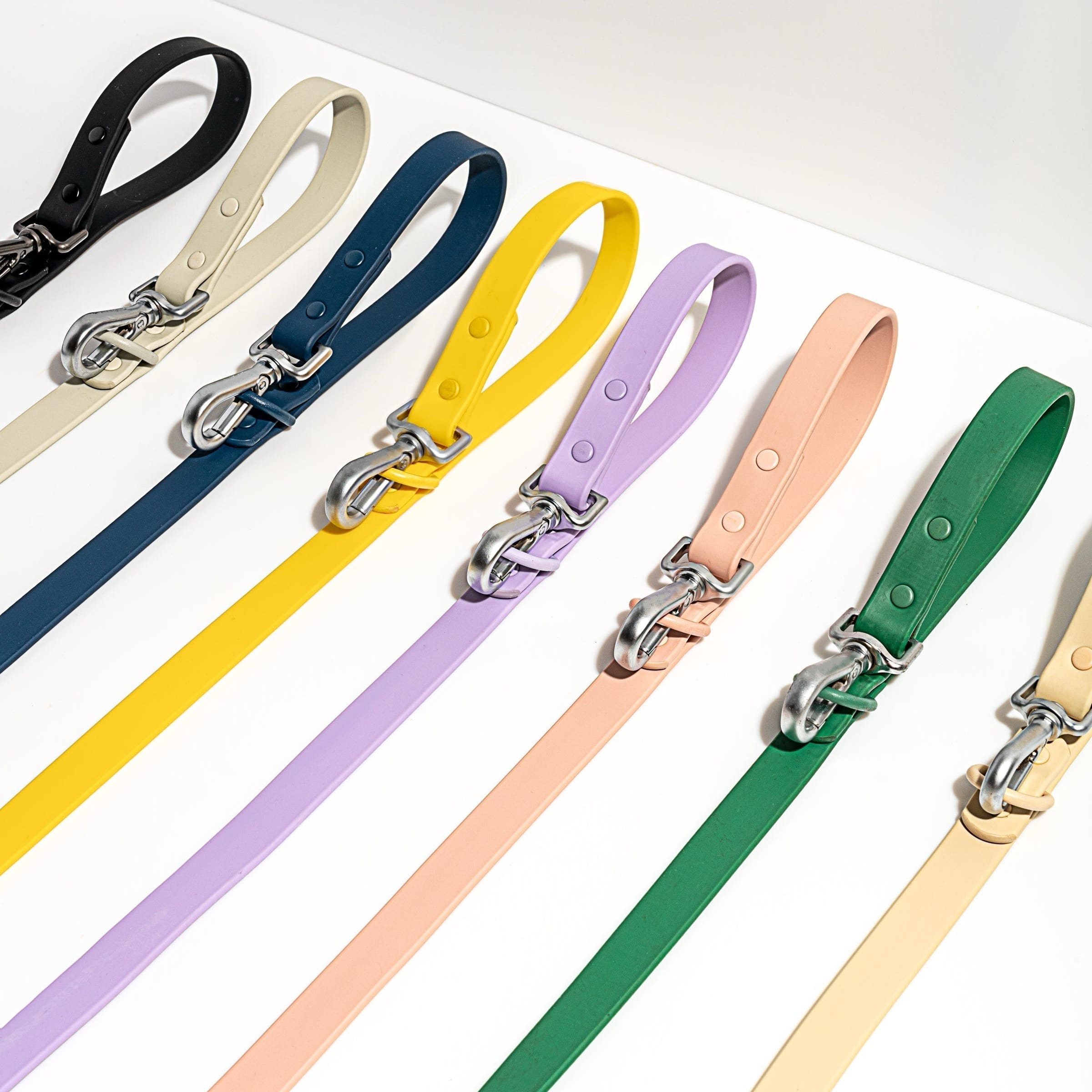
The MoonianPet Waterproof Collar & Leash Set is available in 11 colors — black, navy, sky blue, green, gray, sand, brown, red, pink, purple, and yellow — with the collar and leash manufactured from the same PVC-coated webbing batch for consistent color matching. Zinc alloy hardware throughout, a 360° swivel zinc alloy hook on the leash, and a safety buckle on the collar. The collar adjusts across five sizes from XS to XL; the leash comes in two lengths.
If you are also considering a harness for walks rather than a collar, the collar is also available separately — and the leash from the set is compatible with our no-pull harness for a fully matched three-piece setup.
Frequently Asked Questions
Is it better to buy a collar and leash as a set or separately?
A set is generally better value and ensures the hardware is designed to work together. The main reason to buy separately is if you already own one piece you are happy with, or if you want different lengths or widths than the set provides. For a first purchase or a full replacement, a set is the more practical and economical choice.
What color collar and leash looks best on a black dog?
Bright, saturated colors stand out most against a black coat — yellow, red, sky blue, and pink all create strong visual contrast. Purple reads particularly well on black dogs. Navy and black tend to disappear against dark fur. If you prefer a subtler look, gray or sand creates a softer contrast that is still visible without being stark.
How do I measure my dog for a collar and leash set?
Measure neck circumference with a soft tape measure — wrap it around the base of the neck where the collar will sit, with one finger of slack. This is the key measurement for collar sizing. The leash does not require measurement — it is a standard length that works for any dog. Full instructions in our collar measuring guide.
Will the collar and leash colors match exactly?
Yes — the MoonianPet collar and leash set is manufactured from the same PVC-coated webbing material in the same color batch. The color matches exactly between the two pieces when new and ages at the same rate over time, maintaining the matched appearance through extended use.
Can I use a collar and leash set if my dog pulls?
A collar and leash set is fine for dogs that pull moderately. For consistent, hard pullers — particularly medium and large breeds — a no-pull harness with a front clip is more effective for walking control, with the collar kept on for ID purposes only. See our collar vs harness guide for the full comparison on which is right for your dog’s walking behaviour.
Want to understand more about collar materials before buying? Our collar material guide covers nylon, leather, and coated webbing side by side. Or if your dog swims, see our waterproof collar guide for swimming dogs.

About the Author
Wenyue
Wenyue is the founder of MoonianPet and writes about dog collars, harnesses, waterproof pet gear, and everyday dog care.
Growing up with dogs inspired her lifelong interest in pet care and practical dog gear. Through MoonianPet, she researches dog collars, harnesses, waterproof materials, and everyday solutions that help active dogs stay comfortable during daily adventures.