
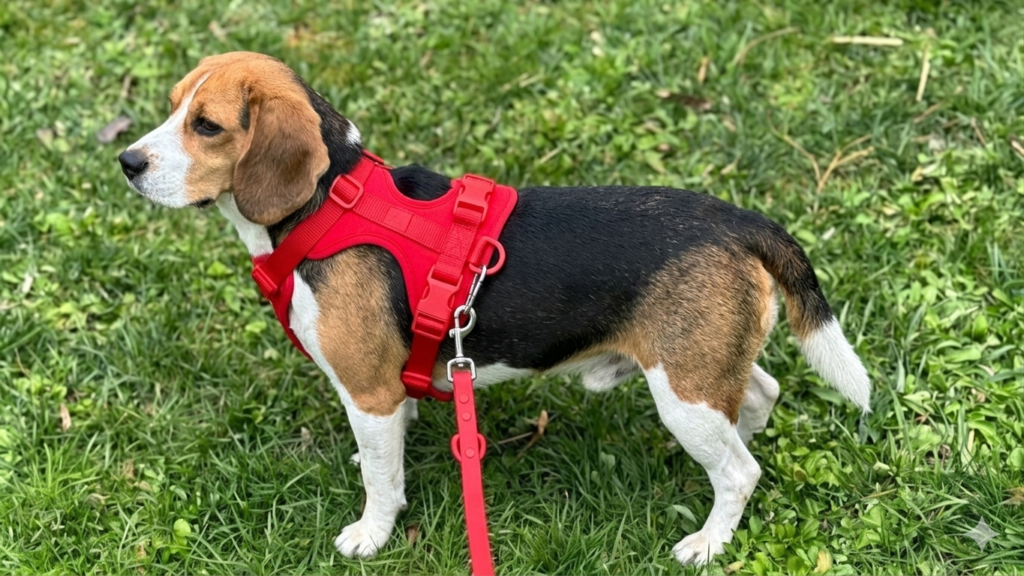
Walking a Beagle is a specific experience. The first part of the walk is usually fine — the dog is trotting along, checking in, looking more or less like a well-behaved dog. Then a smell hits. The nose goes down, the body follows, and suddenly you’re attached to a dog that has completely forgotten you exist and is following an invisible trail with the kind of single-minded commitment that makes Beagles so good at their original job — and so challenging on a leash.
This pattern — not constant pulling, but sudden complete absorption in a scent — creates a specific harness challenge. The sudden shift from trotting to nose-down tracking puts a different kind of load on the harness than steady pulling does, and a Beagle that’s truly locked onto a scent will sometimes back up or twist sideways while following it, testing the harness in ways that a dog walking in a straight line never does.
This guide covers how to choose and fit a harness for a Beagle — escape prevention on a flexible, determined body, managing scent-driven pulling, and getting the fit right on a breed that’s compact but stronger than they look.
Why Beagles Are Notorious for Escaping Harnesses
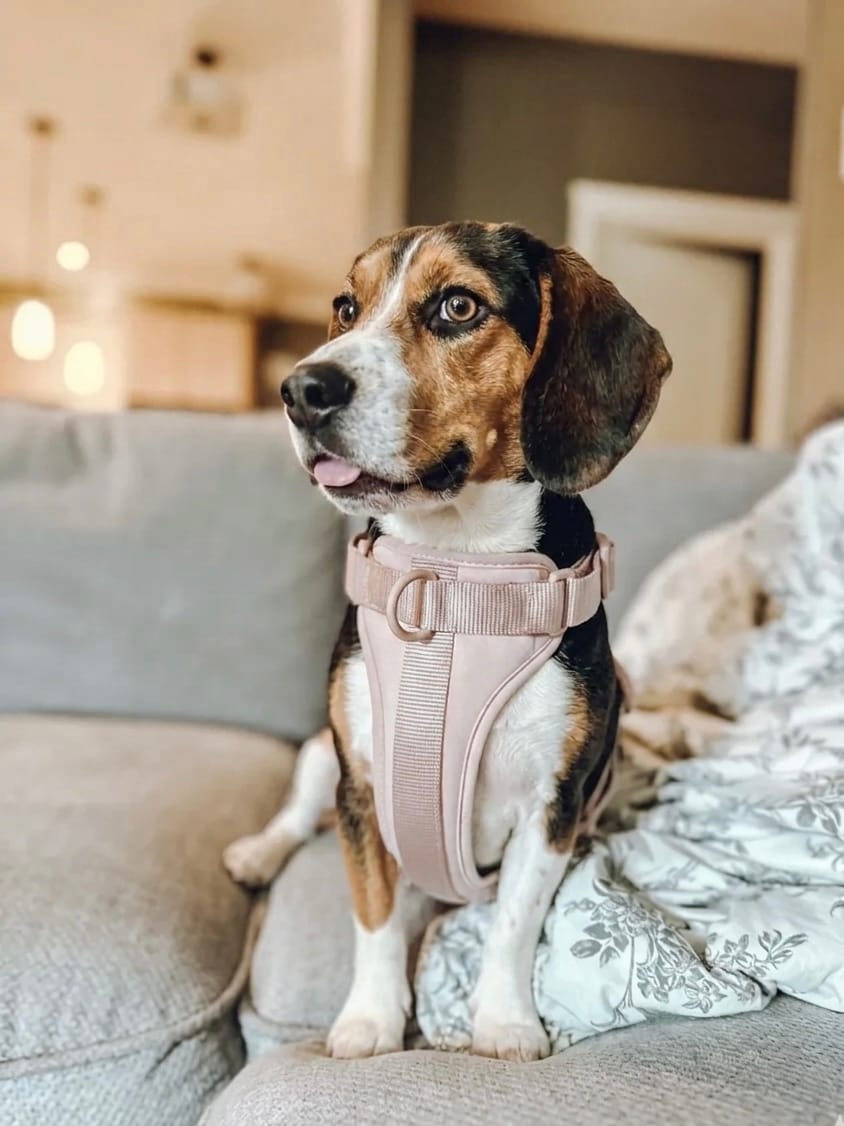
Beagles have a body shape that makes escape easier than it is for many other breeds — a head that’s not dramatically wider than their neck, a flexible, muscular body, and when following a scent, a tendency to lower their head and push forward with their nose down. That nose-down posture is exactly the position that allows a dog to back out of a neck loop that’s even slightly too loose.
The other factor is motivation. A Beagle following a scent is not a dog that’s going to stop and reconsider — they’re running on instinct that centuries of selective breeding have made extremely strong. If there’s a way out of the harness, they’ll find it in the process of following a trail, often without the owner realising the harness has failed until the dog is already gone.
This makes escape prevention the most important single feature in a Beagle harness — more important, arguably, than the no-pull mechanism, because a harness that comes off doesn’t prevent any pulling at all.
How to Make a Harness Escape-Proof on a Beagle
The neck loop: the most important strap
Two fingers flat under the neck loop with light resistance — not three, not freely. Then test it: with the harness on, gently try to slide the neck loop forward toward the dog’s ears. It should not be able to pass the widest point of the skull. If it can, tighten one notch and retest. Do this before every walk until the fit is confirmed correct, then check weekly. This single test prevents the vast majority of Beagle escapes.
Tighten all three straps, not just the neck
A Beagle following a scent will sometimes twist sideways, back up, and generally move in directions that test the whole harness, not just the neck loop. A loose belly strap gives the dog room to manoeuvre during a twisting escape attempt. All three straps — neck, chest, and belly — should be at the two-finger rule, snug but not tight.
Use an overhead harness, not a step-in
Step-in harnesses generally have less independent neck adjustment than overhead designs, and the loop geometry can make them easier for a flexible dog to back out of. An overhead harness with a dedicated neck strap that adjusts independently gives you the most control over escape-proofing the neck loop specifically. For a full comparison of harness types, see our types of dog harnesses guide.
Managing Scent-Driven Pulling
Beagle pulling is different from the forward enthusiasm of a Labrador or the sustained sled-dog tension of a Husky. It’s directional and absorbed — the dog is following something, and the direction changes as the scent changes. One moment they’re pulling forward, the next they’ve turned 90 degrees to follow a trail across the path, then they’re backing up to investigate a spot they passed.
A front-clip harness helps manage this by redirecting the chest sideways when the dog pulls forward, but it’s not as transformative for a scent-following Beagle as it is for a dog that pulls in a straight line. The more useful tool is often the harness working in combination with regular leash training — teaching the “let’s go” cue to interrupt a scent lock before it becomes a full commitment. For the training method, see our leash training guide.
That said, building in deliberate sniff time during walks — letting the Beagle nose around a patch of ground as a reward for walking well — significantly reduces the intensity of scent-chasing behaviour. A Beagle that gets regular, sanctioned sniffing time is less desperate about chasing every scent that crosses their path.

Fit Specifics for a Beagle’s Body Shape
Beagles are compact and muscular for their size — they’re heavier than they look, and their chest is proportionally quite wide relative to their overall size. A few fit points specific to the breed:
Most Beagles fit size S or M
A standard adult Beagle typically has a chest girth of around 18–24 inches, placing most in a size S or M on most harness ranges. The 13-inch variety sits toward the smaller end; the 15-inch variety tends toward M. Measure rather than assume — and measure at the widest point of the ribcage just behind the front legs, not at the belly. Full size chart in our dog harness size guide.
Deep chest relative to neck size
A Beagle’s chest girth is often significantly larger than their neck girth — more so than many other breeds at similar overall size. A harness with independent neck and chest adjustment is essential so each strap can be set correctly for the Beagle’s proportions without the neck being too loose just because the chest is large.
Check fit after wet walks
A wet harness on a short-coated Beagle can feel slightly looser than a dry one — the slippery wet surface reduces friction against the coat. After a wet walk, re-check the neck loop fit before removing the harness if the dog will be going back out in a new location. A harness material that stays dimensionally stable when wet is more reliable in this regard than one that changes texture with moisture.
Secure Fit for the Walk You Didn’t Know You Were Going On
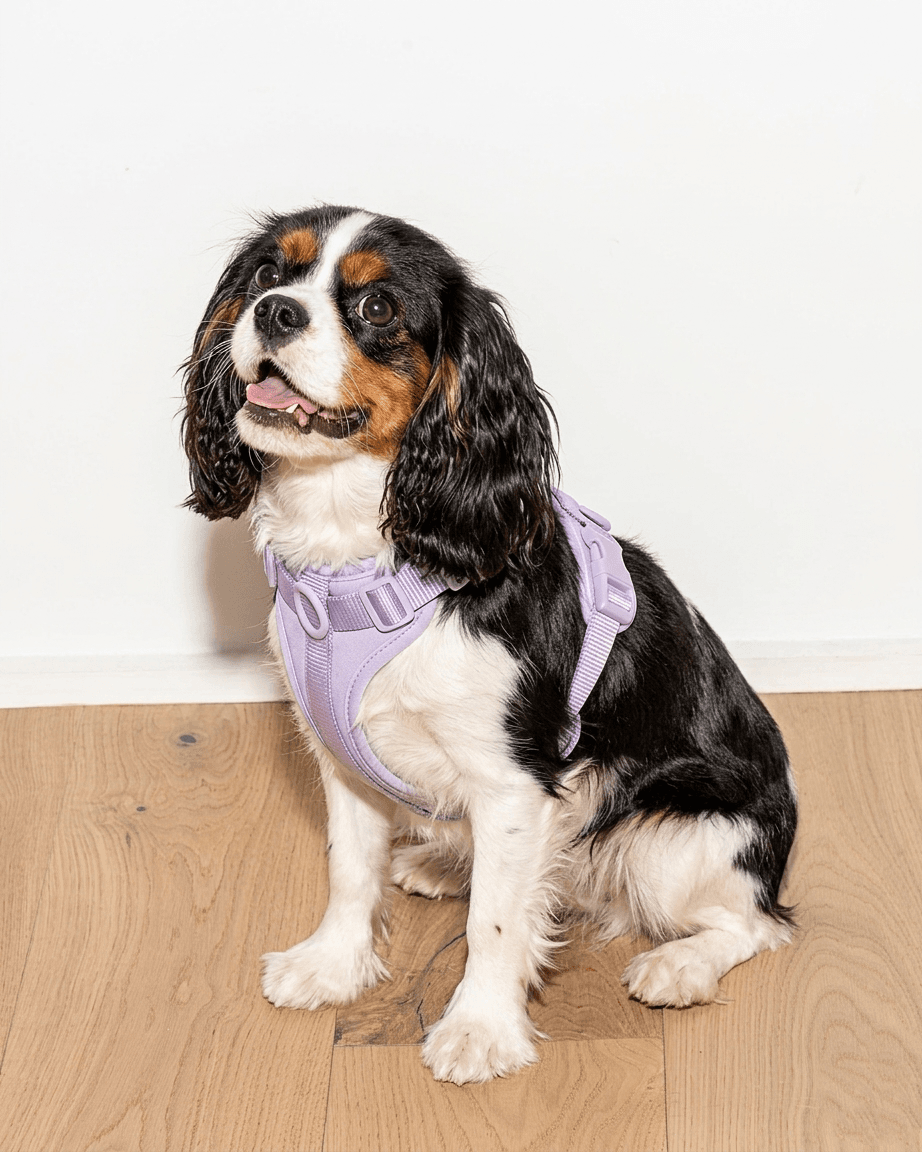
The MoonianPet No-Pull Dog Harness uses three-point independent adjustment — neck, chest, and belly set separately — which is exactly what a Beagle’s proportions require. The neck strap adjusts independently of the chest, so you can tighten it to the escape-proof two-finger rule without affecting the chest fit. Zinc alloy hardware throughout, lightweight neoprene that stays stable when wet, and a reinforced ABS buckle that doesn’t pop open under sideways stress. Available in five sizes from XS to XL across 11 colours.
For a matched everyday setup, the Harness & Leash Set pairs the harness with a PVC-coated waterproof leash — odour-proof after muddy trail-following, easy to wipe clean.
Frequently Asked Questions
Why does my Beagle keep escaping from harnesses?
Almost always a neck loop that’s too loose. When a Beagle puts their nose down to follow a scent, they naturally lower their head and push forward — which is exactly the motion that allows a dog to back out of a loose neck loop. Tighten the neck strap until two fingers fit snugly and the loop cannot be slid forward over the widest point of the skull. Test this before every walk until you’ve confirmed the fit is correct.
What size harness does a Beagle need?
Most adult Beagles fit a size S or M depending on whether they’re the 13-inch or 15-inch variety and how stocky their build is. Always measure chest girth at the widest point just behind the front legs and neck girth at the base of the neck — Beagles often have a chest that’s proportionally wider than their neck size suggests.
Will a no-pull harness stop my Beagle following scents?
A front-clip harness redirects forward pulling and makes the walk more manageable, but it won’t override a Beagle’s scent instinct entirely — that instinct is too deeply bred in. The harness is most useful combined with regular reward-based training and deliberately building in scent time during walks as a reward for walking well. A Beagle that gets regular sanctioned sniffing is less frantic about chasing every scent.
Is a harness or collar safer for a Beagle?
A harness is significantly safer for a Beagle that pulls while nose-down — collar pressure on the trachea during the sudden, committed pulls that scent-following produces is more concentrated and potentially harmful than the distributed pressure of a harness across the chest. Keep a collar for ID tags and use the harness as the primary walking attachment.
My Beagle pulls so hard when they smell something that I can’t hold on — what should I do?
A front-clip harness gives you the most mechanical advantage in this situation — the sideways redirect is harder to overpower than a straight-line pull against a back clip. Keep the leash short enough that the redirect engages early, before the dog reaches full commitment speed. For extreme cases, working with a trainer on a “leave it” or “let’s go” cue is the most effective long-term solution — the harness manages the walk while the training builds the interruptible behaviour.
For step-by-step fitting guidance covering every strap adjustment, see our no-pull harness fitting guide. For the leash training method that works alongside a front-clip harness, see our leash training guide.
Wenyue
Wenyue is the founder of MoonianPet and writes about dog collars, harnesses, waterproof pet gear, and everyday dog care. Growing up with dogs inspired her lifelong interest in pet care and practical dog gear. Through MoonianPet, she researches dog collars, harnesses, waterproof materials, and everyday solutions that help active dogs stay comfortable during daily adventures.