
Most people buy their first dog leash the same way — they grab whatever looks reasonable at the pet store, take it home, and figure out the problems later. The leash is too long and tangles around legs. Or too short and feels tense even on a calm walk. The material absorbs mud and smells after a few weeks. The handle is stiff and uncomfortable after twenty minutes.
None of these are big problems individually, but they add up — and they are all avoidable if you know what to look for before you buy. Length, width, and material are the three decisions that actually matter, and each one has a clear answer once you know what your dog needs.
This guide covers all three, with specific recommendations for different dog sizes, walking styles, and situations.
Leash Length: The Decision Most People Get Wrong
Leash length affects how a walk actually feels — for both of you. Too long and you have no real control when it matters. Too short and every walk feels tense, even when your dog is behaving perfectly. The right length depends on what kind of walking you are doing and how trained your dog is.
Standard leashes come in a few common lengths, and each one has a specific use case:
1.2m / 4ft — Close control
This is the length that feels uncomfortably short until you understand when it is actually useful. On busy pavements, around other dogs, near roads, or in any situation where you need your dog right next to you — a shorter leash gives you immediate, precise control without constantly adjusting your grip. It is also the length most trainers recommend for leash-manners work, because there is less slack for the dog to build momentum before you feel the pull. For city walking specifically, 1.2m is often the better choice than the default 1.8m.
1.5–1.8m / 5–6ft — Everyday standard
This is what most people think of when they picture a dog leash, and for good reason — it gives the dog enough room to move naturally without pulling the leash taut every few steps, while still keeping them close enough for control. For a dog that walks reasonably well on a loose leash, 1.8m covers the vast majority of everyday situations. It is also the length that feels most natural to hold, because you can let it hang slightly without it dragging on the ground.
3m+ / 10ft+ — Training and open space
Long lines — sometimes called check cords — are training tools, not everyday leashes. They give the dog freedom to explore or practice recall at a distance while still being physically connected to you. They are useful in open parks or fields, but impractical on pavements and genuinely dangerous near roads. If you want your dog to have more freedom on walks, a longer standard leash is not the answer — a long line for specific sessions is.
Leash Width: Match It to Your Dog’s Size
Leash width is less talked about than length or material, but it matters — especially at the two extremes of dog size.
The general principle is that wider webbing holds up better under force but feels heavier and bulkier, while narrower webbing is lighter and more comfortable for smaller dogs but may not hold up under repeated strain from a large, strong dog.
| Dog Size | Recommended Width | Why |
|---|---|---|
| Small (under 10kg) | 13–15mm | Lighter on the clip and easier to handle; wide leashes feel disproportionate on small dogs |
| Medium (10–25kg) | 15–20mm | The standard range; handles everyday pulling without being bulky |
| Large (25kg+) | 20–25mm | Wider webbing distributes force across the hand better and holds up longer under repeated strain |
One thing worth noting: the handle matters as much as the strap width. A narrow strap on a large dog concentrates force across fewer fingers when they lunge — which is uncomfortable at best and can cause injury if it happens repeatedly. A leash with a padded or reinforced handle compensates for this, which is why handle construction is worth checking before you buy, not just strap width.

Leash Material: What the Difference Actually Feels Like Day to Day
This is where most leash buying decisions go wrong, because the differences between materials are not obvious in a shop but become very obvious after a few weeks of daily use.
Nylon
Nylon is the default — inexpensive, widely available, and comes in every color. It works fine in dry conditions. The problems emerge with regular use: nylon absorbs water, which means it stays wet long after a rainy walk; it absorbs odor from wet dog, mud, and saliva over time; and the fibers fray at stress points (usually the clip end and the handle loop) after months of regular use. For a dog that never goes near water and walks on dry paths, nylon is acceptable. For most real-world dogs, it is a leash you will be replacing every year or two.
Leather
Leather leashes feel genuinely good in the hand — soft, substantial, and they develop a patina with age that many owners like. The problem is maintenance: leather needs conditioning to stay supple, dries out and cracks if it gets repeatedly wet, and is not easy to clean after a muddy walk. For a city dog on dry pavements with an owner who does not mind the upkeep, leather holds up well. For a dog that swims, runs on muddy trails, or lives somewhere with regular rain, leather is the wrong choice.
PVC-coated webbing (BioThane-style)
This is the material we use for the MoonianPet leash, and the honest reason is that it solves every practical problem the other materials have. The PVC coating makes the leash waterproof — not water-resistant, actually waterproof — so it does not absorb rain, mud, or dog saliva. It wipes clean in seconds. It does not absorb odor. And it holds up under repeated use without fraying at the stress points the way nylon does. The tradeoff is that it costs more than nylon — but when you factor in not replacing it every year, the math usually works out in favor of coated webbing over any two-year period.
Rope and chain
Rope leashes look appealing and are popular as training leads, but the texture causes rope burn if a dog lunges and the leash slides through your hand — something that happens faster than you expect. Chain leashes were once thought to deter chewing, but a determined chewer will chew through most things anyway, and chain is heavy, cold in winter, and noisy. Neither is a practical everyday leash for most owners.
What About Retractable Leashes?
Retractable leashes deserve their own mention because they are extremely common and, in most situations, the wrong choice — even though the idea behind them is appealing.
The cord on a retractable leash is under constant tension. This means your dog is always feeling some resistance and learning that pulling gets them more distance — the opposite of what loose-leash walking requires. The locking mechanism also fails unpredictably, the thin cord can cause serious rope burns to both dog and handler if it wraps around a limb during a sudden lunge, and the plastic handle is difficult to hold securely in wet conditions.
If you want your dog to have more freedom in open spaces, a long line — a standard fixed-length leash of 5m or more — is safer and gives better control. Retractable leashes are not inherently dangerous, but they are a tool that requires specific conditions and a lot of handler awareness to use safely. For most everyday walks, a fixed-length leash is the better option.
Hardware: The Part Nobody Talks About Until It Fails
The clip at the end of the leash is the single point connecting you to your dog. It is worth paying attention to.
Zinc alloy vs. cheap pot metal
Clips on budget leashes are often made from low-grade pot metal that corrodes quickly, especially near saltwater or in wet conditions, and the spring inside the gate weakens over time. Zinc alloy is heavier and more expensive but holds up significantly better under repeated use. If you can hear the gate spring weakening — it starts to feel loose or click more softly than when new — replace the leash before it fails on a walk.
360-degree swivel
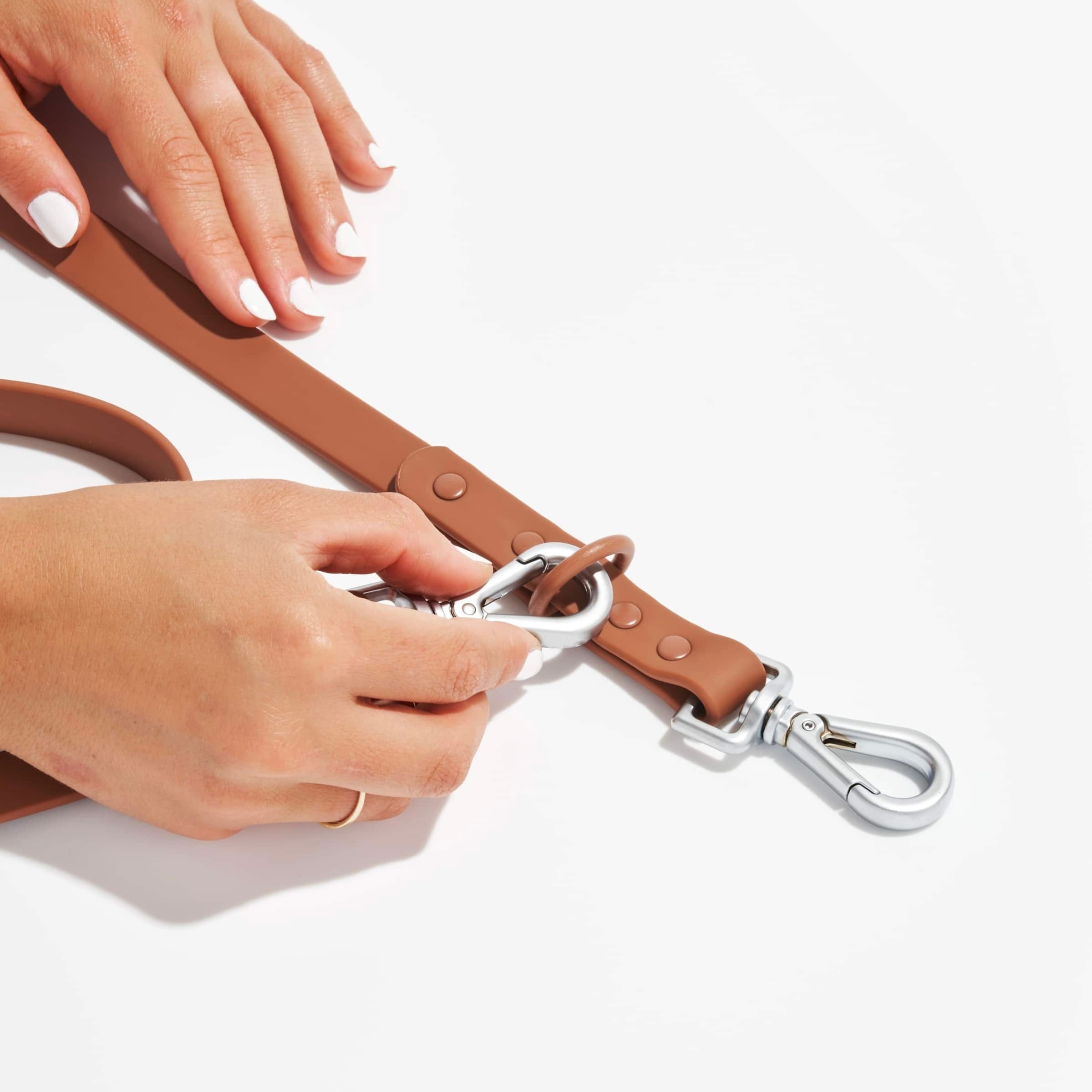
A swivel at the clip end allows the leash to rotate without twisting — which matters more than it sounds on a walk where your dog zigzags, circles, or sniffs at things in all directions. Without a swivel, the leash develops a permanent twist over weeks of use that makes it harder to handle and puts stress on the stitching at the attachment point. The MoonianPet leash uses a 360-degree rotating zinc alloy hook specifically to address this.
Leash and Collar or Leash and Harness?
The leash is only one half of the equation — where it attaches on your dog matters just as much. A well-chosen leash paired with the wrong attachment point will not solve a pulling problem and may cause harm.
For a dog that walks calmly, attaching to a collar is simple and effective. For a dog that pulls — even occasionally — the leash should clip to a no-pull harness rather than a collar, because collar pressure during pulling concentrates force on the trachea. A front-clip no-pull harness redirects the pulling momentum sideways, which is both safer and more effective than trying to manage pulling through the collar. Our collar vs harness guide covers when to use each in more detail.
If you are buying a leash for a dog you are still working on leash manners with, buying the leash together with a no-pull harness as a set makes sense — you get a matched setup and often a better price than buying separately. Need help finding the right size? The dog harness size guide and dog collar size guide both have full measurement charts.

Quick Summary: How to Choose
Choose 1.2m if…
You walk in cities, on busy streets, near traffic, or are actively working on leash manners. Short leash = more immediate control.
Choose 1.8m if…
You walk in parks, quieter areas, or your dog already has solid leash manners. Standard everyday length for most dogs.
Choose PVC-coated webbing if…
Your dog swims, walks in rain, or you want something that stays clean and smell-free without ongoing maintenance. The practical choice for most active dogs.
Add a no-pull harness if…
Your dog pulls at all. The leash alone does not solve pulling — the attachment point does.
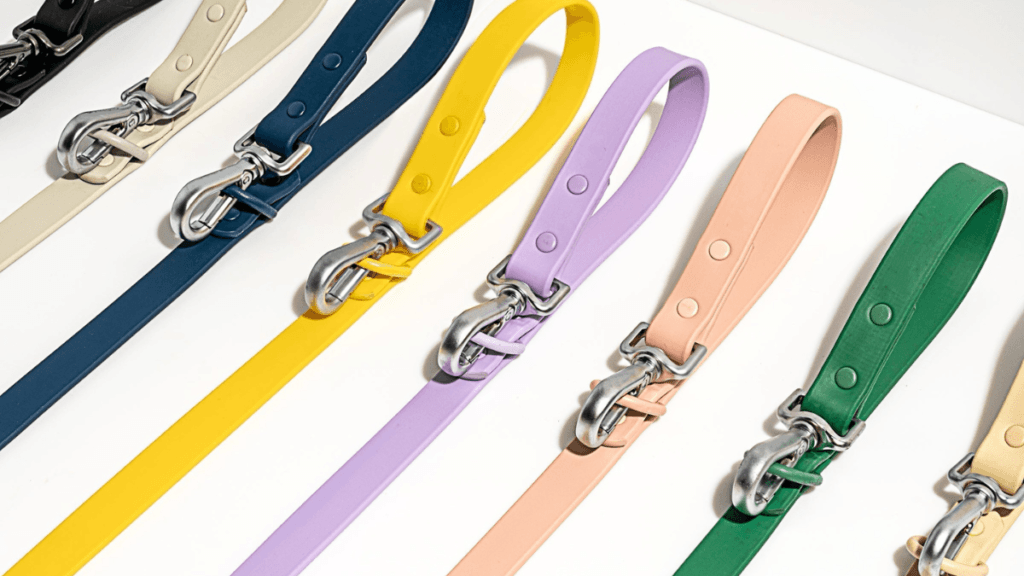
The MoonianPet Waterproof Dog Leash is available in both 1.2m and 1.8m, in 11 colors, with a 360-degree zinc-alloy rotating hook. Pair it with the Waterproof Dog Collar or the No-Pull Dog Harness for a fully matched, fully waterproof setup.
Frequently Asked Questions
What length leash is best for a puppy?
Start with 1.5–1.8m for a puppy — long enough that they do not feel constantly constrained, short enough that you can respond quickly if they head somewhere they should not. As they grow and their leash manners develop, you can decide whether to stay at 1.8m or add a shorter lead for busier environments. Avoid long lines for puppies in public — they are hard to manage quickly and can become a trip hazard around other people and dogs.
Is a 6ft leash the same as 1.8m?
Close — 6ft is approximately 1.83m, so effectively the same for practical purposes. When buying leashes that list length in feet, 4ft ≈ 1.2m and 6ft ≈ 1.8m. These are the two most useful lengths for everyday walking.
How often should I replace my dog’s leash?
Inspect the clip, the stitching at the handle loop, and the stitching where the leash attaches to the clip every few months. If you see fraying, a weakened spring in the clip, or any visible wear at the stress points, replace it — those are the points most likely to fail under sudden force. A PVC-coated leash in good condition can realistically last three to five years with daily use; a nylon leash typically needs replacing every one to two years.
My dog chews through leashes. What should I use?
PVC-coated webbing is more resistant to chewing than nylon or rope, but no standard leash material is truly chew-proof for a determined dog. If leash chewing is a regular problem, address the root cause — boredom, anxiety, or insufficient exercise — rather than trying to out-material the dog. In the meantime, a short, thick leash is harder to chew through than a thin one, and keeping the dog moving on walks gives them less opportunity to turn around and grab the leash.
Can I use the same leash for a no-pull harness and a collar?
Yes — a standard leash with a clip clips to any D-ring, whether that is on a collar or a harness. The same 1.8m leash works on both. The only difference is where you attach it: front D-ring on the harness for no-pull, back D-ring for standard walking, collar D-ring for a trained dog on a flat collar. Having one good leash that works across all three setups is one of the practical advantages of a standard fixed-length leash over more specialised options.
If your dog pulls on the leash, a good leash is only part of the solution — the attachment point matters more. See our guide on choosing a no-pull harness for what to look for. And if you are deciding between a collar and harness setup, our collar vs harness guide covers both in detail.

Wenyue
Wenyue is the founder of MoonianPet and writes about dog collars, harnesses, waterproof pet gear, and everyday dog care. Growing up with dogs inspired her lifelong interest in pet care and practical dog gear. Through MoonianPet, she researches dog collars, harnesses, waterproof materials, and everyday solutions that help active dogs stay comfortable during daily adventures.