
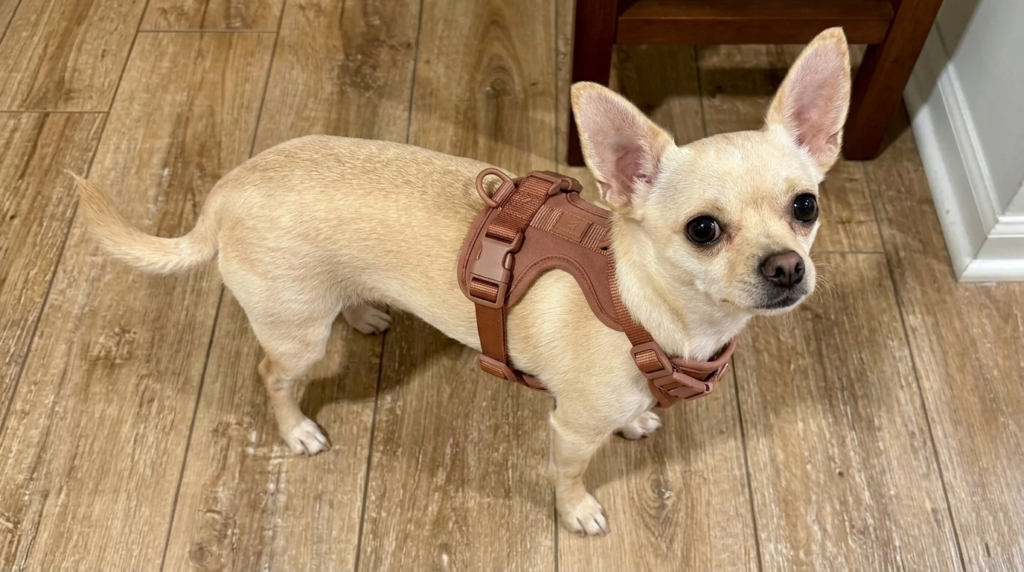
Chihuahuas are the smallest recognised dog breed in the world, and their size creates fitting challenges that don’t exist for any other dog. A harness labelled “XS” is designed for a dog in the 2–5kg range — but Chihuahuas span a much wider weight range than that label suggests, from under 1kg for the smallest individuals to around 3kg for a standard adult. At the smaller end of that range, many XS harnesses are simply too large, and a harness that doesn’t fit correctly is worse than no harness at all.
Beyond size, Chihuahuas have two characteristics that make harness choice particularly important. First, they are among the breeds most commonly affected by tracheal collapse — a condition where the cartilage rings of the windpipe weaken and the airway narrows under pressure. Collar walking is widely considered inadvisable for this reason. Second, their naturally prominent eyes and delicate neck structures mean that any sudden jerking force on the neck area carries more risk than for a robust medium-sized dog.
This guide covers how to measure a Chihuahua for a harness, what to look for at this size, the common fitting mistakes that cause problems, and what actually works for the day-to-day reality of walking a tiny, spirited dog.
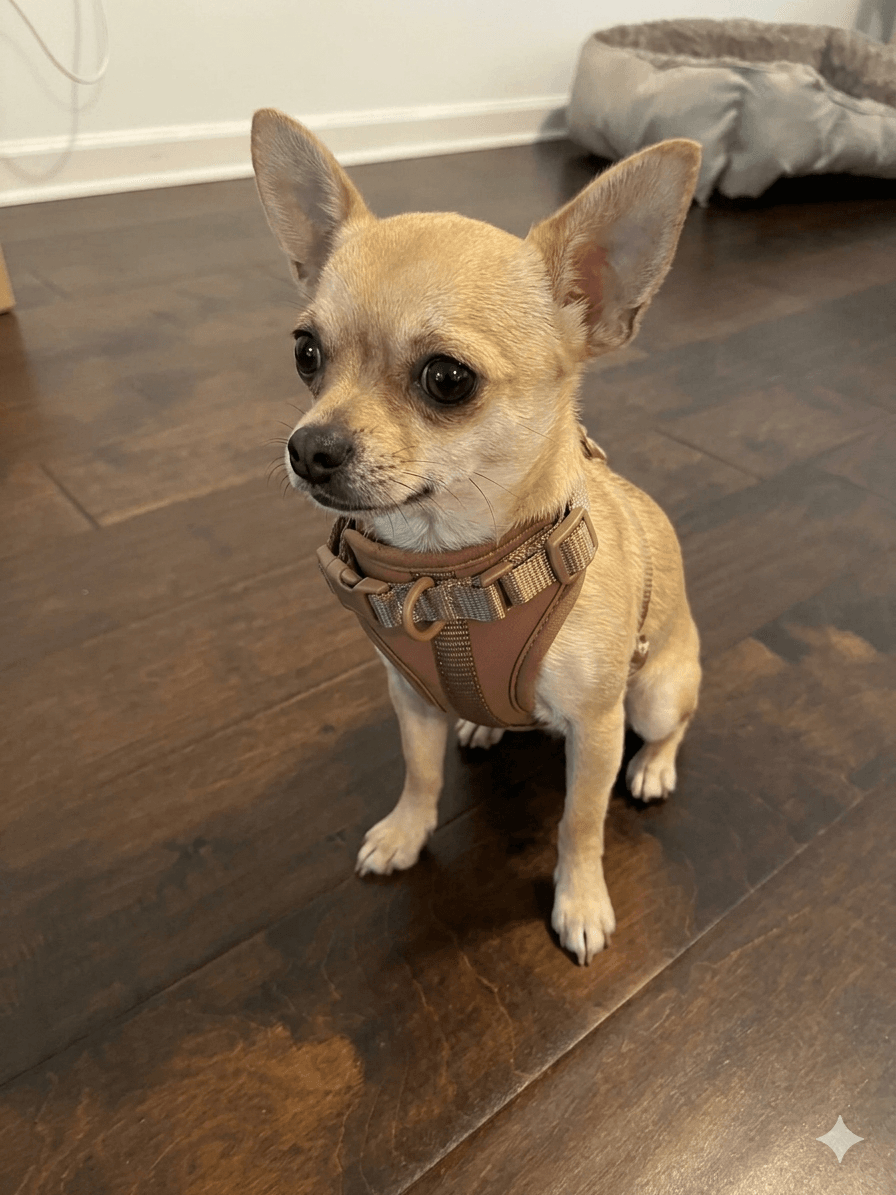
Why Chihuahuas Need a Harness Rather Than a Collar
Tracheal collapse risk
Chihuahuas are one of the breeds with the highest documented incidence of tracheal collapse. The condition — where the C-shaped cartilage rings of the trachea weaken and the airway flattens under pressure — produces the characteristic honking cough that many Chihuahua owners eventually notice. While genetics is the primary driver, sustained collar pressure on the throat is a known aggravating factor. Most veterinary guidance recommends switching Chihuahuas to harness walking as a precautionary measure, whether or not they have been diagnosed with any airway condition. For more detail on tracheal collapse and harness choice, see our dog harness for tracheal collapse guide.
Proportional neck vulnerability
A standard adult Chihuahua weighs between 1.5 and 3kg. The tracheal structures of a dog this size are proportionally more delicate than those of a medium or large dog — and the force a Chihuahua can exert against a collar when it lunges forward, though small in absolute terms, is significant relative to the size of the windpipe involved. This is compounded in apple-head Chihuahuas, where the skull and neck anatomy differ from deer-head types in ways that can affect airway sensitivity.
Chihuahua temperament and collar safety
Despite their small size, Chihuahuas are not calm, plodding walkers. They are alert, reactive, and quick to lunge at perceived threats — other dogs, unfamiliar people, sudden noises. A small dog lunging on a collar creates a brief but intense burst of pressure on the throat. Over hundreds of walks, these repeated pressure spikes accumulate. Harness walking distributes any such force across the chest and shoulders, leaving the throat entirely unloaded regardless of what the dog reacts to.
How to Measure a Chihuahua for a Harness
Accurate measurement is more critical for Chihuahuas than for almost any other breed. At this size, a 2cm error in measurement results in a harness that either slips off the dog or restricts movement uncomfortably. Take both measurements with a soft tape, with the dog standing square.
Chest girth — the primary measurement
Wrap the tape around the widest part of the chest — this is directly behind the front legs. Hold the tape snug but not tight. For most adult Chihuahuas, chest girth falls between 26 and 38cm. This is the measurement that determines harness size; always cross-reference with the brand’s specific chest girth range rather than relying on the XS label. A Chihuahua with a 26cm chest fits a very different harness than one with a 36cm chest, even though both might be labelled “XS” by different brands.
Neck girth
Measure around the base of the neck where the harness neck opening will sit — approximately where a collar would rest. For most adult Chihuahuas, neck girth falls between 18 and 26cm. Check that the harness adjusts independently at the neck and not just at the chest — for a breed with tracheal concerns, being able to set the neck opening precisely is important.
Checking fit once fitted
Slide two fingers under the chest strap — it should move freely but not shift around during walking. The neck opening should sit low at the base of the neck, not high toward the throat. The chest panel should rest on the sternum, below the shoulder blades, not across them. Check the armpit area — the straps should clear the armpit without pressing into it when the dog walks. If any strap rubs against the skin when you move the dog’s front legs through their full range, the harness needs adjustment or resizing.
What to Look for in a Chihuahua Harness
Genuinely lightweight construction
Harness weight is rarely listed on product pages, but it matters significantly at Chihuahua size. A harness with wide webbing, thick padding, and heavy metal hardware adds proportionally significant weight to a 2kg dog. The harness should feel almost weightless when you hold it. Narrow flat webbing — 10 to 15mm — and appropriately small hardware keep the harness light and prevent it from dragging the dog’s posture down during walking. Neoprene fabric is notably lighter than padded nylon for equivalent coverage.
Low neck opening positioned away from the trachea
Given Chihuahuas’ tracheal vulnerability, the position of the neck opening is critical. The opening should sit at the base of the neck — not high toward the larynx. When the harness is correctly fitted, there should be a visible gap between the neck strap and the front of the throat when the dog looks forward. Any harness where the neck strap presses against the front of the throat when the leash is taut is unsuitable for a Chihuahua regardless of its other qualities.
Soft contact surfaces at the chest and armpits
Chihuahuas have thin skin and a fine coat that provides less protection against friction than a thick double coat. Harness straps with rough edges or stiff webbing that rubs at the armpit or chest cause skin irritation and coat thinning at contact points more quickly than on coarser-coated breeds. Look for a harness with smooth, soft-edged straps or neoprene padding at the areas that contact the skin. Run your finger along the inner edge of the chest strap before purchasing — if it feels sharp against your fingertip, it will be worse against a small dog’s skin after an hour of walking.
Independent adjustment at neck and chest
Chihuahuas vary considerably in build — some are fine-boned and leggy, others are more compact and barrel-chested. A harness with independent neck and chest adjustment allows precise fitting across this range of individual body shapes. Harnesses with only one adjustment point, or those where the neck and chest adjust together via a single strap, often fit the average Chihuahua shape but struggle with outliers — and at XS sizes, individual variation is proportionally larger than at medium or large sizes.
Front D-ring for no-pull control
Chihuahuas are more reactive and more prone to sudden lunging than their size suggests. A front D-ring on the chest panel redirects the dog back toward the handler when it lunges — reducing the intensity of the pulling episode and, over time, reducing pulling behaviour. For a breed with tracheal concerns, reducing the frequency and force of pulling episodes matters more than it would for a healthy medium-sized dog. The front clip also keeps the leash attachment away from the back, which is more comfortable for long-coated Chihuahuas whose coat can get tangled around a back clip leash during active walking.
Common Fitting Mistakes for Chihuahua Harnesses
Buying XS without checking the measurement range
XS means different things to different brands. Some XS harnesses fit a chest girth of 30–45cm; others fit 26–36cm. A 4cm difference in the minimum is the difference between a harness that fits a small Chihuahua and one that gaps open at the chest. Always check the stated chest girth range on the size chart for the specific brand, not just the size label.
Fitting the harness too loose
The instinct with a small dog is often to leave the harness slightly loose — it seems kinder, and it’s harder to judge the two-finger test on a tiny dog than on a larger one. A loose harness on a Chihuahua shifts during walking, causing the back D-ring to slide sideways and the chest panel to migrate upward toward the shoulders. A shifting harness also creates more friction at the contact points than a static one. The two-finger rule applies at every size — snug but not tight, with enough room to slide two fingers under the chest strap but no more.
Choosing a harness based on appearance rather than fit
Chihuahua harnesses in particular are heavily marketed on aesthetics — florals, rhinestones, novelty shapes. Decorative harnesses for toy breeds often sacrifice adjustability and proper contact surface softness for visual appeal. A harness that looks charming but has a fixed neck opening that sits high on the throat, or webbing that presses against the armpit seam, is doing the dog a disservice regardless of how it looks. Choose fit first, aesthetics second.

The MoonianPet No-Pull Harness for Chihuahuas
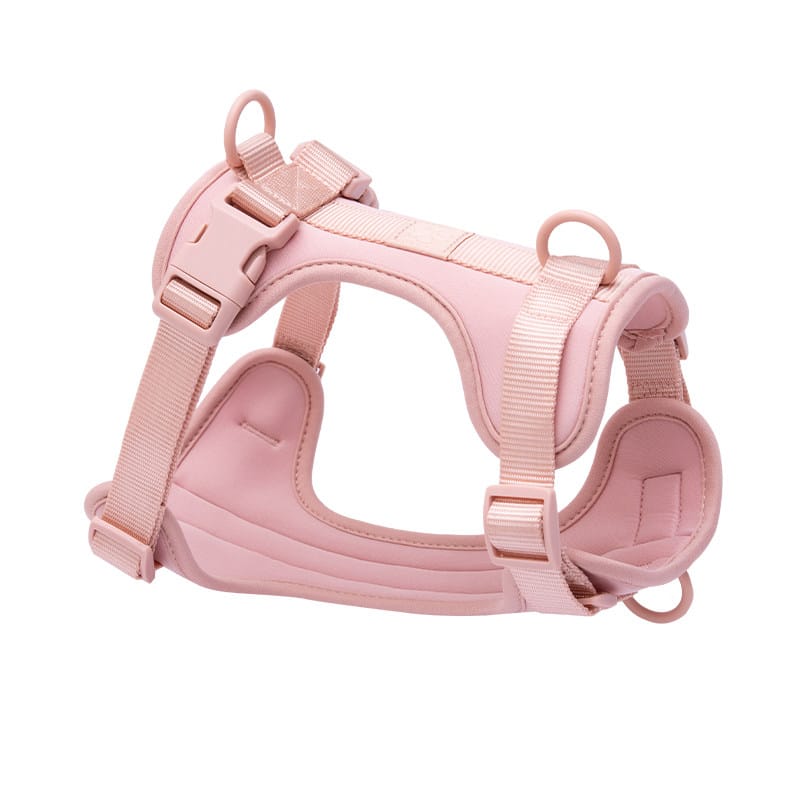
The MoonianPet No-Pull Dog Harness in XS fits a chest girth of 30–40cm, covering most standard adult Chihuahuas. The neoprene fabric is lightweight and soft at the contact points — no raw webbing edges at the armpits or chest. The neck and chest straps adjust independently, so you can set the neck opening low and away from the trachea while achieving a separate precise chest fit. Both front and back D-rings are included.
Available in 11 colours — including pink, lilac, sky blue, and red — the harness pairs with the matching Harness & Leash Set if you want a coordinated walking setup. The leash is also appropriately lightweight for a small dog — coated webbing that doesn’t pull the harness sideways during walking the way a heavy leash can.
I’ve seen a lot of Chihuahua owners come in with harnesses that technically fit but were clearly the wrong choice for the individual dog — too wide, too heavy, with neck openings sitting uncomfortably high. Getting both measurements before buying and checking the brand’s specific chest girth range makes a noticeable difference in how the harness sits and how willing the dog is to wear it. Use our size guide to confirm before ordering.
Frequently Asked Questions
What size harness does a Chihuahua need?
Most adult Chihuahuas need an XS harness with a chest girth adjustment range starting at 28–30cm. Measure the chest at its widest point behind the front legs and match to the brand’s specific size chart — don’t rely on the XS label alone, as minimum sizes vary between brands. Very small Chihuahuas under 1.5kg may fall below the range of standard XS harnesses and require specialist toy breed sizing. Our dog harness size guide has the full measurement chart.
Can a Chihuahua wear a collar instead of a harness?
A collar is appropriate for carrying ID tags, and most Chihuahuas wear a flat collar for identification without any issue. The concern is specifically about attaching a leash to a collar for walking — given Chihuahuas’ documented predisposition to tracheal collapse, leash pressure on the throat is inadvisable for this breed. The standard recommendation is a collar worn for ID and a harness used for all walks. See our small dog collar guide for what to look for in an ID collar for a small breed.
My Chihuahua refuses to wear a harness — how do I get them used to it?
Harness resistance in Chihuahuas is almost always about the fitting process rather than the harness itself. Start by leaving the harness on the floor for several days — let the dog investigate, sniff, and approach it on their own terms without any attempt to put it on. Then reward any calm interaction with the harness using treats. Progress to touching the harness to the dog’s body briefly before giving a treat, then to clipping just the chest section, then to a full fitting. The key is to move slowly and keep every step associated with something positive. Rushing the process creates the resistance that makes harness wearing a daily battle.
Is a step-in or overhead harness better for a Chihuahua?
Both designs can work well for Chihuahuas, but the choice often comes down to the individual dog’s tolerance for handling. Step-in harnesses require the dog to place their front feet through loops — some Chihuahuas object to having their feet handled this way, particularly in a new harness. Overhead harnesses require slipping the neck opening over the dog’s head, which some Chihuahuas find startling initially. Try whichever design requires less of the specific handling your dog finds uncomfortable. What matters more than the design type is the neck position — low at the base of the neck rather than high toward the throat — and the weight and softness of the harness material.
How do I know if the harness is too tight or too loose?
The two-finger rule applies at every size, including for Chihuahuas. You should be able to slide two fingers under the chest strap comfortably, but no more than that. A harness that is too loose will shift during walking — you’ll notice the back D-ring sliding sideways, or the chest panel riding up toward the shoulders. A harness that is too tight will leave visible indentation marks on the coat at the strap edges after the harness is removed, and the dog may show reluctance to move freely or hold their shoulders in a slightly hunched position. Both are reasons to refit. For full guidance on finding the right tightness, see our guide on dog gear fit.
For more on why small breeds need harnesses and what tracheal collapse means for gear choice, see our dog harness for tracheal collapse guide. For Yorkie-specific harness fitting at similar sizes, see our Yorkie harness guide.
Wenyue
Wenyue is the founder of MoonianPet and writes about dog collars, harnesses, waterproof pet gear, and everyday dog care. Growing up with dogs inspired her lifelong interest in pet care and practical dog gear. Through MoonianPet, she researches dog collars, harnesses, waterproof materials, and everyday solutions that help active dogs stay comfortable during daily adventures.