
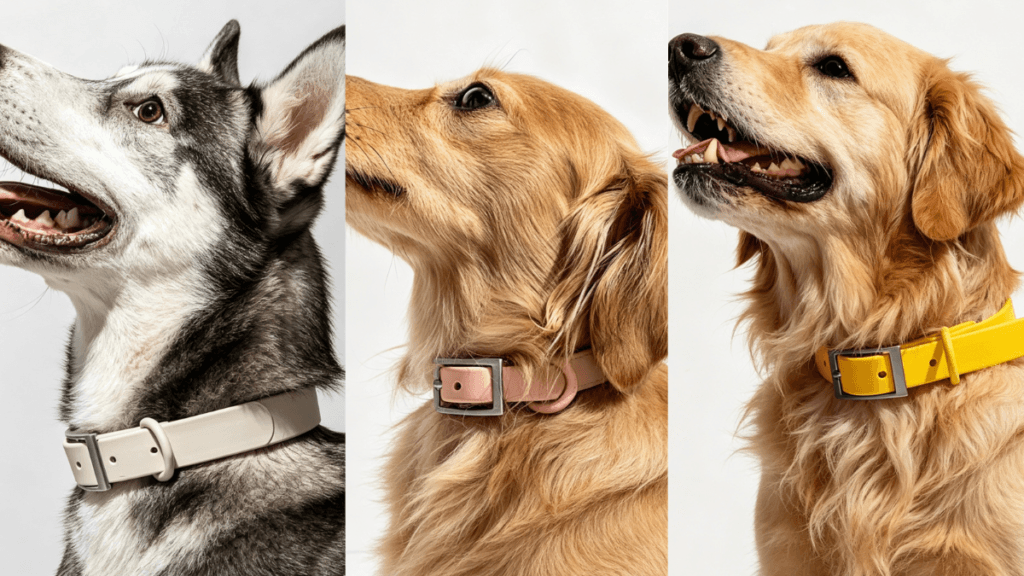
A hunting dog’s collar takes more punishment in a single season than most pet collars see in their entire lifespan. It goes through water repeatedly — rivers, marshes, retrieves in standing water. It gets dragged through thick brush, brambles, and heavy cover that catches and abrades anything with texture. It gets caked in mud, blood, and the general debris of fieldwork, and it needs to be wiped down and back in use the same day. And it needs to be visible — orange or blaze colours exist because a dog disappearing into tall cover with a brown or green collar is genuinely difficult to locate quickly.
Standard pet collars fail in the field not because they’re badly made but because they’re designed for different conditions. Nylon absorbs water and develops a persistent smell after repeated wetting. Leather softens and stretches when wet, then stiffens and cracks as it dries — repeated cycling through wet and dry conditions destroys leather faster than any other use pattern. The buckles and D-rings on standard collars are often adequate for leash attachment under normal conditions but show stress under the physical demands of heavy cover work and retrieves in cold water.
This guide covers what makes a hunting dog collar different from a standard collar, the features that actually matter in the field, and how to choose for your dog’s specific work.

What a Hunting Dog Collar Needs to Do
Withstand repeated wetting and drying
Water resistance is the single most important functional requirement for a hunting dog collar. Waterfowl dogs retrieve from cold water dozens of times in a single session. Flushing dogs and pointers work through dew-heavy grass, cross streams, and sometimes retrieve from water as well. A collar that absorbs water adds weight to the dog’s neck, dries slowly between uses, and degrades faster than one that stays waterproof. The collar also needs to maintain its structural integrity when wet — it shouldn’t stretch, soften, or slip on the buckle when saturated.
Resist abrasion from cover
Thick brush, brambles, briars, and heavy cover abrade collar material constantly as a dog pushes through. A collar with a soft, fibrous surface — standard nylon webbing — catches on vegetation and frays at the edges over a season of heavy field use. A collar with a smooth, hard-surfaced outer layer sheds vegetation contact and resists surface abrasion significantly better. The collar also shouldn’t catch on branches or briars in a way that could trap the dog — smooth surfaces release from cover more easily than textured ones.
Clean easily after fieldwork
After a day’s hunting, a collar may be covered in mud, blood from game, waterfowl droppings, and general field debris. A collar that can be wiped clean with a damp cloth and dried in minutes is far more practical than one that needs soaking and scrubbing, or that holds odours despite cleaning. This is a daily maintenance reality for working dog owners during the season, and the difference between a wipe-clean collar and a scrub-required collar adds up across a season of regular use.
Stay visible in cover
Locating a dog in tall grass, thick timber, or marshland vegetation is much easier when the collar provides a visual reference. Blaze orange is the standard choice for hunting dog collars precisely because it’s visible against the brown, green, and grey tones of most field environments. Some hunting dog collars also include reflective strips for early morning and late evening work when light is low. A collar that blends into the environment — brown, green, or black — reduces the speed at which a handler can visually locate a dog in cover.
Carry ID and tracking hardware reliably
Hunting dogs work at range — sometimes significantly out of sight. A D-ring that can carry an ID tag, a GPS tracker attachment, or a beeper collar’s receiver unit needs to be robust enough that it doesn’t flex open or fail under the physical demands of fieldwork. Lightweight or stamped-metal D-rings that are adequate for leash attachment under normal conditions may not hold up to the additional weight and impact stress of field equipment attached over a full season.

Best Materials for a Hunting Dog Collar
PVC-coated webbing (BioThane-style) — the best all-round choice
Coated webbing combines a strong woven core with a smooth, waterproof outer coating. It doesn’t absorb water, doesn’t hold odour, and wipes clean instantly — a quick wipe with a damp cloth after a day’s hunting is all it needs. The smooth surface sheds vegetation contact rather than catching it, and the coating is abrasion-resistant enough to handle regular exposure to cover. It maintains its structural integrity when wet — no stretching, no softening — and its buckle fit stays consistent regardless of how saturated it gets. For hunting dogs that work in water and heavy cover, coated webbing is the most practical collar material available.
Leather — traditional but high maintenance in field conditions
Leather has a long history in hunting dog equipment, and good quality leather is genuinely durable when properly maintained. The problem in field conditions is the wet-dry cycling that destroys leather faster than any other use pattern. A leather collar that gets soaked in a retrieve, dries in a warm vehicle, gets soaked again the next morning, and repeats this across a season will harden, crack, and fail at the stitching well before a coated webbing collar would show comparable wear. Leather is a good choice for dogs that hunt in dry upland conditions with minimal water work; it’s a poor choice for waterfowl or marsh dogs.
Standard nylon — adequate for light field use, struggles with water work
Standard nylon webbing is inexpensive and widely available, and for dogs that hunt in dry conditions with minimal water exposure it’s functionally adequate. For dogs that retrieve from water or work in wet environments, nylon absorbs water, takes a long time to dry, and develops a persistent smell after repeated wetting that worsens across the season. The fibrous surface also catches on vegetation more readily than a smooth-surfaced coated collar. Nylon is acceptable for light upland work; for water dogs or all-season hunting, coated webbing is significantly more practical.
Colour: Visibility vs. Preference
Blaze orange is the functional choice for hunting dog collars — it provides the fastest visual location of the dog in field conditions. If visibility is the priority, orange is the answer. That said, many hunting dog owners use a brightly coloured collar — red, yellow, or a similarly high-contrast colour — that is easier to spot than earth tones without requiring a dedicated hunting-orange collar. The key is contrast against the typical colours of the environments the dog works in: brown grass, green timber, grey marsh.
A secondary consideration is the dog’s coat colour. A red collar on a Red Setter or Irish Setter provides less contrast than a navy or yellow collar on the same dog. Choose a collar colour that contrasts with the dog’s coat as well as the environment — this maximises visibility from both directions.
The MoonianPet Waterproof Dog Collar for Hunting Dogs
The MoonianPet Waterproof Dog Collar is made from PVC-coated webbing — 100% waterproof, odour-resistant, and wipe-clean after fieldwork. It doesn’t absorb water, doesn’t hold game scent or mud, and maintains its buckle fit consistently whether dry or saturated. The smooth surface sheds cover contact rather than catching it.
Available in 25mm width across five sizes (XS to XL) and 11 colours — including red, yellow, and navy for high visibility against typical field environments. The zinc alloy D-ring is sturdy enough for ID tag and GPS tracker attachment in the field. For sizing, measure the dog’s neck circumference and use our dog collar size guide to find the right length. The collar pairs with the matching waterproof collar and leash set for a complete waterproof walking setup between hunting sessions.
The wipe-clean property is the feature hunting dog owners appreciate most in practice. After a morning’s waterfowl work, a quick wipe and the collar is ready for the afternoon — no soaking, no drying time, no smell carried into the vehicle. It’s a small thing that makes a consistent daily difference across a full season.

Frequently Asked Questions
Should a hunting dog wear a collar in the field?
Yes — a collar carrying ID tags is essential for any dog working at range in the field. If the dog gets separated or injured, a collar with current contact information is often the fastest way to get the dog back. Many hunting dog owners also use the collar to mount a GPS tracker or attach a beeper collar receiver. The question isn’t whether to use a collar but which one is appropriate for fieldwork. A collar that can’t handle water, mud, and cover is a liability in hunting conditions.
What’s the best collar for a Labrador Retriever used for waterfowl hunting?
For a Labrador doing regular water retrieves, a waterproof coated webbing collar is the most practical choice. It doesn’t absorb water, doesn’t hold scent, wipes clean after the retrieve, and maintains its structural integrity when saturated. Most adult Labradors need a large collar — neck circumference typically falls between 45 and 55cm. A high-visibility colour — yellow, red, or orange — makes the dog easier to locate in tall marsh grass. See our dog collar size guide for the full sizing chart.
How do I keep my hunting dog’s collar from smelling?
Odour in a dog collar comes from absorbed water, oils, and organic material that the collar material retains. Nylon and untreated webbing absorb all of these and are difficult to fully deodorise. A waterproof coated webbing collar doesn’t absorb any of them — a quick wipe after fieldwork removes the surface material before it has a chance to build up. For existing nylon collars, soaking in a dilute vinegar solution and air drying helps but doesn’t fully resolve the problem once odour has established in the fibres. Switching to a coated collar is the most effective long-term solution.
Should I use a collar or a harness for my hunting dog?
Most hunting dogs are walked on a collar with a leash attached before and after fieldwork, and work loose in the field without leash attachment. The collar in the field is primarily for ID and equipment mounting rather than leash control. A harness is a good choice for transport and controlled walking — particularly for dogs with any neck or tracheal concerns — but most hunting dogs’ field collars are flat collars rather than harnesses. If your dog does wear a harness for walking, keep a flat waterproof collar on for ID in the field regardless. See our dog collar vs harness guide for a full comparison.
How wide should a hunting dog collar be?
Most hunting dogs are medium to large breeds — Labradors, Golden Retrievers, Spaniels, Pointers, Setters, Vizslas. A 25mm (1 inch) collar is appropriate for most of these breeds and is wide enough to mount a standard GPS tracker or ID tag without the hardware overwhelming the collar band. Wider collars (38mm) suit giant breeds or dogs with very broad necks. Narrower collars (15–20mm) suit smaller hunting breeds like Cockers and smaller Spaniels. See our wide dog collar guide for a full breakdown of width by dog size.
For waterproof collar and leash options suited to active outdoor dogs, see our waterproof dog collar guide. For collar sizing across all breeds and sizes, see our dog collar size guide.
Wenyue
Wenyue is the founder of MoonianPet and writes about dog collars, harnesses, waterproof pet gear, and everyday dog care. Growing up with dogs inspired her lifelong interest in pet care and practical dog gear. Through MoonianPet, she researches dog collars, harnesses, waterproof materials, and everyday solutions that help active dogs stay comfortable during daily adventures.