
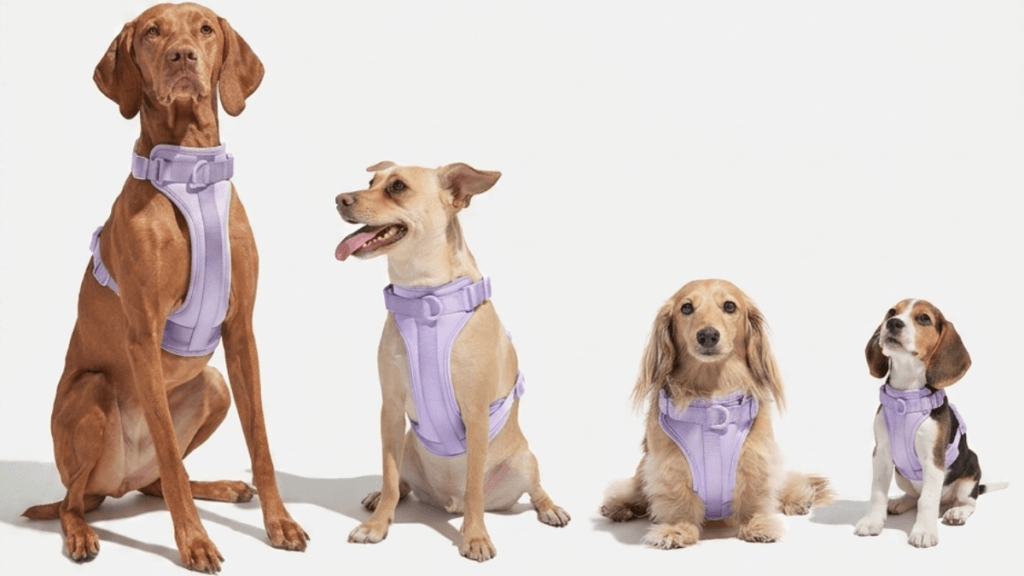
A harness that does not fit is worse than no harness at all. Too loose and it shifts around on the body, causes chafing, and can be backed out of by a determined dog. Too tight and it restricts movement, digs into the armpits, and makes walking uncomfortable. Unlike collars, where one measurement gets you most of the way there, harnesses require a little more precision.
The good news is that measuring for a harness is straightforward once you know which measurements actually matter. This guide walks through exactly how to measure your dog, what to do if they fall between sizes, and how to check the fit once the harness arrives.
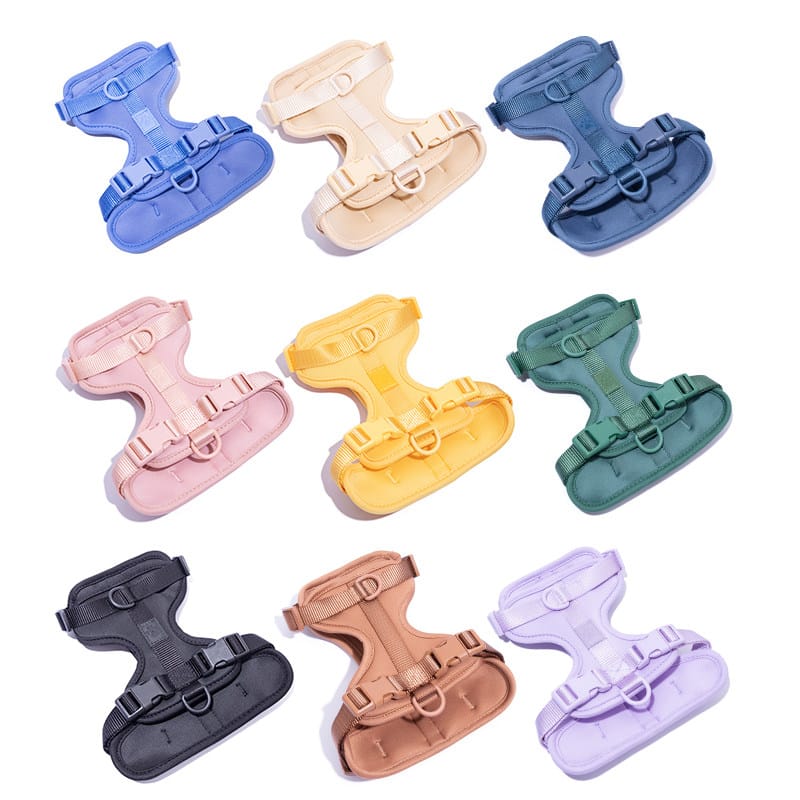
All measurements and size charts in this guide refer to the MoonianPet No-Pull Dog Harness — a neoprene adjustable harness designed for dogs that pull, available in multiple sizes and colours.
What You Need to Measure
Unlike a collar, which only requires a neck measurement, a harness fit depends on two key measurements: the chest girth and the neck girth. Some harnesses also factor in back length, but for most adjustable step-in or over-the-head designs, chest and neck are the primary numbers.
You will need a soft fabric measuring tape — the same kind used for collar measuring. If you do not have one, a piece of string and a ruler works just as well. Do not use a rigid metal tape measure.
Have your dog standing upright and relaxed if possible. Measurements taken while a dog is lying down or sitting tend to be slightly off — the body compresses in ways that do not reflect how a harness will sit during a walk.
How to measure your dog’s neck and chest for the perfect harness fit — step-by-step tutorial.
How to Measure Chest Girth
Chest girth is the most important measurement for harness sizing. This is the circumference of your dog’s chest at its widest point — typically just behind the front legs.
Step 1 — Find the widest point
With your dog standing, locate the point just behind the front legs where the chest is broadest. This is typically a few centimetres back from the armpits. On deep-chested breeds this point is lower; on barrel-chested breeds it is further back.
Step 2 — Wrap the tape around the chest
Wrap the measuring tape around the chest at this point, keeping it level and snug against the body. The tape should sit flat — not pulled tight, not hanging loose. You want firm contact with the coat.
Step 3 — Note the measurement
Record the number in both centimetres and inches. This is your base chest circumference. Write it down — you will use it against the size chart below.
Step 4 — Add the fit allowance
Unlike collar measuring, where two fingers is the standard, harness fitting uses a one to two finger allowance depending on the harness style. For a no-pull harness with a snug front clip design, one finger of slack is usually correct. For a looser walking harness, two fingers. The MoonianPet harness should have one to two fingers of slack at the chest panel — snug enough to prevent slipping, loose enough for free movement.
How to Measure Neck Girth
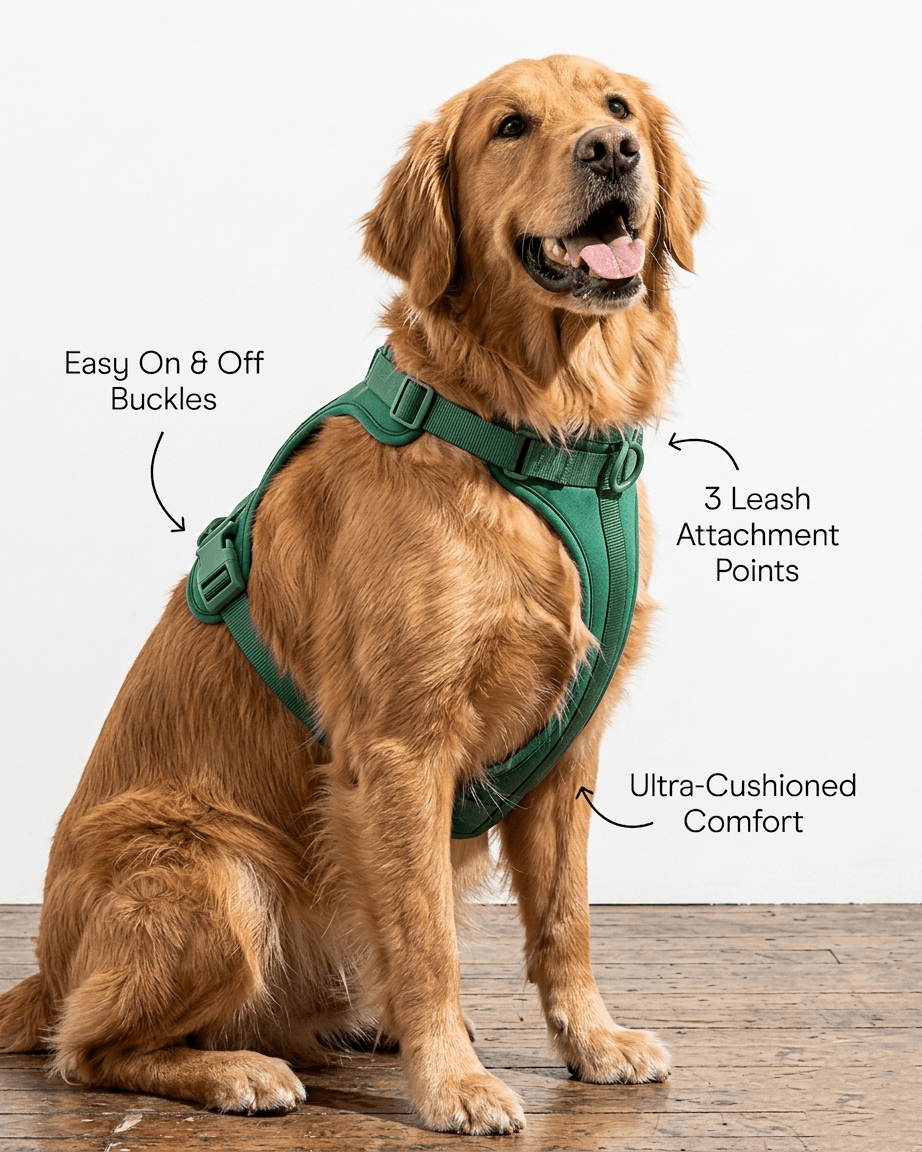
The neck measurement for a harness is taken at the same position as a collar — at the base of the neck, just above the shoulders. This is where the neck loop of the harness sits.
Wrap the tape snugly around the base of the neck and note the measurement. For harness sizing, the neck measurement is usually secondary to the chest measurement — most adjustable harnesses have enough range in the neck loop to accommodate dogs within a size range. But if your dog has an unusually thick or thin neck relative to their chest, it is worth noting.
If you have already measured your dog for a collar, you can use that measurement here. For a full guide to neck measuring technique, see our collar sizing guide which covers the process in detail.
MoonianPet Harness Size Chart
Use your chest girth measurement (with fit allowance) to find your size in the table below. The MoonianPet No-Pull Harness is fully adjustable within each size range, so you can fine-tune the fit once it arrives.
| Size | Chest girth (inches) | Chest girth (cm) | Typical breeds |
|---|---|---|---|
| XS | 13.4″ – 16.9″ | 34 – 43 cm | Chihuahua, Toy Poodle, Maltese |
| S | 15.4″ – 21.3″ | 39 – 54 cm | Miniature Schnauzer, Shih Tzu, Dachshund |
| M | 20.9″ – 28.0″ | 53 – 71 cm | Beagle, Cocker Spaniel, Corgi, French Bulldog |
| L | 28.0″ – 38.6″ | 71 – 98 cm | Labrador, Border Collie, Husky, German Shepherd |
| XL | 28.0″ – 40.2″ | 71 – 102 cm | Golden Retriever, Rottweiler, Bernese Mountain Dog |
If your dog falls at the top of a size range, size up. The adjustable straps give you room to tighten — but you cannot make a too-small harness larger.
What to Do If Your Dog Is Between Sizes
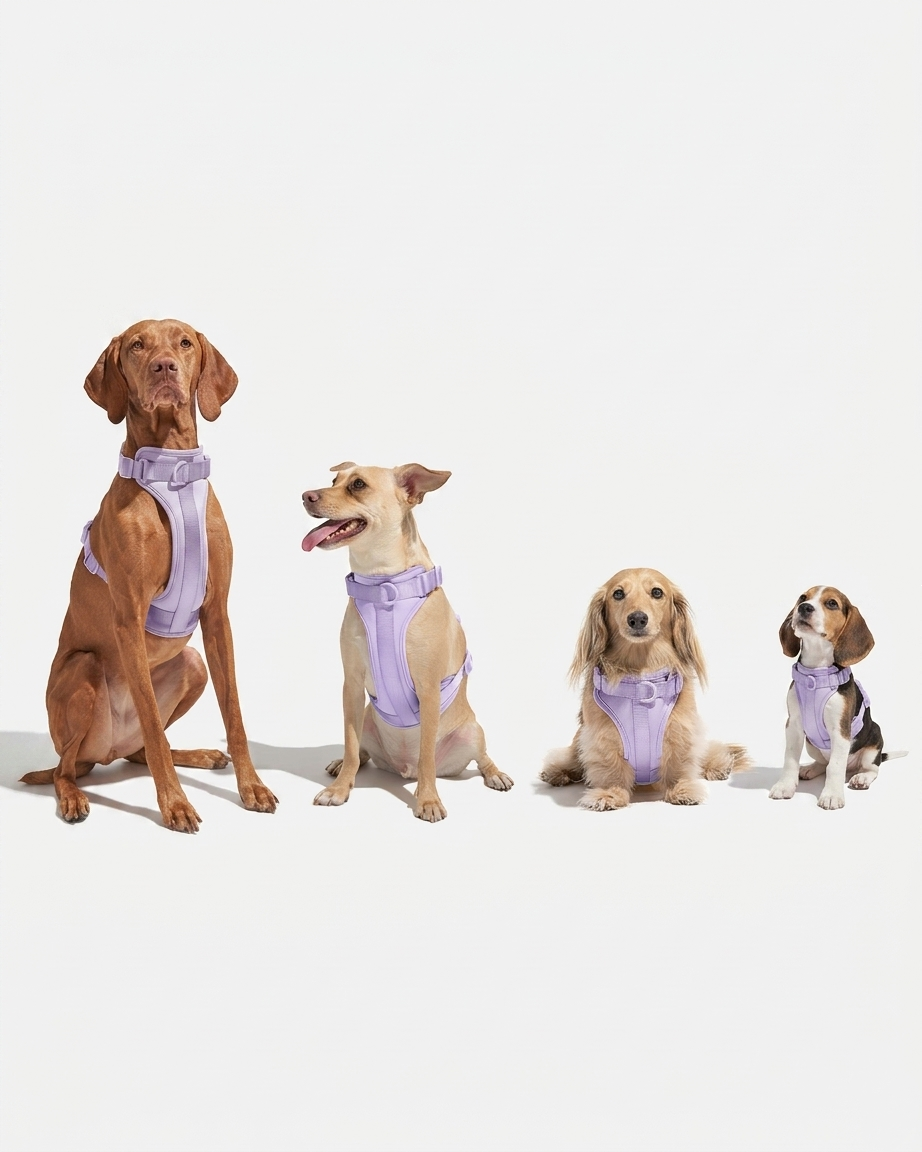
Harness sizing is less forgiving than collar sizing at the boundaries, because a harness that is even slightly too small cannot be adjusted to fit safely. Here is how to decide when you are on the edge of a size:
Growing puppy — size up
Puppies grow quickly and an adjustable harness that is slightly large today will have room to grow into. Make sure the straps can be tightened enough to pass the fit check right now before committing to the larger size.
Deep-chested or barrel-chested breeds — measure carefully
Breeds like Greyhounds, Whippets, and English Bulldogs have chest shapes that can be misleading on a tape measure. Make sure you are measuring at the widest point, not the narrowest. If in doubt, go up a size.
Thick or double-coated breeds — measure under the coat
Dogs with dense coats like Huskies, Samoyeds, and Golden Retrievers can appear larger than they are when measured over the fur. Part the coat and measure as close to the skin as possible for the most accurate reading.
How to Check the Fit When the Harness Arrives
Once you have the harness on your dog, run through these checks before your first walk:
The two-finger check at the chest
Slide two fingers under the chest panel. They should fit comfortably but not loosely. If you can fit your whole hand under, the harness is too large. If you cannot fit two fingers, it is too tight.
Check for armpit clearance
The straps that run under the front legs should not dig into the armpits. There should be a small gap — enough that the strap moves freely when your dog walks but does not shift significantly. Armpit chafing is the most common sign of a harness that sits too low or too tight.
Check that it cannot be slipped
With the harness on and buckled, gently push it backwards toward the tail. It should not slide over the shoulders. If it does, tighten the neck strap. A harness your dog can back out of is a safety risk, particularly near roads.
Watch for restricted movement on the first walk
A correctly fitted harness should not visibly restrict your dog’s stride. If you notice a shortened front step or the dog shaking the harness during the walk, the chest straps may be too tight or positioned too far forward. Adjust and recheck.
How Harness Sizing Differs From Collar Sizing
If you have already measured your dog for a collar, the process here will feel familiar — but there are some key differences worth knowing.
| Collar | Harness | |
|---|---|---|
| Primary measurement | Neck circumference | Chest girth |
| Fit allowance | 2 fingers at neck | 1 to 2 fingers at chest |
| Between sizes | Size up for puppies, down for pullers | Always size up |
| Main fit risk | Too loose — dog backs out | Too tight — armpit chafing |
| Check frequency | Every few months | Every few months, more often for puppies |
Ready to Find Your Dog’s Harness Size?
The MoonianPet No-Pull Dog Harness is made from soft neoprene with fully adjustable straps — gentle against the skin, secure on walks, and built for dogs that pull. It is available in multiple sizes and colours, with a front clip design that naturally discourages pulling without causing discomfort.
For a quick reference you can bookmark, see our standalone Dog Harness Size Guide with the full size chart and breed lookup table.
Not sure whether a harness or collar is the right choice for your dog? Our guide on collar vs harness covers when each makes sense. If you have decided on a harness for pulling, our guide to no-pull harnesses explains what to look for in more detail.
Still not sure which size is right? Get in touch and we will help you work it out based on your measurements.
Frequently Asked Questions
Do I measure chest or neck for a dog harness?
Chest girth is the primary measurement for harness sizing. Neck girth is secondary and mainly relevant for over-the-head harness designs. Measure the chest at its widest point — just behind the front legs — and use that number against the size chart.
My dog is between harness sizes. Which should I choose?
Size up. A harness that is slightly too large can be adjusted with the straps to fit correctly. A harness that is too small cannot be made to fit safely. The only exception is if the larger size cannot be tightened enough to pass the two-finger check — in that case, contact us before ordering.
How tight should a dog harness be?
You should be able to slide two fingers under the chest panel comfortably. The harness should not shift or rotate when your dog moves, and the armpit straps should not dig into the skin. A correctly fitted harness stays in place without restricting movement.
Can my dog wear a harness and collar at the same time?
Yes — many owners use both. A collar carries ID tags and can be used for lead attachment on calm walks. A harness is used when more control is needed or for dogs that pull. The two do not interfere with each other when fitted correctly.
How often should I check my dog’s harness fit?
Check the fit every few months, and more frequently for growing puppies. Dogs gain and lose weight seasonally, and coat thickness changes between seasons — both can affect how the harness fits. A harness that fitted perfectly in summer may need adjusting by winter.
Already measured and ready to order? Go straight to the MoonianPet No-Pull Harness. Need a collar to go with it? Browse the full collar range in 11 colours and 5 sizes — or read our collar vs harness guide if you are still deciding between the two.
Wenyue
Wenyue is the founder of MoonianPet and writes about dog collars, harnesses, waterproof pet gear, and everyday dog care. Growing up with dogs inspired her lifelong interest in pet care and practical dog gear. Through MoonianPet, she researches dog collars, harnesses, waterproof materials, and everyday solutions that help active dogs stay comfortable during daily adventures.
Harnesses
Best Harness for Dogs That Pull
What to look for and why neoprene makes a difference.
Harnesses
How to Put On a No-Pull Dog Harness
Step-by-step guide with fit checks for every strap.
Fit and Use
Collar vs Harness
When to use each and what changes for pullers and puppies.
Collars
How to Measure Your Dog for a Collar
Get the fit right first time. Includes our full size chart.
Collars
Dog Collar Colour Guide
How to choose the right shade for your dog.
Materials
Is Nylon Safe for Dogs?
Nylon is popular but it has real downsides for active dogs.
Fit and Use
How to Clean a Dog Collar
Step by step for nylon leather and coated webbing collars.
Collars
Dog Collar Smell After Swimming
Why wet collars smell and which materials do not.