
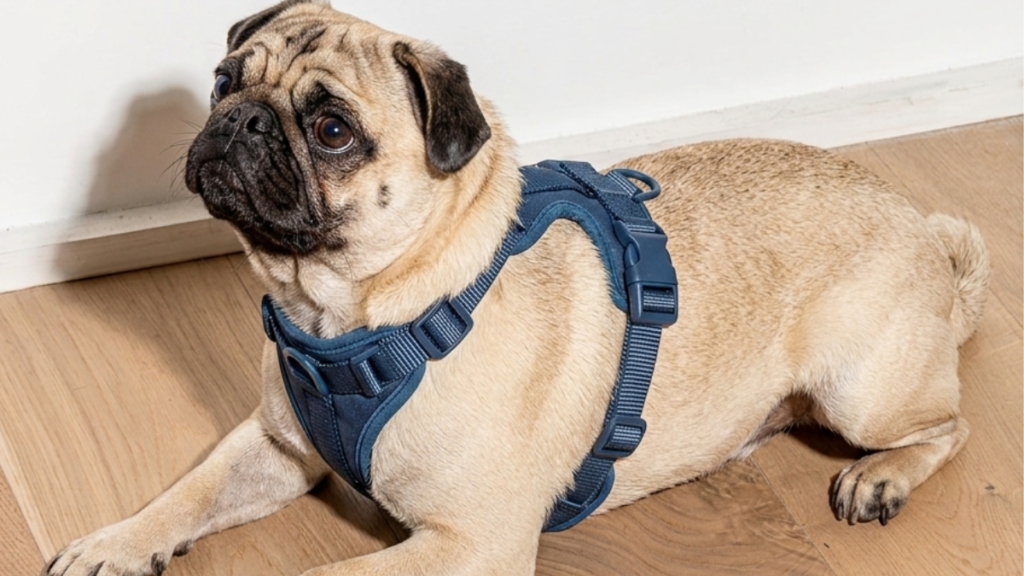
The difference between a front clip and a back clip harness is not just where the leash attaches. It changes the entire mechanics of how your dog moves on the leash — and for dogs that pull, that difference matters a great deal.
Back clip harnesses are comfortable and natural for calm walkers. Front clip harnesses are specifically designed to reduce pulling by redirecting momentum. Most no-pull harnesses have both — which means the choice of which ring to clip to is something every dog owner should understand before they leave the house.
This guide covers exactly how each clip type works, when to use each one, and which dogs benefit most from the front clip approach.

How Each Clip Type Works
The physics of each clip type are simple — but the practical effect on your walk is significant.
For Pullers
Front Clip
The leash attaches to a D-ring on the chest, in front of the dog’s body. When the dog pulls forward, the leash creates a sideways force that turns the dog’s body toward you rather than allowing them to build momentum straight ahead. Pulling becomes physically awkward — not painful, just ineffective.
For Calm Walkers
Back Clip
The leash attaches to a D-ring between the shoulder blades, behind the dog’s body. When the dog pulls, the force goes straight forward — which is comfortable and natural for a dog that already walks well, but does nothing to discourage pulling in a dog that doesn’t.
Front Clip Harness: Who It’s For and How to Use It
A front clip harness works best for dogs that actively pull, lunge at distractions, or drag their owners down the street. The redirection effect kicks in the moment the leash goes taut — the dog feels their body turning sideways rather than forward, which interrupts the pulling pattern without any correction from the handler.
Most owners see a noticeable difference within the first one or two walks. The front clip does not replace training, but it gives you immediate mechanical assistance while training is ongoing — which makes the whole process faster and less frustrating.
Best for: strong pullers and lungers
Any dog that consistently pulls ahead, strains against the leash, or lunges at other dogs, people, or squirrels. The front clip is most effective when the pulling behavior is consistent — not just occasional.
Best for: dogs in leash training
If you are actively working on leash manners, the front clip harness makes every walk a training session by default. The redirection gives the dog immediate feedback without any verbal or physical correction from you.
How to use the front clip effectively
Keep the leash short enough that redirection happens quickly — a very long leash gives the dog too much time to build momentum before the front clip effect kicks in. When your dog turns toward you after being redirected, reward calmly and continue walking. Consistency over multiple walks builds the new pattern.

Back Clip Harness: Who It’s For and When to Switch
The back clip is the standard, natural walking attachment. For dogs that already walk calmly on a leash, it is the more comfortable option — the leash drops naturally from the back rather than crossing under the dog’s body, and there is no turning force applied to the dog’s movement.
The back clip is also the right choice for running or jogging with your dog. The front clip creates directional steering on every step at speed, which becomes uncomfortable and disruptive over a longer distance. For runs and hikes, use the back clip.
Best for: calm walkers and dogs that have learned leash manners
Once a dog consistently walks without pulling, the back clip is the more comfortable everyday option. Many owners use the front clip during the training phase, then transition to the back clip as a reward for good leash behavior.
Best for: running, hiking, and off-leash activities
The back clip allows natural forward movement without any steering force, which is essential at pace. For any activity where your dog needs to move freely and you are not actively training leash manners, the back clip is the right attachment point.
When not to use the back clip
Do not use the back clip on a dog that pulls consistently — it does nothing to discourage the behavior and can actually reinforce it. A back clip harness on a strong puller transfers all of their body weight into the leash, which makes the pulling stronger and the walk harder on both the handler and the dog’s joints over time.

Front Clip vs Back Clip: Quick Comparison
| Front Clip | Back Clip | |
|---|---|---|
| Stops pulling? | Yes — redirects momentum sideways | No — transfers pulling force forward |
| Comfort for calm walkers | Moderate — slight steering effect | High — natural movement |
| Good for running? | No — disruptive at pace | Yes — free forward movement |
| Best for training? | Yes — immediate feedback on pulling | No — no feedback mechanism |
| Works on small dogs? | Yes — equally effective | Yes — for calm small dogs |
| Works on large dogs? | Yes — most effective on strong pullers | Yes — for calm large dogs |
Which Should You Use?
The answer comes down to one question: does your dog pull on the leash?
If your dog pulls → start with the front clip
Use the front clip consistently for the first several weeks. Once your dog is walking calmly most of the time, you can try switching to the back clip on quieter walks and see if the behavior holds. If pulling returns, go back to the front clip.
If your dog walks calmly → use the back clip
No need for the redirection effect if your dog already walks well. The back clip is more comfortable for long walks and gives your dog more natural movement.
If it depends on the situation → use both
Many owners clip to the front ring in busy or distracting environments — the park, busy streets, other dogs nearby — and switch to the back ring for quieter neighborhood walks. Having both options on one harness means you can adapt to whatever the walk requires without changing equipment.
Why Fit Matters More Than Clip Type
A front clip harness only works correctly when it fits correctly. If the harness is too loose, the chest D-ring drifts to one side instead of staying centered — and a D-ring that is not centered on the chest does not redirect pulling effectively. It just creates an uneven, rotating mess.
The two-finger rule applies to every strap: neck, chest, and belly. The front D-ring should sit flat and centered on the chest when the harness is properly adjusted. If it slides to one side within the first few minutes of walking, tighten the chest strap evenly on both sides.
For the complete fitting guide, see our post on how to put on a no-pull dog harness, which covers all four fitting steps and the fit checks to run before every walk.

A Harness With Both Clips — Ready for Any Walk
The MoonianPet No-Pull Dog Harness has both a front chest D-ring and a back D-ring, so you can switch between clip types depending on the walk without changing equipment. The 3-point tri-glide adjustment keeps the front D-ring centered on the chest for maximum no-pull effectiveness, and the neoprene padding makes it comfortable enough for all-day wear on either clip.
Available in 5 sizes (XS–XL) and 11 colors. Pair with the MoonianPet Waterproof Leash for a fully matching setup, or save with the Harness & Leash Set.
Not sure which size? Our dog harness size guide has the full XS–XL chart with chest and neck measurements.
Frequently Asked Questions
Does a front clip harness hurt dogs?
No — a front clip harness does not cause pain or discomfort. The redirection effect works by turning the dog’s body sideways when they pull, not by applying pressure to any sensitive area. It is a mechanical interruption, not a correction. The key is that the harness must fit correctly — a front clip that is too loose or positioned incorrectly can rub under the front legs, which is a fit issue rather than a clip issue.
Can I use a double-ended leash with both clips at once?
Yes — a double-ended or traffic leash clipped to both the front and back D-rings simultaneously is a training technique some handlers use for very strong pullers. It gives more directional control than either clip alone. This is more advanced and requires some practice to handle comfortably, but it is safe and effective when used correctly.
Why does my dog still pull with a front clip harness?
The most common reason is that the harness is too loose and the front D-ring is not staying centered on the chest. Check that you can fit two fingers under every strap and that the D-ring is sitting flat in the middle of the chest when your dog walks. If the fit is correct and pulling continues, try shortening the leash slightly so the redirection effect kicks in faster, and reinforce every moment your dog walks calmly with praise or a treat.
Is a front clip harness better than a head halter for pulling?
Both tools interrupt pulling, but they work differently and suit different dogs. A head halter gives very precise directional control and is highly effective on very strong pullers, but many dogs resist wearing it on the face and it requires careful introduction. A front clip harness is less intrusive, easier to put on, and accepted readily by most dogs. For most pet owners, a well-fitted front clip harness is the more practical starting point.
When should I switch from front clip to back clip?
Switch to the back clip when your dog consistently walks without pulling for several walks in a row. Start by testing the back clip on quieter, lower-distraction walks first. If pulling returns, go back to the front clip and give it more time. There is no fixed timeline — some dogs transition in a few weeks, others benefit from front clip use long-term in high-distraction environments.
Want to know how to put the harness on and get the D-rings positioned correctly? See our step-by-step harness fitting guide. Or if you are still deciding between a collar and a harness, our collar vs harness guide covers the full comparison.
Wenyue
Wenyue is the founder of MoonianPet and writes about dog collars, harnesses, waterproof pet gear, and everyday dog care. Growing up with dogs inspired her lifelong interest in pet care and practical dog gear. Through MoonianPet, she researches dog collars, harnesses, waterproof materials, and everyday solutions that help active dogs stay comfortable during daily adventures.