
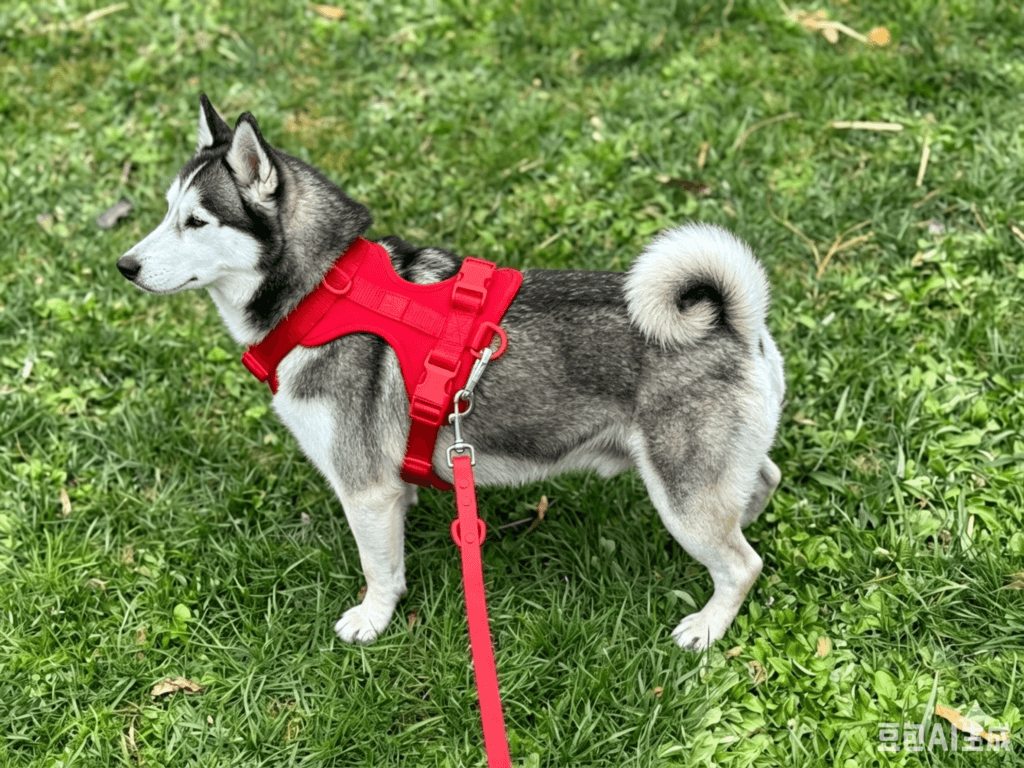
If your dog pulls hard on the leash, you’ve almost certainly come across two tools that come up repeatedly: the Halti head collar and the no-pull harness. Both claim to reduce pulling. Both work through a redirection mechanism rather than punishment. And both are frequently recommended by trainers — sometimes for the same dog.
The honest answer is that they work differently, suit different dogs, and aren’t always interchangeable. A Halti works by controlling the head — where the nose goes, the body follows. A front-clip no-pull harness works by redirecting the chest — when the dog pulls forward, the leash attachment point turns them sideways. Understanding the mechanics of each helps you decide which is actually right for your dog, or whether using both together makes sense.
This guide covers how each tool works, the practical advantages and limitations of each, which dogs do better with one versus the other, and what to look for if you decide a no-pull harness is the right fit.

How the Halti Head Collar Works
The Halti fits over the dog’s muzzle and behind the ears, with the leash attaching under the chin. When the dog pulls forward, the leash tension turns the head sideways — and because the body follows the head, the dog is redirected rather than simply restrained.
This mechanism is highly effective on strong pullers. The head is the lightest and most easily redirected part of the body — a relatively small leash force produces a large directional change. This is why head collars are often recommended for very large or very powerful dogs where upper body strength alone isn’t enough to manage the walk.
The tradeoff is that the Halti requires careful fitting and significant adjustment time. Most dogs dislike the sensation of something over their muzzle and will paw at it, rub their face on the ground, or refuse to walk forward when first fitted. A proper introduction period — starting indoors, pairing with high-value treats, building positive association before the first walk — takes days to weeks. Fitting incorrectly risks the leash putting traction on the spine or neck if the dog lunges hard.
How the No-Pull Harness Works
A front-clip no-pull harness has a D-ring on the chest. When the dog pulls forward, the leash pulls the chest sideways — redirecting the dog’s momentum and making it harder to continue pulling in a straight line. The effect is subtler than a head collar, but it works across the whole body rather than just the head, and most dogs adapt to it immediately without any adjustment period.
The key to effectiveness is keeping the leash short enough that the redirecting mechanism engages early — before the dog builds forward momentum. A long loose leash lets the dog accelerate before the redirection kicks in, which reduces the effect significantly. Most of the no-pull harness’s effectiveness is in that early-engagement window.
The back clip on the same harness gives you a second attachment point for exercise, running, or off-leash hiking where natural free movement is the priority. Switching between front and back clip for different activities is one of the practical advantages of a two-clip harness over a head collar. For a detailed breakdown, see our front clip vs back clip guide.

Halti vs No-Pull Harness: Side by Side
Immediate effectiveness on strong pullers
The Halti has a stronger immediate effect on very powerful pullers — controlling the head gives more mechanical leverage than redirecting the chest. If your dog is large, strong, and you struggle to hold on during lunges, a head collar may give you more immediate control. A no-pull harness is effective but requires consistent short-leash technique to get the most from it.
Acceptance and adjustment time
Most dogs tolerate a harness immediately — it goes on, they walk. The Halti requires days to weeks of desensitisation before most dogs accept it comfortably. If you need something that works from day one, a harness is significantly easier to introduce. If a dog is extremely resistant to anything around the muzzle, pushing through the adjustment period can cause more stress than the pulling problem it was meant to solve.
Versatility across activities
A dual-clip harness works for daily walks, running, hiking, and dog sports — switch attachment points for the activity. A Halti is used primarily for controlled walks; it is not appropriate for running or play because a hard lunge on the front-clip chin attachment while moving at speed puts significant stress on the neck. For active owners who want one piece of equipment that covers multiple activities, the harness is more versatile.
Comfort and long-term wear
A well-fitted harness can be worn for hours without discomfort. A head collar is designed for walk use only — it should not be left on unsupervised, and wearing it for extended periods can cause rubbing around the muzzle and under the chin. Dogs that spend time in cars, crates, or off-leash areas between walks are better served by a harness that can stay on without issue.
Public perception
A practical consideration: many people mistake head collars for muzzles. This is not a reason to avoid them if they’re the right tool, but it is worth knowing — some dogs that wear Haltis attract unnecessary concern from other people on walks, which can complicate otherwise straightforward outings. A harness never creates this issue.
Which Dogs Do Better With Each
Dogs that tend to do better with a Halti
Very large, extremely powerful dogs where the owner cannot physically hold on during a full lunge. Dogs that have already been introduced to head collars without issue and tolerate them calmly. Situations where maximum directional control is needed immediately — such as reactive dogs in high-traffic environments where the handler needs to quickly redirect attention.
Dogs that tend to do better with a no-pull harness
Brachycephalic breeds (Pugs, French Bulldogs, Bulldogs) where anything around the muzzle restricts breathing. Short-muzzled breeds where the Halti doesn’t fit securely. Dogs that are highly stressed by anything over the face. Active dogs that need a single piece of equipment for walks, runs, and exercise. Puppies being introduced to walking equipment for the first time — a harness is the gentler starting point. Dogs with any history of neck or spinal issues where head restraint is contraindicated.
Using both together
Some trainers recommend using a Halti and a harness simultaneously for the most challenging cases — the Halti for directional control, the harness for body restraint, with the leash clipped to both. This combination gives more control than either alone and distributes leash force across two attachment points. If you’ve tried a harness alone and found it insufficient, this is worth discussing with a certified trainer before abandoning the harness entirely.
What to Look for in a No-Pull Harness
If you’ve decided the no-pull harness is the right tool for your dog, these are the features that distinguish a harness that will hold up from one that won’t:
Metal D-rings at both attachment points
The front chest D-ring is under constant tension on a pulling dog. A plastic D-ring deforms under sustained load — losing its centred position and reducing the effectiveness of the no-pull mechanism over time. Zinc alloy D-rings maintain their shape and position through years of use.
Three-point independent adjustment
Neck, chest, and belly straps that adjust independently allow precise fit across different body shapes. A harness with only two adjustment points often fits either the neck correctly or the chest correctly — rarely both. Three independent adjustments are especially important for dogs with deep chests and narrow waists, or for double-coated breeds where coat thickness varies by season.
Metal tri-glide sliders
Plastic sliders gradually allow the strap to creep through under sustained tension — the harness slowly loosens during the walk without any deliberate adjustment. Metal sliders grip the strap under load and hold the set adjustment throughout. On a consistent puller, this matters more than on an occasional puller.
Reinforced quick-release buckle
The buckle needs to open quickly for daily use but resist lateral stress — a dog twisting and pulling sideways applies significant lateral force to the buckle throughout the walk. An ABS-reinforced buckle that clicks firmly into a locked position gives both ease of use and structural reliability. See our full no-pull harness guide for a breakdown of the top options across all dog sizes.
The No-Pull Harness That Works Without the Adjustment Period
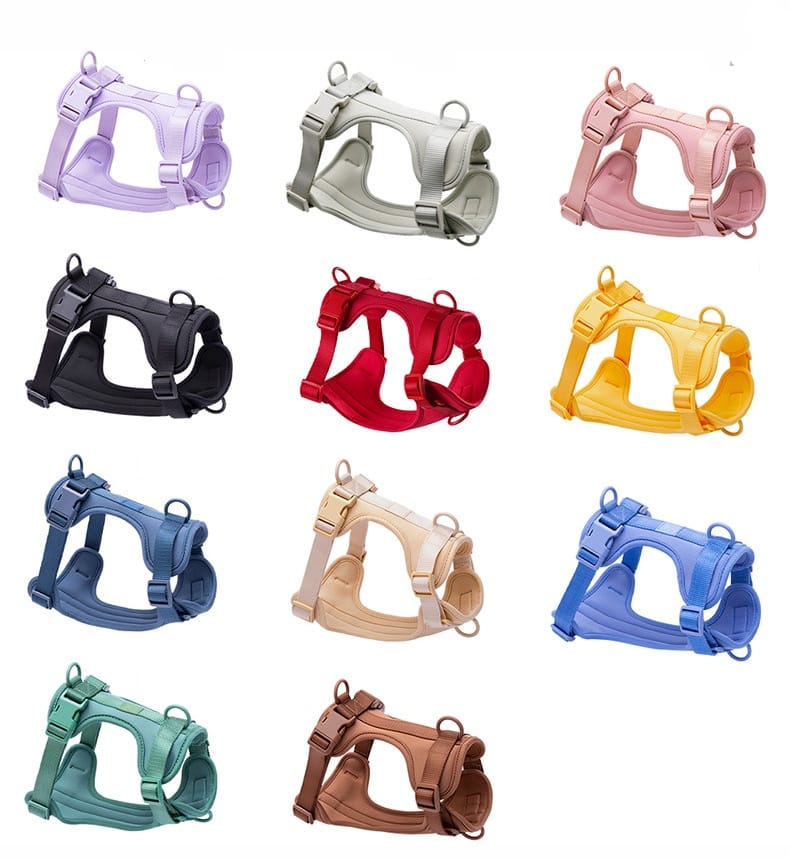
The MoonianPet No-Pull Dog Harness uses zinc alloy D-rings, metal tri-glide sliders, and a reinforced ABS quick-release buckle — hardware built for consistent pullers rather than occasional use. Three-point independent adjustment covers neck, chest, and belly separately, which means a precise fit on any body shape without compromising on either end.
The neoprene construction is lightweight, breathable, and doesn’t absorb moisture — important for active dogs that spend time outdoors in variable conditions. Available in five sizes and 11 colours. For walks that also need a matched leash, the Harness & Leash Set pairs the harness with a heavy-duty PVC-coated leash — odour-proof and easy to wipe clean after wet or muddy walks.

Frequently Asked Questions
Is a Halti the same as a no-pull harness?
No — they use different mechanisms. A Halti is a head collar that controls pulling by redirecting the dog’s head. A no-pull harness attaches at the chest and redirects pulling momentum sideways across the whole body. Head collars generally have a stronger immediate effect on powerful pullers; harnesses are easier to introduce, more versatile, and suitable for a wider range of activities and body types.
Does the Halti hurt dogs?
A correctly fitted Halti used with a short leash and attentive handling does not hurt dogs. The risk of injury is from using a head collar with a long leash — if a dog reaches the end of a long leash at a run while wearing a Halti, the sudden force on the chin attachment can cause neck strain. Head collars should always be used with a short leash, never with a flexi-lead.
Will a no-pull harness stop my dog pulling completely?
A no-pull harness significantly reduces pulling and makes walks more manageable, but it is a management tool rather than a training solution on its own. Dogs that pull as a default behaviour — Huskies, Malamutes, working breeds — will pull less in a front-clip harness but still pull. Combining the harness consistently with reward-based loose-leash walking training produces better long-term results than either approach alone.
Can brachycephalic breeds use a Halti?
Generally not — Pugs, French Bulldogs, Bulldogs, and other short-muzzled breeds have faces that don’t accommodate a standard head collar fit, and anything that restricts the muzzle area can worsen breathing difficulties in dogs that already breathe with effort. A front-clip no-pull harness is the recommended alternative for brachycephalic breeds. See our French Bulldog harness guide for breed-specific fit guidance.
My dog hates the Halti — should I keep trying?
Some dogs never fully accept a head collar regardless of how carefully it is introduced. If after two to three weeks of consistent, patient desensitisation your dog is still highly stressed by the Halti — pawing frantically, refusing to move, showing clear distress signs — it is not the right tool for that dog. A front-clip no-pull harness or trainer-guided alternative is a better direction than continuing with a tool that causes ongoing stress.
Comparing other no-pull options? Our Freedom Harness vs Easy Walk comparison covers the most popular front-clip harness alternatives in detail. For an overview of all harness styles, see our types of dog harnesses guide.
Wenyue
Wenyue is the founder of MoonianPet and writes about dog collars, harnesses, waterproof pet gear, and everyday dog care. Growing up with dogs inspired her lifelong interest in pet care and practical dog gear. Through MoonianPet, she researches dog collars, harnesses, waterproof materials, and everyday solutions that help active dogs stay comfortable during daily adventures.